Category Archives: Uncategorized
Tuskegee University: Andrew W. Mellon Foundation awards Tuskegee University $100k for President’s initiatives
Source: Tuskegee University
Filed under Uncategorized
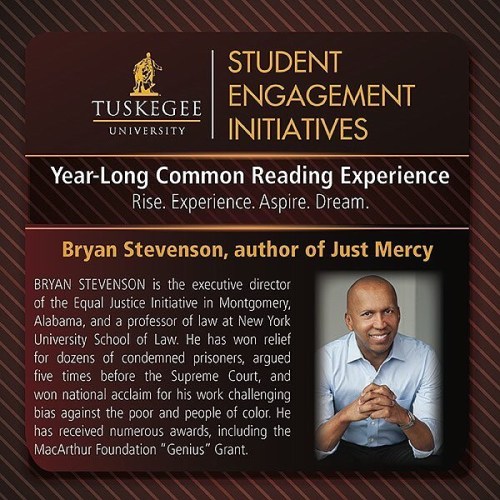
Tuskegee University: Bryan Stevenson’s ‘Just Mercy’ is the 2016-2017 Common Reading Experience
Source: Tuskegee University
Filed under Uncategorized
Tuskegee University: Derek Luke Summer 2016 Commencement Speaker
Source: Tuskegee University
Filed under Uncategorized
Tuskegee University: Online Programs Named No. 1 in Alabama
Source: Tuskegee University
Filed under Uncategorized
Tuskegee University to Pay Home to Famed Benefactor Julius Rosenwald at American Jewish History Museum
Source: Tuskegee University
Filed under Uncategorized
Tuskegee University: Viewing to be Held for Animal Planet Series about Tuskegee University Veterinarians
Source: Tuskegee University
Filed under Uncategorized
Tuskegee University: ANDREW W. MELLON FOUNDATION AWARDS $100k For Presidential Initiatives
Source: Tuskegee University
Filed under Uncategorized
Tuskegee University
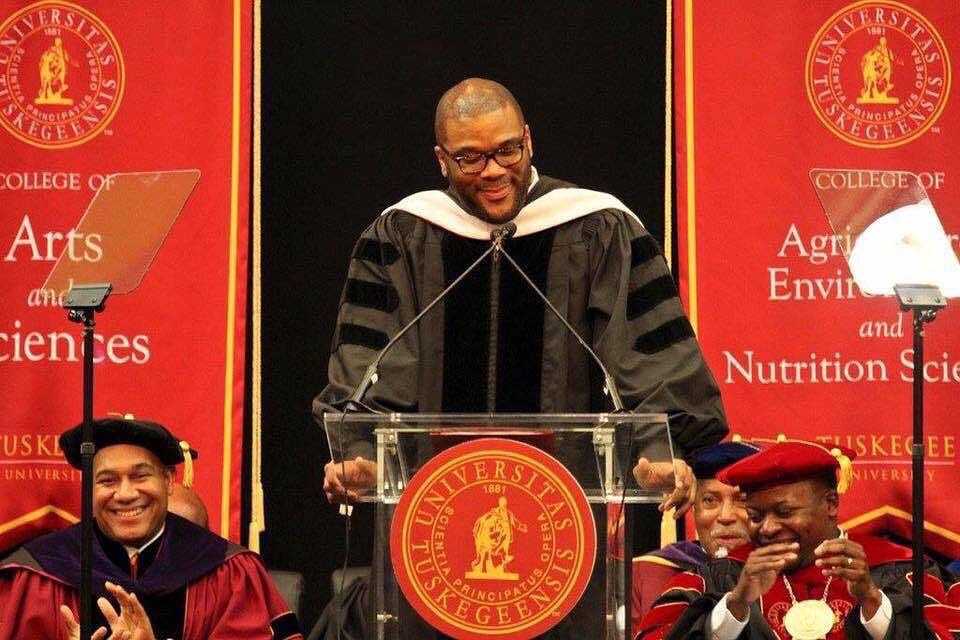
Source: Tuskegee University TYLER PERRY SPRING 2016 COMMENCEMENT SPEAKER 
Filed under Uncategorized
Tuskegee University
Filed under Uncategorized
Tuskegee University Board of Trustees unanimously approves 2015-2020 Strategic Plan
Source: Tuskegee University
Filed under Uncategorized
Tuskegee University welcomes 1,456 attendees to successful Spring Open House
Source: Tuskegee University
Filed under Uncategorized
Tuskegee University unveils new Additive Manufacturing (3-D printing) Laboratory sponsored by Chevron with generous $250,000 gift.
Source: Tuskegee University
Filed under Uncategorized
Tuskegee University: Distinguished inventor and alumnus gives generous gift of $100,000
Source: Tuskegee University
Filed under Uncategorized
Tuskegee University Board of Trustees unanimously approves 2015-2020 Strategic Plan
Source: Tuskegee University
Filed under Uncategorized
Race and the State of Higher Education: Gordon College Faith Seeking Understanding Lecture Series
Filed under Uncategorized
http://m.toledoblade.com/Education/2016/02/07/Youths-urged-to-seek-out-role-models.html
Filed under Uncategorized
Tuskegee University receives Higher Carnegie Classification Status
Source: Tuskegee University
Filed under Uncategorized
Tuskegee University-Cornel West to speak at Tuskegee University MLK celebration
Source: Tuskegee University
Filed under Uncategorized
Tuskegee University -PRESIDENT JOHNSON AUBURN UNIVERSITY MLK SPEAKER
Source: Tuskegee University
Filed under Uncategorized

Filed under Uncategorized
Tuskegee University Alumni family makes historic living-learning facility gift to Tuskegee
Source: Tuskegee University
Filed under Uncategorized
Tuskegee University
Source: Tuskegee University Tuskegee University Receives its 3rd $500,000 or more Foundation Grant/Gift in 2015 with a $600,000 Lilly Endowment Grant.
Filed under Uncategorized
1. “A Young Man Apart, A World Apart” News & Observer AUGUST 31, 1995 (20 YEARS AGO TODAY)
Filed under Uncategorized
Tuskegee University: Ranked #2 HBCU AVERAGE SALARIES FOR GRADUATES EDSMART
Filed under Uncategorized
Andrew W. Mellon Foundation awards Tuskegee University One-Half Million Dollar Gift
Filed under Uncategorized
TUSKEGEE UNIVERSITY: (LAST WASHINGTON WORD) JUNE 15, 2015-ONE YEAR ANNIVERSARY 7TH PRESIDENT
Presidential Commentary by Dr. Brian Johnson
Filed under Uncategorized
Tuskegee University: The Daily Word from Washington with Presidential Commentary
“Some people may say that it was Tuskegee’s good luck that brought to us this gift of fifty thousand dollars. No, it was not luck. It was hard work. Nothing ever comes to me, that is worth having, except as a result of hard work. When Mr. Huntington gave me the first two dollars, I did not blame him for not giving me more, but made up my mind that I was going to convince him by tangible results that we were worthy of large gifts. For a dozen years I made a strong effort to convince Mr. Huntington of the value of our work. I noted that just in proportion as the usefulness of the school grew, his donations increased.” -Booker T. Washington, My Larger Education (1911)
Presidential Commentary by Dr. Brian Johnson
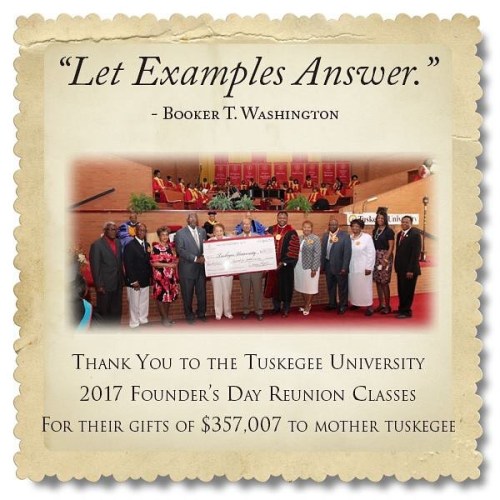
Nothing is more disturbing to hear about individual or organizational success-especially if you have contributed to such success-than that such success should be attributed to “luck” and not “hard work”. Hard work involves deliberate and persistent effort directed towards a designated end that is often easy to gloss over when witnessing the outcome and not the work preceding it. And such was Mr. Washington’s work in the advancement and development efforts of Tuskegee Institute (University). Here was a man who did not scoff at any amount received into the coffers of Tuskegee whether great or small. Without regard to the amount, he “made up [his] mind” to be resolute about his pursuit for even larger ones with his chief aid being “tangible results.” Or, as he wrote elsewhere, “Let[ting] Examples Answer.” For when an organization’s “examples answer,” it becomes easier to proceed from strength to strength because past successes are often the surest indicators of future successes.
Filed under Uncategorized
Tuskegee University: The Daily Word from Washington with Presidential Commentary
Presidential Commentary by Dr. Brian Johnson
In the lore of Tuskegee Institute’s illustrious history, there are scores of accounts, stories, and anecdotes about the meticulous management of its founding Principal and President Booker T. Washington. (This was all in addition to his visioning and planning at a macro level.) From his daily rounds around campus on his horse to his quick admonition of a student who was not properly attired, Mr. Washington’s attention to all things Tuskegee is often unknown to persons beyond the Tuskegee Institute (University) family. And this piece of correspondence directed to his own older brother speaks volumes about how his management was without “respect of persons.” Mr. John Henry Washington played a pivotal role in the founding and development of Tuskegee Institute (University). Moreover, he played an important role in the life of his little brother Booker. For it was he who assisted younger Booker’s efforts to receive a formal education. All the same, Booker played no favorites in communicating with his brother-his older brother-concerning those matters that lie within his charge. And in order to provide such correction, Mr. Washington must have went out from his office and home to observe and inspect those things within his brother’s charge. Imagine this, in addition to all of his activities, the founding Principal and President made time to visit and inspect both the barn and underneath the barn-even his own brother’s barn. Such a tenacious commitment to consistency surely must have resonated with all other employees within Tuskegee Institute. For surely if the Tuskegee Institute (University) President found the time to inspect, correct and communicate with his own older brother about his area, he would surely make the time to inspect, correct and communicate with anyone else about their areas.
Filed under Uncategorized
Tuskegee University: The Daily Word from Washington with Presidential Commentary
“Among the most trying class of people with whom I come in contact are the persons who have been educated in books to the extent that they are able, upon every occasion, to quote a phrase or a sentiment from Shakespeare, Milton, Cicero, or some other great writer. Every time any problem arises they are on the spot with a phrase or a quotation. No problem is so difficult that they are not able, with a definition or abstraction of some kind, to solve it. I like phrases, and I frequently find them useful and convenient in conversation, but I have not found in them a solution for many of the actual problems of life.”– Booker T. Washington, My Larger Education (1911)
Presidential Commentary by Dr. Brian Johnson
We often deceive ourselves by assuming that a word fitly spoken, an opinion boldly proffered, an argument well-written or a critique loosely given is tantamount to leadership–particularly with respect to solving “the actual problems of life.” And this is the idea that Booker T. Washington explained in his observations of men and women who offer words without any accompanying works. Thomas Edison suggested that “A vision without execution is a hallucination.” To be clear, “vision”-the single greatest 6-letter word- requires words for articulating, reasoning, inspiring and motivating. Yet, this is only one half of the deal in leadership. The other half is transforming those words into works. Such works, unlike words, are never philosophical or theoretical “abstraction[s]”. These works are “solution[s] for many of the actual problems” that visionary words propose to solve. Works are the evidentiary and documentable deeds done that substantiate the words of visionary leadership. Works are what can be touched, pointed to and-most importantly-verified, substantiated and authenticated precisely like the presence of Tuskegee (Institute) University that still stands a full century since Mr. Washington’s death (1915-2015). Mr. Washington’s late 19th and early 20th century demonstration of visionary leadership is the complete expression of a leader’s love for “words” that he found “useful and convenient in conversation,” as well as his “work” achieved and completed at Tuskegee. And witnessing such visionary leadership is akin to persons upon a ship viewing an iceberg in the middle of a frigid ocean. The “words” are what sit atop the iceberg’s tip until the “works” of the impressive mass that lies beneath comes slowly into view.
Filed under Uncategorized
Tuskegee University: The Daily Word from Washington with Presidential Commentary
“I remember one young man in particular who graduated from Yale University and afterward took a post-graduate course at Harvard, and who began his career by delivering a series of lectures on “The Mistakes of Booker T. Washington.” It was not long, however, before he found that he could not live continuously on my mistakes. Then he discovered that in all his long schooling he had not fitted himself to perform any kind of useful and productive labour. After he had failed in several other directions he appealed to me, and I tried to find something for him to do. It is pretty hard, however, to help a young man who has started wrong.” -Booker T. Washington, (1911) My Larger Education
Presidential Commentary by Dr. Brian Johnson
Oliver Wendell Holmes, Sr. offers the following concerning men and women whose actions are similar to the young man described in Booker T. Washington’s aforementioned passage: “Controversy equalizes fools and wise men in the same way – and the fools know it.” And the founding principal and president of Tuskegee (Institute) University provides several important lessons about both the young man-as well as all men and women of his ilk-who seek to establish their name and reputation on the basis of disparaging the name and reputation of others-particularly those whose accomplishments they will only be brought in close proximity to only upon the basis of “controversy.” First, Mr. Washington never ever mentions this young man’s name. While this unidentified young man knew full well that persons might give him a hearing-not upon the basis of his own person and accomplishments, but based upon the person and accomplishments of his topic, “The Mistakes of Booker T. Washington,”-identifying or responding to this young man provided not a single, solitary benefit to Mr. Washington and Tuskegee. Second, Mr. Washington understood that the young man’s premises were flawed from the onset, and it is the clearest telltale example of Mr. Washington’s oft-repeated phrase, “Let examples answer.” To be sure, the actions of no man or woman are all “good” or all “bad.” (This is naïve, simplistic and child-like thinking.) Yet, in the face of the clear, overwhelming and documentable evidence that testify to the good that Mr. Washington had done locally, regionally and nationally, this young man titled his lecture series according to what he perceived were the mistakes of Mr. Washington. Here again, what one consistently reads and hears, one will consistently become. And this young man ought to have taken heed to how and to what he was hearing for it ultimately led to what he had become. (For this young man’s attempt to categorize and confine a man of Booker T.Washington’s eminence and accomplishments to a series of perceived mistakes that his limited training, limited knowledge and limited life experience identified did nothing but demonstrate his failure to understand the significance of the (2) greatest 9-letter words and the single, most dangerous 9-letter word: (1) “Integrity,” (2) “Knowledge,” and (3) “Ignorance.”) Finally, we should consider Mr. Washington’s demonstration of another one of his famous aphorisms: “I let no man drag me down so low as to make me hate him.” The very same young man who sought to disparage and defame Mr. Washington later sought him for assistance, and Mr. Washington “tried to find something for him to do.” (This dynamic needs no additional commentary.) Yet what is deserving of additional commentary is that this young man might have spent his time and work writing, lecturing and building his own legacy and life worth reading as opposed to seeking to denigrate another’s whose legacy and life of building Tuskegee (Institute) University spanned 34 years (1881-1915) and remains and is read to this very day.
Filed under Uncategorized
Tuskegee University: The Daily Word from Washington with Presidential Commentary
“I have often said to you that one of the best things that education can do for an individual is to teach that individual to get hold of what he wants, rather than to teach him how to commit to memory a number of facts in history or a number of names in geography. I wish you to feel that we can give you here orderliness of mind-I mean a trained mind-that will enable you to find dates in history or to put your finger on names in geography when you want them. I wish to give you an education that will enable you to construct rules in grammar and arithmetic for your-selves. That is the highest kind of training. But, after all, this kind of thing is not the end of education. What, then, do we mean by education? I would say that education is meant to give us an idea of truth. Whatever we get out of text books, whatever we get out of industry, whatever we get here and there from any sources, if we do not get the idea of truth at the end, we do not get education. I do not care how much you get out of history, or geography, or algebra, or literature, I do not care how much you have got out of all your text books:-unless you have got truth, you have failed in your purpose to be educated. Unless you get the idea of truth so pure that you cannot be false in anything, your education is a failure.”– Booker T. Washington, “A Sunday Evening Talk”
Presidential Commentary by Dr. Brian Johnson
Of the many truths the founding principal and president of Tuskegee (Institute) University proffered in his many speeches, writings and correspondence, the following is perhaps the single most profound and difficult one to grasp: “Unless you get the idea of truth so pure that you cannot be false in anything, your education is a failure.” Now it may appear to the naysayer that Mr. Washington makes a rather prideful or arrogant assertion but C.S. Lewis’s idea that “perfect humility dispenses with modesty” rejects such an accusation. (“Humility” is the greatest 8-letter word and “Fearless” is the second greatest 8-letter word in succession with good reason.) To be clear, there is no man or woman who will have not had error or failure at some point in their vocational path or journey. Yet, Mr. Washington’s conception of “education” encompasses those who have erred and failed because a “truth so pure that you cannot be false in anything” permits a single man or woman to ascertain valuable and truthful lessons whether through triumph or tragedy. For this man or woman-the truly educated man or woman-never experiences “falsity [or failure] in anything” because he or she lives, learns and then leads others to wrest the valuable water of “knowledge”-the second greatest 9-letter word-from any dampening circumstance. Moreover, these men and women proceed undauntedly, unflinchingly and unwaveringly day-to-day, month-to-month and year-to-year to continuous and ongoing “success”-one of the greatest 7-letter words-without ever experiencing real “falsity” or “failure” in the truest sense of the words. For never can a man or woman who possesses and applies the sort of education Mr. Washington established at Tuskegee University can ever rightly be called “false” or a “failure” because a truly educated man or woman ultimately views success and failure rightly according to the greatest 8-letter words: “Humility” and “Fearless,” which again are the greatest 8-letter words in succession.
Filed under Uncategorized
Tuskegee University: The Daily Word from Washington with Presidential Commentary
Presidential Commentary by Dr. Brian Johnson
Esteemed author and educator, Parker Palmer, writes the following regarding finding one’s purpose and passion in connection with one’s work: “It is not easy work rejoining soul and role.” And the founding principal and president of Tuskegee (Institute) University, Booker T. Washington thoroughly outlines in this letter to Mr. Gilchrist Stewart the kind of employee he sought to assist him in his work at Tuskegee. Expounding upon his conception of “heart (calling), head (competence) and hands (capable),” Mr. Washington wanted someone to “take hold in a whole souled way,” and “whose soul is deeply in love with his work.”
While Mr. Washington’s passage needs no additional commentary, and one might argue that he offers a 19th century notion of work, we are able to glean two important lessons for the 21st century from his remarks to Mr. Stewart. First, he wanted someone “who gives [work] his thought night and day.” Now, there are a great many employees whose work ends as soon as the bell rings, yet there are some who give constant thought and deliberation to how their work might be improved and made better. To be sure, work-life balance dictates prudence in these matters. Notwithstanding, the student, scholar, professor, staff member and administrator who is constantly turning about in their head how to make things better will likely become the person who surpasses those whose work is done at the close of the class period or the business day. (For this man or woman is working while others are talking or sleeping, and when they become successful, it is only a surprise to those who do not know the supreme value of works as opposed to words.) Second, Mr. Washington wanted someone “who looks so closely after every detail of his work…whom orders will not have to be continually repeated…[and] one who is continually planning for the improvement and perfection of his work.” Herein lies the (3) chief descriptors of any successful man or woman at their craft: 1. They look closely after the details. Contrary to popular opinion, “it does take all of that” to become a man or woman whose work transcends any boundary. Attention to the most minute of details is a characteristic of excellence that is oft-times avoided because it is perceived as additional work 2. They do not need to be told repeatedly what to do. If a supervisor must spend his or her time repeatedly issuing the same instructions and expectations to those within their charge, then they might rightly do the work themselves. On the other hand, if a supervisor can issue a general set of expectations and instructions and never return to the person except when absolutely necessary it enables the supervisor to attend to their own duties and not the duties of others. 3. They are continually planning for improvement and perfection in their work. Note, one will never arrive at perfection which is precisely why an institution and its employees must be in a constant state of “continuous improvement.” It is a poor employee or organization that rests upon past successes or achievement. The best employees and organizations work constantly to achieve and do MORE and MORE. Success-true success-begets more success and, most importantly, continued success. (Success is the 3rd greatest 7-letter word after “purpose” and “passion.”) Every successful man or woman wants to work in a culture of success. And such success is both the tradition and trajectory of Tuskegee (Institute) University.
Brian L. Johnson, Ph.D.
Filed under Uncategorized
Tuskegee University: The Daily Word from Washington with Presidential Commentary
Personal and Private
Dear Sir: I am not active in politics and do not expect to be, and have no claim upon your time or attention. I simply write to assure you that I am doing in a rather quiet way whatever I can in connection with our mutual friend, Mr. Clarkson, to bring about your nomination for the presidency at St. Louis Convention […]. “April 10, 1896,” Booker T. Washington
Presidential Commentary by Dr. Brian Johnson
Booker T. Washington possessed many detractors who railed against the founding principal and president of Tuskegee (Institute) University for not being “active in politics.” In spite of this, we repeatedly find in his letters and correspondence that he was simply not “active” in the precise manner at the precise time that persons wanted him to be. Such was the case in his communication to William Boyd Allison. Although Mr. Washington was not loud, boisterous nor public in communicating the whole of his ideas and activities, he moved “in a rather quiet way” as demonstrated in this letter marked “personal and private.” Unlike those without such responsibilities, many leaders of large and vast organizations like Booker T. Washington are not at liberty to publicly communicate all of their opinions or activities directed towards particular ends. Whether in the 19th century where leaders communicated through pen and paper or in the 21st century where men and women communicate via email or social media, you will rarely find the most effective leaders revealing the whole of their minds and the whole of their undertakings upon a matter. (The weightier their position, the weightier their word.) It is a small and insignificant thing for a person who possesses no public reputation or great authority to offer opinion on highly charged political matters. Yet for a man in Booker T. Washington’s position, every move and word was scrutinized because of the eminence of his role and institution. For some 34 years, he was not simply Booker Washington; He was Booker Washington, principal and president of Tuskegee (Institute) University. As such, prudence dictated that he move “in a rather quiet way” on a great majority of matters for a great majority of his 34 years at the helm of Tuskegee (Institute) University.
Filed under Uncategorized
Tuskegee University: The Daily Word from Washington with Presidential Commentary
“I hope that each of you as you go out for the summer, whether you go out with the view of returning here to finish your course of study, or whether you go out as graduates of the institution, I want each of you to remember that you are going to go backward or you are going to go forward. It will be impossible for you to stand still. You will either go upward or you will go downward, and as you go upward, you will take others up with you, or as you go downward, you will take others with you.” “Sunday Evening Talk,” “May 13, 1900,” Booker T. Washington
Presidential Commentary by Dr. Brian Johnson
In life, leadership and a host of other endeavors, one can hardly expect to move “forward” or “upward” while “stand[ing] still”. As the founding principal and president of Tuskegee (Institute) University eloquently articulates in one of his “Sunday Evening Talks” with students, “you are going to go backward or you are going to go forward.” To be sure, Mr. Washington’s idea of moving “forward,” “backward,” “upwards,” or “downwards” is not an absolute formula. There are a great many occasions where perceived “backward” movements propel individuals and organizations “forward,” and perceived “upward” movements move individuals and organizations “downward.” Notwithstanding, the idea contained in Mr. Washington’s aforementioned formulation speaks most precisely to “activity” or “inactivity,” which is otherwise known as, “stand[ing] still”. History and contemporary society are replete with examples of men, women and organizations whose constant activity have led to a single monumental success after many repeated failures. Yet, what is constant in both the successes and failures is “activity.” Mr. Washington has also described it as, “going”. And while it is true that busyness is not the same as effectiveness, it is equally true that the man, woman or organization that is busy “going” is more likely to become successful as opposed to those who are “standing still.”
Filed under Uncategorized
Tuskegee University: The Daily Word from Washington with Presidential Commentary
“Dear Mr. Benner: Please tell Booker that I am to be here for a week, and that I should like to hear from him. He has a tendency, I have noticed, to stoop over when he sits, and to stand not at all erect when he walks. I hope you will do all that you can to correct this habit. Very truly yours.”– “May 5, 1904,” Booker T. Washington
Presidential Commentary by Dr. Brian Johnson
The founding principal and president of Tuskegee (Institute) University was not only an affectionate father who wanted to hear from his sons, he was also a father that provided instruction to them as well. His namesake attended the Wellesley School for Boys in Wellesley, MA, and Mr. Edward Augustine Benner was principal of the school during young Booker’s tenure. Similar to his stewardship over the affairs of Mother Tuskegee, he equally considered important the stewardship over his children as a father. A consummate educator, his letters, speeches and writings demonstrate that he used every incident occurring in the walls of the university to provide object lessons to his students for their betterment. Similarly, he used the opportunity to inquire of his son’s well -being while simultaneously requesting that the principal make note of his recommendations concerning his son’s posture. Like a good teacher, Mr. Washington well understood that paternal love is not constrained to a demonstration of empathy and concern, it also involves correction. For love, empathy and concern properly understood involves both.
Filed under Uncategorized