“In order to be successful in any kind of undertaking, I think the main thing is for one to grow to the point where he completely forgets himself; that is, to lose himself in a great cause. In proportion as one loses himself in the way, in the same degree does he get the highest happiness out of his work.” – Booker T. Washington, “Up From Slavery,” 1901
Presidential Commentary by Dr. Brian Johnson
One can find no greater joy than to serve a cause higher than one’s self-particularly when the cause is associated with one’s work. And it would be very difficult to find a historic figure whose life and work better embodies this notion than Booker T. Washington and the work of building Tuskegee Institute (University). Consider the circumstances of his arrival in Tuskegee from Hampton Institute. An abandoned hen house served as his first classroom; His students possessed varying levels of literacy, and above all, he had few resources to purchase additional property for the institute’s growth-pawning his own watch in repayment of an early loan. And while he might have easily thought of himself and abandoned the entire enterprise, he did precisely the opposite. Mr. Washington “completely [forgot] himself” to serve a “great cause.” Serving a cause greater than personal preference often leads to the kind of success that benefits not only a singular person but both people and purposes. For careers fill pockets; Careers linked to callings fulfill individual people; and fulfilled people achieve great purposes.
That he would grant you, according to the riches of his glory, to be strengthened with might by his Spirit in the inner man;
KJV
There are a great many strengths to be had during our time here on earth, yet the Apostle Paul recognized that none are more pressing to pray for than “to be strengthened with by his Spirit in the inner man.” For spiritual strength is none other than God’s own Holy Spirit finding union with and abiding within our very own spirit (the inner man). And the results of such a union are clear enough even throughout biblical history. For though Old Testament personages like Gideon, David, Elijah, Sampson and a host of others were not able to experience the finished work of Christ, and thus able to have God’s own Spirit permanently abiding within them, as many interpreters would argue, God would intermittently endow such men with His Spirit for the accomplishment of great and mighty tasks. And when one considers their accomplishments, all of which done in the face of opposition and adversity, then it becomes all the more necessary for contemporary believers in God through Jesus Christ to labor in prayer for the same abiding spiritual strength when we face the challenges of our lives:
[(For) if thou faint in the day of adversity, thy strength is small.] Proverbs 24:10
“My dear Mr. Schmidlapp: I thank you very much for your letter of January 3rd, also, for yours of December 7th, which I did not have the privilege of answering in person. We thank you for your subscription of One Hundred Dollars toward the Repair Fund. This will help us much.” – Booker T. Washington, January 12, 1910.”
Presidential Commentary by Dr. Brian Johnson
There is no greater expense for many universities that were founded in the mid to late 1800s than the following: Deferred Maintenance Costs for both living and learning facilities. And the founding principal and president of Tuskegee (Institute) University was at the forefront of understanding how to create a diverse portfolio of fundraising that included, among other things, restricted gifts for the express purpose of going to the “Repair Fund.” Note, the modern-day equivalent of the “Repair Fund” is akin to seeking both small and major “restricted” gifts for the renovation, restoration and repair of “bricks and mortar”. (These are living facilities where students reside and learning facilities where professors teach and research. Many institutions have now combined such functions where students and professors can simultaneously “live and learn.”) “Restricted” gifts designated for the renovation, restoration or repair of living and learning facilities are often used to serve “unrestricted” purposes. For when an institution can secure such gifts then monies contained within its own annual deferred maintenance budget can be used to renovate, restore and repair additional living and learning facilities or be used for other items in support of teaching, learning or research. More importantly, when an institution possesses a deferred maintenance plan, schedule or a campus master plan that designates monies for renovation, restoration and repair projects over a certain period, a single major “restricted” gift might allow the institution to improve a residential facility or classroom facility years before what the deferred maintenance schedule and plan originally projected. While this is generally understood in a knowledge-based, data-informed and outcomes-oriented 21st century higher education enterprise, here we find that Booker T. Washington was doing this not only in 1910, but as early as 1881 when he arrived in Tuskegee, Alabama only to discover that he would be spending his earliest years teaching in a hen house. (34 years later, he took this hen house and-with the help of employees like Robert R. Taylor and Emmett J. Scott and faculty members like George Washington Carver-transformed it into the single most immaculate campus in all of higher education both nationally and globally. At the time of this writing Tuskegee University is one of 15 largest campuses in America in terms of acreage owned.) And this is why we celebrate Booker T. Washington in this the centennial year (1915-2015) since his passing. For this was a man of “substance” whose writings, correspondence and (most importantly) deeds demonstrate “integrity” and “knowledge,” which are the two single greatest 9-letter words. This is also probably why one of Mr. Washington’s favorite sayings was as follows: “Let Examples Answer.”
11 Now therefore make confession unto the LORD God of your fathers, and do his pleasure: and separate yourselves from the people of the land, and from the strange wives.
12 Then all the congregation answered and said with a loud voice, As thou hast said, so must we do.
13 But the people are many, and it is a time of much rain, and we are not able to stand without, neither is this a work of one day or two: for we are many that have transgressed in this thing.
KJV
In our zeal to remedy past errors, we must never presume that such reforms are an overnight process. When Ezra learned that many of the people had married strange wives that did not honor the God of heaven, he directed and implemented what was necessary for reform.
And while the people confessed their transgressions in the matter and consented to his plans, they were wise enough to realize that such efforts could not take place in “one day or two.” For the people well understood that true repentance always accompanies works in keeping with it, and they desired to do nothing less than to bring forth fruits meet for it; And they fully understood that such fruit would “not” be had in “one day or two.”
[For behold this selfsame thing, that ye sorrowed after a godly sort, what carefulness it wrought in you, yea, what clearing of yourselves, yea, what indignation, yea, what fear, yea, what vehement desire, yea, what zeal, yea, what revenge! In all things ye have approved yourselves to be clear in this matter.] KJV 2 Corinthians 7:11
“My dear friend Mr. Briggs: I will open school the 1st Monday in July. Judging from present prospects I shall have about thirty students the first day and a steady increase…” – Booker T. Washington, June 28, 1881
Presidential Commentary by Dr. Brian Johnson
On June 28, 1881, a 25-year old Booker T. Washington had enrolled 30 students before Tuskegee Institute (University) was officially founded on July 4, 1881. While this was clearly a noteworthy moment at the onset of his presidency, this is not what is most startling about the first of many achievements that this young president would accomplish during his subsequent 34-years at the helm of Tuskegee (Institute) University. This young man’s single most signal historic achievement-in this writer’s opinion-occurred on June 24,1888, which is the date that this student and teacher who had been trained by General Samuel Armstrong, arrived in Tuskegee, Alabama. (We know this because on June 25, 1881 Mr. Washington wrote to James Fowled Baldwin Marshall the following: “Dear friend: Arrived here yesterday.”) And it was on that day that a “Copernican Revolution” in the landscape of higher education occurred, not only in Tuskegee but in the history of the world. For this young man’s arrival (to start an institution of higher learning for newly freed African Americans) reverberated and transcended not simply the city of Tuskegee and the county of Macon, but the entire world. These 30 men and women who were likely still using skill sets acquired during enslavement would now be afforded the opportunity to use these skills to gain their own economic and intellectual independence. They need not work for their former masters with little distinction in pay from the time of physical bondage. After the training of their hearts, heads and hands within this new institution of higher learning called Tuskegee Normal School (Institute) University, they could now use their own skill sets to start their own businesses and offer their services in a much more economically viable exchange between formerly enslaved men and women and their former masters. And this perhaps ranks atop of the many other significant reasons why we celebrate Booker T. Washington in this the centennial year (1915-2015) since his passing.
13 Brethren, I count not myself to have apprehended: but this one thing I do, forgetting those things which are behind, and reaching forth unto those things which are before,
14 I press toward the mark for the prize of the high calling of God in Christ Jesus.
15 Let us therefore, as many as be perfect, be thus minded: and if in any thing ye be otherwise minded, God shall reveal even this unto you.
KJV
Pressing is the position that the perfect (mature) believer takes to progressively move toward all of what God has for him or her both in this time and in the time to come. For contemplation and meditation of things of old (both good and bad) results only in stagnation and inactivity in the present unless it translates into present activity. Even in this, the mature believer quickly forgets both his or her shortcomings and successes because he or she is reaching towards an even higher calling in his or efforts to fulfill their God-given purpose. For to fulfill the will of God is one whereby the believer proceeds from “glory to glory” yet often accompanied by trials, valleys and the need to press in between.
[Therefore, give diligence to make your calling and election sure: for if ye do these things, ye shall never fall.] KJV 2 Peter 1:10
[And remember not the former things, neither consider the things of old. For behold, the Lord will do a new thing.] KJV Isaiah 43:18-19
5 Then said I, Woe is me! for I am undone; because I am a man of unclean lips, and I dwell in the midst of a people of unclean lips: for mine eyes have seen the King, the LORD of hosts.
6 Then flew one of the seraphims unto me, having a live coal in his hand, which he had taken with the tongs from off the altar:
7 And he laid it upon my mouth, and said, Lo, this hath touched thy lips; and thine iniquity is taken away, and thy sin purged.
8 Also I heard the voice of the Lord, saying, Whom shall I send, and who will go for us? Then said I, Here am I; send me.
KJV
Although there have been men and women throughout scripture who have been privy to eternal majesties and have been assigned to spectacular missions by God himself, their qualifications were not much different than our own. James writes of the prophet Elias that he was a man subject to like passions even as we are. Notwithstanding, the virtue and nobility of those men and women selected by God for magnificent purposes lie not in the fact that they were sinless and perfect like our Lord, but within the fact that they were deeply aware of, and admitted their own sinfulness when others were not and would not. Though Isaiah’s vision of the throne and his subsequent response, “Here am I; send me” is quite familiar to most, what’s most impressive about the prophet is his acknowledgement of his own uncleanness, and God’s subsequent purging of his sin. His proverbial confession was not, “I am righteous!” Yet rather, it was “I am a man of unclean lips and I dwell amongst a people of unclean lips.” For this pattern is one whereby all believers follow when responding to a call from God to serve. One must be completely assured of one’s own forgiveness, and having been forgiven, one must serve.
[For how much more shall the blood of Christ who through the eternal Spirit offered himself without spot to God, purge your conscience from dead works to serve the living God?] KJV Hebrews 9:14
31 The horse is prepared against the day of battle: but safety is of the LORD.
KJV
In all our exhortations to believe in, trust in and rely entirely upon God, let us also be mindful that our horses ought still be prepared in the process. Throughout Israel’s biblical history, we are most attentive to the many miraculous deliverances that were wrought at the hands of God—enemies slaying one another, hail and rainstorm descending upon foreign invaders and even the sun being held in time and space to ensure victory; Yet and still, in each of these events Israel was ready, armed and prepared for victory to be delivered into their hand. For contrary to what many believe, safety, deliverance and the spectacular often comes to those who have prepared themselves for it. (We do our very best, and then we trust completely in the Lord.)
[Some trust in chariots, and some in horses: but we will remember the name of the LORD our God.] KJV Psalm 20:7
12 Him that overcometh will I make a pillar in the temple of my God, and he shall go no more out: and I will write upon him the name of my God, and the name of the city of my God, which is new Jerusalem, which cometh down out of heaven from my God: and I will write upon him my new name. KJV
Although some read the book of Revelations for those things that have already been fulfilled, some read it for its many future implications and still others read it for its many present implications; perhaps the most expedient way to read it is to bear all three in mind, simultaneously, particularly for the principle of the pillar. For having overcome his insecurities, doubts and double-mindedness, Peter (along with James and John) was considered a pillar in the Lord’s house. And surely all who have endured to the very end, overcoming the world and its temptations, trials and afflictions, will become pillars in the temple of God found in Heavenly Jerusalem. Moreover, we who are alive ought to appear as pillars in our present assemblies, (fixed in the faith) grounded and settled, always overcoming because of it. For the overarching principle of the pillar is one of strength to support and to bear the weight of not only ourselves but others. Most importantly, pillars stand upon truth chiefly expressed through the word of God.
[That thou mayest know how thou oughtest to behave thyself in the house of God, which is the church of the living God, the pillar and ground of the truth.] 1 Tim. 3:15 KJV
“I remember one young man in particular who graduated from Yale University and afterward took a post-graduate course at Harvard, and who began his career by delivering a series of lectures on “The Mistakes of Booker T. Washington.” It was not long, however, before he found that he could not live continuously on my mistakes. Then he discovered that in all his long schooling he had not fitted himself to perform any kind of useful and productive labour. After he had failed in several other directions he appealed to me, and I tried to find something for him to do. It is pretty hard, however, to help a young man who has started wrong.” – Booker T. Washington, (1911) My Larger Education
Presidential Commentary by Dr. Brian Johnson
Oliver Wendell Holmes, Sr. offers the following concerning men and women whose actions are similar to the young man described in Booker T. Washington’s aforementioned passage: “Controversy equalizes fools and wise men in the same way – and the fools know it.” And the founding principal and president of Tuskegee (Institute) University provides several important lessons about both the young man-as well as all men and women of his ilk-who seek to establish their name and reputation on the basis of disparaging the name and reputation of others-particularly those whose accomplishments they will only be brought in close proximity to only upon the basis of “controversy.” First, Mr. Washington never ever mentions this young man’s name. While this unidentified young man knew full well that persons might give him a hearing-not upon the basis of his own person and accomplishments-but based upon the person and accomplishments of his topic, “The Mistakes of Booker T. Washington,” identifying or responding to this young man provided not a single, solitary benefit to Mr. Washington and Tuskegee. Second, Mr. Washington understood that the young man’s premises were flawed from the onset, and it is the clearest telltale example of Mr. Washington’s oft-repeated phrase, “Let examples answer.” To be sure, the actions of no man or woman are all “good” or all “bad.” (This is naïve, simplistic and child-like thinking.) Yet, in the face of the clear, overwhelming and documentable evidence that testify to the good that Mr. Washington had done locally, regionally and nationally, this young man titled his lecture series according to what he perceived were the mistakes of Mr. Washington. Here again, what one consistently reads and hears, one will consistently become. And this young man ought to have taken heed to how and to what he was hearing for it ultimately led to what he had become. (For this young man’s attempt to categorize and confine a man of Booker T. Washington eminence and accomplishments to a series of perceived mistakes that his limited training, limited knowledge and limited life experience identified did nothing but demonstrate his failure to understand the significance of the (2) greatest 9-letter words and the single, most dangerous 9-letter word: 1. “Integrity” 2. “Knowledge” 3. “Ignorance;”) Finally, we should consider Mr. Washington’s demonstration of another one of his famous aphorisms: “I let no man drag me down so low as to make me hate him.” The very same young man who sought to disparage and defame Mr. Washington later sought him for assistance, and Mr. Washington “tried to find something for him to do.” (This dynamic needs no additional commentary.) Yet what is deserving of additional commentary is that this young man might have spent his time and work writing, lecturing and building his own legacy and life worth reading as opposed to seeking to denigrate another’s whose legacy and life of building Tuskegee (Institute) University spanned 34 years (1881-1915) and remains and is read to this very day.
6And he said, It is a light thing that thou shouldest be my servant to raise up the tribes of Jacob, and to restore the preserved of Israel: I will also give thee for a light to the Gentiles, that thou mayest be my salvation unto the end of the earth. Isaiah 49:6 KJV
Whenever we limit God to our own provincial location based upon race, ethnicity, or socioeconomics, we’ll quickly discover that His plans are always surpassingly greater than our own preconceived notions. Consider the prophet Isaiah in describing his mission, even signifying prophetically the mission of Christ. God sees ministry directed only towards the tribes of Jacob and Israel as a light thing in comparison to the innumerable persons that would eventually become fully and intimately acquainted with the good news of the gospel. And this is God’s usual pattern when he calls his people to fulfill particular purposes.
Joseph not only served his own people but the Egyptians and persons from surrounding nations; Paul not only preached to the Jews of Damascus and at Jerusalem but would go on throughout the coasts of Judaea and then to the Gentiles. Bearing prophetic witness which transcends race, culture and creed (even as Christ) is the intrinsic calling of every man or woman regardless of our vocation:
[For whom he did foreknow, he also did predestinate to be conformed to the image of his Son, that he might be the firstborn among many brethren.] KJV Romans 8:29
“I do not say you should not use them, should not posses them, should not crave them, but do not make the mistake of feeling that titles are going to help you, unless you have got strength aside from the title. No amount of titles will put brains into a person’s head if the brains are not there before.” – Booker T. Washington, “A Sunday Evening Talk,” January 10, 1909
Presidential Commentary by Dr. Brian Johnson
Hear this again and again: Positional and titular authority is the lowest form of authority. If a man or woman cannot nor does not command the respect of his supervisors, peers, colleagues and subordinates independent of a position or title, this man or woman is no greater than the man or woman who has no such position and title. Positions change, and the only permanence one can possess is that found in one’s own person in back of the position. This is why the founding principal and president of Tuskegee University constantly impressed upon his students the need to constantly improve their own persons. Note the following: It is but half the task to secure the title or position. The most significant half is what one does with the title or position. (One must not only plan how to get the position or title, but what to do with the position and title when one gets it.) And the attention paid to one’s own person helps towards this end. Aside from acquiring credentials and competence, the comprehensive development of one’s person is a third facet that can never be taken from the person in back of a position. More importantly, these facets are easily transferable from position to position, unit to unit or organization-to-organization, which is why the singular, solitary focus upon a position and title (as opposed to the development of one’s own person) is unwise. For the man or woman who has “strength aside from the title” and who has “brains” in their “heads” will always possess these attributes without regards to a position or a title. (And they will always be desired and in demand.) And the founding principal and president of Tuskegee University who we celebrate in the centennial year since his passing (1915-2015) was not only such a man, but he also offered these wise “words” and set forth the accompanying “works” in his 34-year long presidency at the helm of Tuskegee (Institute) University (1881-1915).
39 And David girded his sword upon his armour, and he assayed to go; for he had not proved it. And David said unto Saul, I cannot go with these; for I have not proved them. And David put them off him.
KJV
Perhaps the surest way of failing to achieve one’s calling is by trying to employ the gifts of another. For while we each have our Goliaths to slay, let us not slay them with weapons that we are unfamiliar with. For whatever our calling, God has already granted the requisite gifts for it. Gifts are the unique materials that He has given to every man to do their part in building His complete testimony in earthly history. And when gifts are linked to careers and then are linked to callings, combined they will fulfill great purposes.
[For every good gift and every perfect gift is from above, and cometh down from the Father of lights, with whom is no variableness, neither shadow of turning.] KJV James 1:17
“[…] After the man was shot his son brought him to my house for help and advise, (and you can easily understand that the people in and about Tuskegee come to me for help and advice in all their troubles). I got out of bed and went out and explained to the man and his son that personally I would do anything I could for them but I could not take the wounded man into the school and endanger the lives of students entrusted to my care to the fury of some drunken white men. Neither did I for the same reason feel that it was the right thing to take him into my own house. For as much as I love the colored people in that section, I can not feel that I am in duty bound to shelter them in all their personal troubles any more than you would feel called to do the same thing in Washington. I explained my position fully to the man and his son, and they agreed with me as to the wisdom of my course. And I now state what I have not to any one before. I helped them to a place of safety and paid the money out of my own pocket for the comfort and treatment of the man while he was sick. Today I have no warmer friends than this man and his son. They have nothing but the warmest feelings of gratitude for me and are continually in one way or another expressing this feeling. I do not care to publish to the world what I do and should not mention this except for this false representation. I simply chose to help and relieve this man in my own way rather than in the way some man a thousand miles away would have had me do it.” – Booker T. Washington, “To Francis James Grimke,” November 27, 1895
Presidential Commentary by Dr. Brian Johnson
A man of Booker T. Washington’s eminence, position and stature was often criticized on a great many matters from persons who perhaps had his interest-or their own-at heart, but were wholly removed from the facts. Often in the case of leadership-particularly in the leadership of a vast organization such as Tuskegee Institute (University)-one must exercise tremendous restraint in responding to erroneous opinions, ill-informed recommendations or ill-advised suggestions. However, Mr. Washington’s response to what he perceived was a “false representation” of his character was another matter altogether. During the difficult period of “Jim Crow,” many persons-white and black-held opinions about how the Tuskegee Principal should respond and react to racial atrocities as described in his letter to Grimke. In the present circumstance, Mr. Washington is responding to a letter from Grimke wherein the writer indicated that someone-“whose name [he had] forgotten”-relayed the circumstances of this event during a Bethel literary society meeting in Atlanta and that the founding Principal “refused to allow him to be brought in or the physician to attend him.” To Grimke’s credit, he went on to inform Mr. Washington that he felt it his “duty to apprise [him] of what was said.” All the same, aside from Mr. Washington’s detailed correspondence communicating the circumstances aright to Mr. Grimke, he went on to provide additional facts concerning his activities that were intentionally not designed for public consumption or publication. It would be remiss to think or believe that Mr. Washington’s advocacy of industrial education or internal uplift and reform, was free from sympathetic interest to the political matters of his day. Rather, Mr. Washington’s approach-as sound approaches often are-was marked by tact, sagacity and, most importantly, prudence. For Mr. Washington’s true audience was not political constituents who suggested what ought be done but the father and the son who were the beneficiaries of what needed to be done.
“We can fill your heads with knowledge, and we can train your hands to work with skill, but unless all this training of head and hand is based upon high, upright character, upon a true heart, it will amount to nothing. You will be no better off than the most ignorant.” – Booker T. Washington, A Sunday Evening Talk
Presidential Commentary by Dr. Brian Johnson
In this writer’s opinion, “integrity” is the greatest 9-letter word, “knowledge” is the second greatest, and “ignorance” is-by far-the worst and most dangerous. And the founding principal and president of Tuskegee (Institute) University, Booker T. Washington, gives on this Sunday evening talk his oft-repeated conception of “heart-head-hands” to help his students avoid the dread of becoming “no better off than the most ignorant.” One can easily seek the help of professors to develop one’s “head”. (These men and women have as their primary purpose to fill the “heads” of students with “knowledge”.) Likewise, professors are able to help make a student’s “hands”-or their work-“skill”[ful]. (Through repeated instruction and correction a student will either become skillful at their work or they will receive failing grades.) Yet, the matter of the “heart,” Mr. Washington suggests, is one matter where students must begin and complete this work largely alone. (Let no man or woman ever presume to become an expert on the subject of another’s heart.) Of all subject matters, it is the one that is deeply personal and unique to the individual. Whereas both the competencies of the “head” and the credentials of the “hands” lie in full view, the “heart” is always hidden from view. Yet, without it, all else “will amount to nothing.” For Mr. Washington’s complete configuration of Heart-Head-Hands in education is akin to the strength necessary to shoot arrows a great distance even as Tuskegee University has shot forth the sons and daughters of Booker into rewarding and meaningful careers of service for over 133 years. The heart is the unseen and invisible strength that determines how far one can bend the bow to make the arrow go.
“Among the most trying class of people with whom I come in contact are the persons who have been educated in books to the extent that they are able, upon every occasion, to quote a phrase or a sentiment from Shakespeare, Milton, Cicero, or some other great writer. Every time any problem arises they are on the spot with a phrase or a quotation. No problem is so difficult that they are not able, with a definition or abstraction of some kind, to solve it. I like phrases, and I frequently find them useful and convenient in conversation, but I have not found in them a solution for many of the actual problems of life.” – Booker T. Washington, My Larger Education (1911)
Presidential Commentary by Dr. Brian Johnson
We often deceive ourselves by assuming that a word fitly spoken, an opinion boldly proffered, an argument well-written or a critique loosely given is tantamount to leadership–particularly with respect to solving “the actual problems of life.” And this is the idea that Booker T. Washington explained in his observations of men and women who offer words without any accompanying works. Thomas Edison suggested that “A vision without execution is a hallucination.” To be clear, “vision”-the single greatest 6-letter word- requires words for articulating, reasoning, inspiring and motivating. Yet, this is only one half of the deal in leadership. The other half is transforming those words into works.
Such works, unlike words, are never philosophical or theoretical “abstraction[s]”. These works are “solution[s] for many of the actual problems” that visionary words propose to solve. Works are the evidentiary and documentable deeds done that substantiate the words of visionary leadership. Works are what can be touched, pointed to and-most importantly-verified, substantiated and authenticated precisely like the presence of Tuskegee (Institute) University that still stands a full century since Mr. Washington’s death (1915-2015).
Mr. Washington’s late 19th and early 20th century demonstration of visionary leadership is the complete expression of a leader’s love for “words” that he found “useful and convenient in conversation,” as well as his “work” achieved and completed at Tuskegee. And witnessing such visionary leadership is akin to persons upon a ship viewing an iceberg in the middle of a frigid ocean. The “words” are what sit atop the iceberg’s tip until the “works” of the impressive mass that lies beneath comes slowly into view.
And that we may be delivered from unreasonable and wicked men: for all men have not faith.
KJV
There’s really no way to get around what the apostle suggests in this verse: All men have not faith. While it would be grand indeed if every exhortation to “believe God” were returned with “I believe,” were the typical exchange between men and women (both believing and unbelieving) that we encounter on a daily basis, this is usually not the case. For faith requires submission, patience, humility, perseverance and complete adherence to God’s way of doing things in spite of its perceived absurdity. Sadly enough, most men believe in the exact opposite. Instead of submission, they believe in force. In place of patience, they believe in haste. In lieu of humility, self-assertion and pride, and for perseverance, they believe in taking the path of least resistance. And above all things, for (perceived) expediency’s sake, most will not follow God’s way of doing things with promises of succeeding results because of fear of ostracism, men, and a variety of other factors. This is why such men are described as unreasonable. For to place one’s faith in any other course of action than that which proceeds from God’s word and Himself is not only unreasonable but foolish:
[The fool hath said in his heart, There is no God.] Psalm 14:1
“My dear Mr. President [Theodore Roosevelt]: If you have in mind the sending in of a special message bearing upon the lynching of Italians in Mississippi, I am wondering if you could not think it proper to enlarge a little on the general subject of lynching; I think it would do good. I think you could with perfect safety, give the Southern States praise, especially the Governors and the daily press, for assisting in reducing the number of lynchings. The subject is a very important and far reaching one and keeps many of our people constantly stirred up […].” – Booker T. Washington, “To Theodore Roosevelt, January 5, 1902”
Leo Tolstoy offers the following expression concerning men and women who live according to their conscience, as opposed to the dictates of popular sentiment: “He who lives not for the sake of his conscience, but for the sake of others’ praise, lives badly.” Although Booker T. Washington, founding principal and president of Tuskegee (Institute) University, might have expressed his views more diplomatically than most men and women of his era who were not situated at the helm of a major institution, he possessed his own methods to express his views nevertheless.
And the communication to U.S. President Theodore Roosevelt suggests a great deal about how this institutional president operated in matters of national importance. First, he need not make a public announcement of his views. Booker T. Washington had direct access to the President of the United States. An advisor to President Roosevelt on a number of political matters, his letters reveal an ongoing stream of communication that suggests that his advice and opinion mattered to the President and would be weighed carefully.
Second, he used the opportunity of President Roosevelt’s apparent willingness to discuss “the lynchings of Italians in Mississippi” to suggest that he broaden his discussion to encompass to one of his primary constituencies and concerns during the period-the lynching of African Americans. Finally, he alluded to the importance of the President addressing the subject: It was for the benefit of all Americans.
He fittingly ascribed his concern to the well being of the country similar to Lyman Beecher Stowe’s sentiment when he penned the following: “Here in America, we are all, in the end, going up or down together.” Here again, the man Booker T. Washington might not have done what many desired him to do and in the precise manner they would have liked for him to do but he did do what he thought was right to do.
Joshua 3:3-4 3 And they commanded the people, saying, When ye see the ark of the covenant of the LORD your God, and the priests the Levites bearing it, then ye shall remove from your place, and go after it. 4 Yet there shall be a space between you and it, about two thousand cubits by measure: come not near unto it, that ye may know the way by which ye must go: for ye have not passed this way heretofore. KJV
Herein lies a most excellent piece of wisdom for we who would learn to follow God. As Joshua prepared to lead the people of Israel into the land of promise, he instructs them to remain behind the ark of the covenant; this way they will be able to follow the direction it leads, for they have never passed this way before. Similarly, it is in our best intrest to remain well behind God’s leadership when we are entering into phases of our life that we are presently unfamiliar with. To follow God from behind is far better than attempting to be in front of him.
[For the Lord will bring the blind by a way that they knew not; He will lead in paths that they have not know. He will make darkness light before them, and crooked things straight.] KJV Isaiah 42:16
I have often said to you that one of the best things that education can do for an individual is to teach that individual to get hold of what he wants, rather than to teach him how to commit to memory a number of facts in history or a number of names in geography. I wish you to feel that we can give you here orderliness of mind-I mean a trained mind-that will enable you to find dates in history or to put your finger on names in geography when you want them. I wish to give you an education that will enable you to construct rules in grammar and arithmetic for your-selves. That is the highest kind of training. But, after all, this kind of thing is not the end of education. What, then, do we mean by education? I would say that education is meant to give us an idea of truth. Whatever we get out of text books, whatever we get out of industry, whatever we get here and there from any sources, if we do not get the idea of truth at the end, we do not get education. I do not care how much you get out of history, or geography, or algebra, or literature, I do not care how much you have got out of all your text books:-unless you have got truth, you have failed in your purpose to be educated. Unless you get the idea of truth so pure that you cannot be false in anything, your education is a failure.” – Booker T. Washington, “A Sunday Evening Talk”
Presidential Commentary by Dr. Brian Johnson
Of the many truths the founding principal and president of Tuskegee (Institute) University proffered in his many speeches, writings and correspondence, the following is perhaps the single most profound and difficult one to grasp: “Unless you get the idea of truth so pure that you cannot be false in anything, your education is a failure.” Now it may appear to the naysayer that Mr. Washington makes a rather prideful or arrogant assertion but C.S. Lewis’s idea that “perfect humility dispenses with modesty” rejects such an accusation. (“Humility” is the greatest 8-letter word and “Fearless” is the second greatest 8-letter word in succession with good reason.) To be clear, there is no man or woman who will have not had error or failure at some point in their vocational path or journey. Yet, Mr. Washington’s conception of “education” encompasses those who have erred and failed because a “truth so pure that you cannot be false in anything” permits a single man or woman to ascertain valuable and truthful lessons whether through triumph or tragedy. For this man or woman-the truly educated man or woman-never experiences “falsity [or failure] in anything” because he or she lives, learns and then leads others to wrest the valuable water of “knowledge”-the second greatest 9-letter word-from any dampening circumstance. Moreover, these men and women proceed undauntedly, unflinchingly and unwaveringly day-to-day, month-to-month and year-to-year to continuous and ongoing “success”-one of the greatest 7-letter words-without ever experiencing real “falsity” or “failure” in the truest sense of the words. For never can a man or woman who possesses and applies the sort of education Mr. Washington established at Tuskegee University can ever rightly be called “false” or a “failure” because a truly educated man or woman ultimately views success and failure rightly according to the greatest 8-letter words: “Humility” and “Fearless,” which again are the greatest 8-letter words in succession.
17 But the wisdom that is from above is first pure, then peaceable, gentle, and easy to be intreated, full of mercy and good fruits, without partiality, and without hypocrisy. KJV
Wisdom (true wisdom that is from above) is like dew. It is largely uncontaminated, it falls silently (often unnoticed); it is easily absorbed by the earth and its vegetation; it usually appears in the absence of rain and it is distributed evenly upon parched lands to assist in the production of fruit; it is no respecter of persons or things (for it blankets and falls upon everything and everyone underneath it) and similar to snowflakes, every drop of dew has its own distinctive character that is unchangeable in nature, reeking of sincerity, authenticity and simplicity. This is also true of the wisdom that comes from God through Jesus Christ. Let us be ever so careful to only ascribe the term wisdom to those words that possess these characteristics.
[My doctrine shall drop as the rain, My speech shall distil as the dew, As the small rain upon the tender herb, And as the showers upon the grass. Because I will publish the name of the Lord.] Deuteronomy 32:2-3 KJV
“Some years ago, in an effort to bring our rhetorical and commencement exercises into a little closer touch with real things, we tried the experiment at Tuskegee of having students write papers on some subject of which they had first-hand knowledge. As a matter of fact, I believe that Tuskegee was the first institution that attempted to reform its commencement exercises in this particular direction.” – Booker T. Washington, My Larger Education (1911)
Presidential Commentary by Dr. Brian Johnson
What might now be considered as painstakingly obvious-the idea that an educated man or woman should be well-versed in having “first-hand knowledge”-Tuskegee University was a visionary institution in the education of her students under the leadership of its founding principal and president, Booker T. Washington. For the characteristic of possessing “first-hand knowledge” is the hallmark of the thoroughly educated man or woman based upon the following reasons: First, these young men and women will be not easily deceived and misled as they enter into their chosen field of study. Having already experienced in some measure-whether in matters great or small-the activities that will be required of them, they are knowledgeable and prepared to not only deal abstractly but practically. Second, they learn to discern second-hand knowledge (or worst hearsay) as men and women of intelligence. (Only the unintelligible rely upon knowledge that they have not vetted “first-hand” or experienced.) The mark of intelligence is but an extension of one’s integrity, the greatest 9-letter word, and if a man or woman would rely upon second-hand and/or piecemeal information in the employment of their duties in their chosen field of endeavor, they put their own work and reputation at risk through no other’s fault but their own. Third and last, “first-hand knowledge” separates one from peers and colleagues who have not undertaken the requisite work and suffering (endurance) necessary for gaining this knowledge. (Hear again, if one learns how to suffer and is willing to suffer well, one will learn how to succeed.) These men and women undertook to do what others were unwilling to do, afraid to do or simply too lethargic to do. The founder’s oft-repeated two most important qualities, “faith” and “hard work”, are both necessary but the latter-the second greatest 4-letter word-is what gives men and women the grand opportunity to separate themselves on the field of “first-hand knowledge.” (These men and women work while others talk.) You will not learn what you will not work to learn, and in this the centennial anniversary of Tuskegee University’s Booker T. Washington’s passing (1915-2015), we celebrate both the legacy and the institution of higher learning he “worked” for 34 years (1881-1915) to establish.
5 And from Jesus Christ, who is the faithful witness, and the first begotten of the dead, and the prince of the kings of the earth. Unto him that loved us, and washed us from our sins in his own blood,
6 And hath made us kings and priests unto God and his Father; to him be glory and dominion for ever and ever. Amen. KJV
Whether it leads to a position with secular or ecclesiastical influence, as we diligently pursue our vocational callings let’s be ever careful to remember that God’s highest calling involves both. To be sure, God has used His people as instruments of change in both civic and sacred capacities: This is perhaps best demonstrated by Zerubbabel who served as governor and Joshua who served as priest; both of whom worked cooperatively during the restoration of the second temple. Yet and still, when God sent our Lord Jesus Christ, he was not sent solely after the line of Davidic kingship or after the line of Aaronic priesthood, he was sent as a high priest after the order of Melchisedec.
Scripture records of this man that as “king of Salem [he] brought forth bread and wine and he was the priest of the most High God.” Finally this man blessed the patriarch Abram declaring, “Blessed be Abram of the most high God, possessor of heaven and earth.” While very little is known about Melchisedek, we are informed that his positioning as king and priest allowed him to give provision and blessing to someone in need. For it matters very little if one’s singular secular vocation cannot offer a spiritual blessing to those we encounter, and it equally matters very little if one’s singular church vocation cannot offer material and tangible blessing either.
[But ye are a chosen generation, a royal priesthood, an holy nation, a peculiar people; that ye should shew forth the praises of him who hath called you out of darkness into his marvellous light.] KJV 1 Peter 2:9
Time for Episode #36 of Full Court Pressure with Interim Director of Athletics Matt Gregg, as he takes some time to learn about the inside life of Warner Pacific University President, Dr. Brian Johnson! 🎓
President Johnson shares the Stage with his lovely wife of 22 years, Shemeka, during Warner Pacific Chapel. They shared their journey from Johnson C. Smith University Honors College in 1993 until the Present with their 2 sons Brian Asa and Nathan Qodesh. #wpuknights
Booker T. Washington believed in bootstraps, racial uplift, and the power of helping people help themselves through education. Evangelical higher ed has a lot to learn from him, according to Warner Pacific’s Brian Johnson.
Johnson is one of only three Black presidents at a Council for Christian Colleges & Universities–affiliated school, and he’s on a mission to be fiscally responsible, elevate the ideal of excellence, and insist on opportunities for racial minorities.
Read the full article from our November issue below:
Pleased to welcome Judge Xiomara Torres to campus to speak to our students. Her life, career and work has truly moved in both “civic and sacred spaces.” We honor her today for her work in Multnomah County court.
Please view our discussion with Dr. Yancy on the digitized publication of The Yancy Years Wednesday October 13, 2021 8pm EST/5pm PST: http://www.hbcusmarttv.com/watch-live
Johnson C. Smith University Alumni, Friends, Family, faculty & staff members who served between 1994-2008 and HBCU pundits, researchers and enthusiasts who wish to learn about the intricacies of HBCU leadership, we are so excited to announce that the documentary history chronicling the 14 1/2 year presidency of Dr. Dorothy Cowser Yancy is now DIGITIZED and AVAILABLE for you to read and download for FREE.
THE YANCY YEARS: THE AGE OF INFRASTRUCTURE, TECHNOLOGY AMD RESTORATION (2008) co-authored by Dr. Brian Johnson, Benny Smith, APR, MMC and Dr. Sharon Raynor which documents the successes and achievements during this pivotal moment of the university’s first female president is not only essential reading but a guide—for posterity’s sake—in understanding the importance of HBCU leadership which are not described via social media. For this history predates the world of social media where any all opinions are proffered without respect to validity.
As a documentary history, this book is not anecdotal history but qualitative analysis through interviews and publicly accessible documents written by administrators to provide an inside view into the tenure of, arguably, our alma mater’s most successful president whose vocation was to return and serve her beloved alma mater.
Needless to say, Dr. Yancy is alive, well and prospering but let us all “give honor to where honor is due”. And she enjoys the same level of “quickness of thought” that those who have served with her know so well.
Booker T. Washington, arguably the greatest university president, offered the following “Let examples answer.” In this history, JCSU and HBCU enthusiasts will learn about the following during a 14-year history with supplemental documents in the appendix and much more: https://lnkd.in/dpzGGVNA
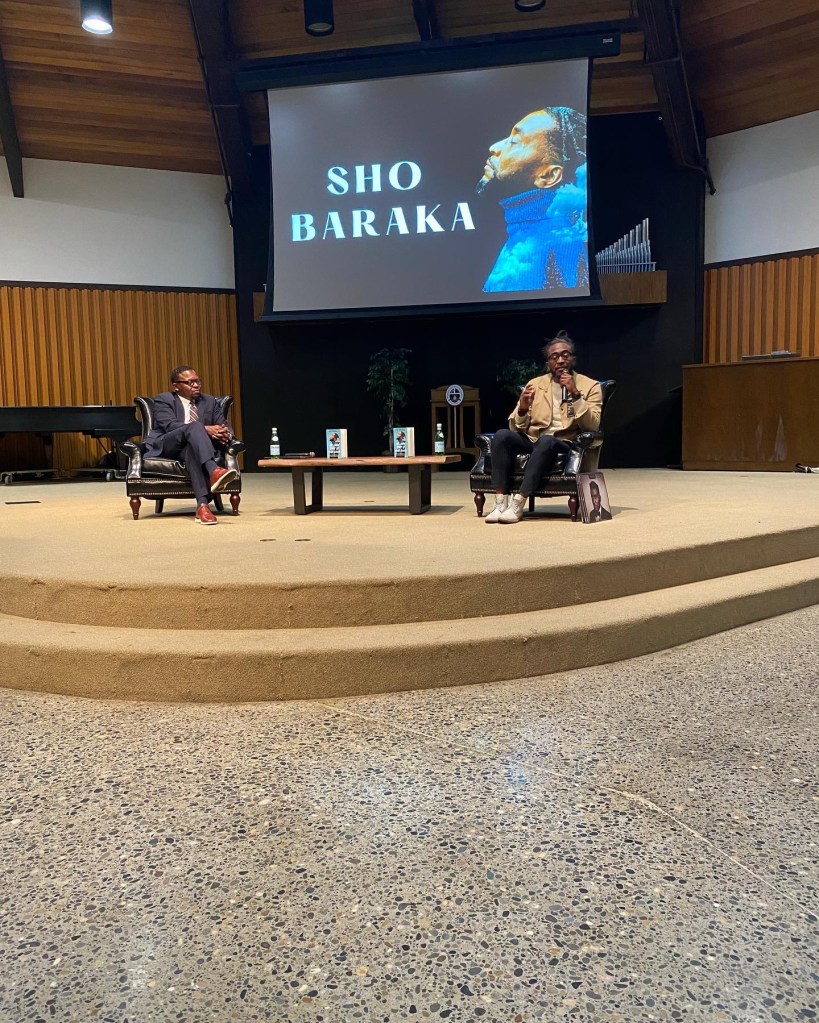
“At such a critical time for race relations in Portland and in our country, Sho’s philosophy and activism is timely as well as crucial,” noted Brian L. Johnson, PhD, president of Warner Pacific University. “I have been a fan of his since listening to his Talented 10th album. I was intrigued by an artist with the breadth and depth to wrestle with race, politics, religion, and faith in a musical and deeply meaningful way.”
An excerpt from Church of God recap of Convention 2021:
“The new (and eighth) president of Warner Pacific University, Brian Johnson, took to the podium to offer the grand finale message of Convention 2021. Though his disclaimer of not being a pastor by vocation suggested his discourse might feel out of place for such an event, the excellent teaching and dynamic preaching that followed proved otherwise. Referring to multiple stories and scriptures in both the Old and New Testaments, Dr. Brian L. Johnson utilized at least six key terms with alliterations—many pastors only get to three or four! (Christ, Calling, Courage, Character, Credentials, Competence.)
Stemming from Dr. Johnson’s experience in academia as a Christian, the all-too-common notion that scholarly pursuits are unnecessary if divine calling is present was thoroughly repudiated. Anointing is necessary, but Brian Johnson insisted that competence and mastery matters, as well. Noting that you don’t take your pet to a veterinarian who simply feels the calling but never got the degree, he emphasized that Christian higher education still has an important role in our society today—whether or not one’s vocational calling is that of a pastor. After all, “All priests were Levites, but not all Levites were priests,” he noted.
34th Street Business Improvement District Partnership Board of Directors and Staff Members at Reopening and Renovation of Greeley Square Restroom (Manhattan, NY)
Put Them Off
Put Them Off
1 Sam 17:39
39 And David girded his sword upon his armour, and he assayed to go; for he had not proved it. And David said unto Saul, I cannot go with these; for I have not proved them. And David put them off him.
KJV
Perhaps the surest way of failing to achieve one’s calling is by trying to employ the gifts of another. For while we each have our Goliaths to slay, let us not slay them with weapons that we are unfamiliar with. For whatever our calling, God has already granted the requisite gifts for it. Gifts are the unique materials that He has given to every man to do their part in building His complete testimony in earthly history. And when gifts are linked to careers and then are linked to callings, combined they will fulfill great purposes.
[For every good gift and every perfect gift is from above, and cometh down from the Father of lights, with whom is no variableness, neither shadow of turning.] KJV James 1:17
Brian Johnson, Ph.D.
Share this:
Leave a comment
Filed under Uncategorized
Tagged as logia biblical commentary