Category Archives: Uncategorized

Oregon Live: Warner Receives $3M

https://www.oregonlive.com/education/2023/10/warner-pacific-gets-3m-federal-grant-to-bolster-hispanic-student-services.html?outputType=amp

Leave a comment

Filed under Uncategorized

Warner Pacific University Announces Historic $3M Grant

We are so blessed to announce that WPU has been selected by the U.S. Department of Education to receive a landmark, five-year, $3 million grant under Title V “Developing Hispanic-Serving Institutions” Program. Announced during Hispanic Heritage Month, WPU is the first university in Oregon to receive this award! 🩵💚

Read more here: https://www.warnerpacific.edu/warner-pacific-university-receives-3-million-dollar-grant/

Leave a comment

Filed under Uncategorized

I REMEMBER ONE YOUNG MAN

I REMEMBER ONE YOUNG MAN

“I remember one young man in particular who graduated from Yale University and afterward took a post-graduate course at Harvard, and who began his career by delivering a series of lectures on “The Mistakes of Booker T. Washington.” It was not long, however, before he found that he could not live continuously on my mistakes. Then he discovered that in all his long schooling he had not fitted himself to perform any kind of useful and productive labour. After he had failed in several other directions he appealed to me, and I tried to find something for him to do. It is pretty hard, however, to help a young man who has started wrong.” – Booker T. Washington, (1911) My Larger Education

Presidential Commentary by Dr. Brian Johnson

Oliver Wendell Holmes, Sr. offers the following concerning men and women whose actions are similar to the young man described in Booker T. Washington’s aforementioned passage: “Controversy equalizes fools and wise men in the same way – and the fools know it.” And the founding principal and president of Tuskegee (Institute) University provides several important lessons about both the young man-as well as all men and women of his ilk-who seek to establish their name and reputation on the basis of disparaging the name and reputation of others-particularly those whose accomplishments they will only be brought in close proximity to only upon the basis of “controversy.” First, Mr. Washington never ever mentions this young man’s name. While this unidentified young man knew full well that persons might give him a hearing-not upon the basis of his own person and accomplishments-but based upon the person and accomplishments of his topic, “The Mistakes of Booker T. Washington,” identifying or responding to this young man provided not a single, solitary benefit to Mr. Washington and Tuskegee. Second, Mr. Washington understood that the young man’s premises were flawed from the onset, and it is the clearest telltale example of Mr. Washington’s oft-repeated phrase, “Let examples answer.” To be sure, the actions of no man or woman are all “good” or all “bad.” (This is naïve, simplistic and child-like thinking.) Yet, in the face of the clear, overwhelming and documentable evidence that testify to the good that Mr. Washington had done locally, regionally and nationally, this young man titled his lecture series according to what he perceived were the mistakes of Mr. Washington. Here again, what one consistently reads and hears, one will consistently become. And this young man ought to have taken heed to how and to what he was hearing for it ultimately led to what he had become. (For this young man’s attempt to categorize and confine a man of Booker T. Washington eminence and accomplishments to a series of perceived mistakes that his limited training, limited knowledge and limited life experience identified did nothing but demonstrate his failure to understand the significance of the (2) greatest 9-letter words and the single, most dangerous 9-letter word: 1. “Integrity” 2. “Knowledge” 3. “Ignorance;”) Finally, we should consider Mr. Washington’s demonstration of another one of his famous aphorisms: “I let no man drag me down so low as to make me hate him.” The very same young man who sought to disparage and defame Mr. Washington later sought him for assistance, and Mr. Washington “tried to find something for him to do.” (This dynamic needs no additional commentary.) Yet what is deserving of additional commentary is that this young man might have spent his time and work writing, lecturing and building his own legacy and life worth reading as opposed to seeking to denigrate another’s whose legacy and life of building Tuskegee (Institute) University spanned 34 years (1881-1915) and remains and is read to this very day.

Leave a comment

Filed under Uncategorized

A THOUSAND MILES AWAY

“[…] After the man was shot his son brought him to my house for help and advise, (and you can easily understand that the people in and about Tuskegee come to me for help and advice in all their troubles). I got out of bed and went out and explained to the man and his son that personally I would do anything I could for them but I could not take the wounded man into the school and endanger the lives of students entrusted to my care to the fury of some drunken white men. Neither did I for the same reason feel that it was the right thing to take him into my own house. For as much as I love the colored people in that section, I can not feel that I am in duty bound to shelter them in all their personal troubles any more than you would feel called to do the same thing in Washington. I explained my position fully to the man and his son, and they agreed with me as to the wisdom of my course. And I now state what I have not to any one before. I helped them to a place of safety and paid the money out of my own pocket for the comfort and treatment of the man while he was sick. Today I have no warmer friends than this man and his son. They have nothing but the warmest feelings of gratitude for me and are continually in one way or another expressing this feeling. I do not care to publish to the world what I do and should not mention this except for this false representation. I simply chose to help and relieve this man in my own way rather than in the way some man a thousand miles away would have had me do it.” – Booker T. Washington, “To Francis James Grimke,” November 27, 1895

Presidential Commentary by Dr. Brian Johnson

A man of Booker T. Washington’s eminence, position and stature was often criticized on a great many matters from persons who perhaps had his interest-or their own-at heart, but were wholly removed from the facts. Often in the case of leadership-particularly in the leadership of a vast organization such as Tuskegee Institute (University)-one must exercise tremendous restraint in responding to erroneous opinions, ill-informed recommendations or ill-advised suggestions. However, Mr. Washington’s response to what he perceived was a “false representation” of his character was another matter altogether.

During the difficult period of “Jim Crow,” many persons-white and black-held opinions about how the Tuskegee Principal should respond and react to racial atrocities as described in his letter to Grimke. In the present circumstance, Mr. Washington is responding to a letter from Grimke wherein the writer indicated that someone-“whose name [he had] forgotten”-relayed the circumstances of this event during a Bethel literary society meeting in Atlanta and that the founding Principal “refused to allow him to be brought in or the physician to attend him.” To Grimke’s credit, he went on to inform Mr. Washington that he felt it his “duty to apprise [him] of what was said.”

All the same, aside from Mr. Washington’s detailed correspondence communicating the circumstances aright to Mr. Grimke, he went on to provide additional facts concerning his activities that were intentionally not designed for public consumption or publication. It would be remiss to think or believe that Mr. Washington’s advocacy of industrial education or internal uplift and reform, was free from sympathetic interest to the political matters of his day.

Rather, Mr. Washington’s approach-as sound approaches often are-was marked by tact, sagacity and, most importantly, prudence. For Mr. Washington’s true audience was not political constituents who suggested what ought be done but the father and the son who were the beneficiaries of what needed to be done.

Leave a comment

Filed under Uncategorized

Dear Mrs. Rumbley

DEAR MRS. RUMBLEY:

“Mrs. Rumbley: When I made arrangements with you to return this year and take the present work, of course I did not mean that you would be retained in the position throughout the year regardless of the way you perform the service. When I said to you a few days ago that no change would be made to interfere with your plans it was on the supposition that you would do the work properly. When you returned from Mrs. Adams’ I had a conversation with you in which I told you plainly that the teachers department went more smoothly while you were away, because Miss Jones gave more personal attention to the work. You seemed to see the point and promised to make it go more smoothly. Since then you have not given the attention to the work that I thought you would. For example, you are almost never present to overlook and see to the preparation of breakfast…Your work needs to be systematized. This can be done by making a study of what will please the teachers. The teachers do not complain of the quality but it is the way the food is prepared. I still think that you can make a success of your work but in order to do this you must become interested. In order to make it a success I shall do all in my power to help you in any reasonable way. Yours.” – Booker T. Washington, [Tuskegee, Ala.] October 10th 1888

Presidential Commentary by Dr. Brian Johnson

In addition to his other more externally visible tasks of speaking, writing and advancing and developing the institution, Mr. Washington was also responsible for the internal management of personnel. And this rather lengthy excerpt taken from Mr. Washington’s correspondence to an employee at Tuskegee Institute, who served in the capacity as a cook, is an example of strong yet supportive management of personnel. First, he makes it plain that retention “in the position” was not “regardless of the way you perform the service,” and that the underlining premise of the employee’s appointment was “that you would do the work properly.” (Positions and appointments are rarely perpetual but are contingent upon performance.) Second, Mr. Washington had a direct and honest conversation regarding his assessment of the work. (He did not avoid being earnest with the employee for Mr. Washington was managing a major institutional enterprise comprised of many interchangeable functions. The function-not feelings-is of paramount importance in the successful management of an organization.) Third, he provided an example of what was not being done properly. (It was neither rumor, second-hand observation nor innuendo but a tangible and objective example that could be readily observed.) Fourth, he provided a recommendation to the employee. He recommends that the work should be “systematized” and that a “study” of the employee’s constituents-namely the teachers-would reveal a possible way for solving the problem. (It is important for managers to not simply point to the problem but to provide a solution as well. And what better recommendation than to go to the constituency group who roundly described the services performed as a problem.) Lastly, he provides a final word of encouragement and a willingness to provide additional help. (Though the very best leaders do not avoid tough conversations about performance, it is imperative to provide a sense of hope, help and encouragement to employees who instead of retreating may actually re-double their efforts to set the matter aright.) In the end, Mr. Washington’s correspondence provides an insight into leadership that is rarely seen because of its sensitive nature but is absolutely necessary for managing an outcomes oriented organization in the 19th, 20th or 21st Century.

Leave a comment

Filed under Uncategorized

It Was Not Luck. It Was Hard Work.

“Some people may say that it was Tuskegee’s good luck that brought to us this gift of fifty thousand dollars. No, it was not luck. It was hard work. Nothing ever comes to me, that is worth having, except as a result of hard work. When Mr. Huntington gave me the first two dollars, I did not blame him for not giving me more, but made up my mind that I was going to convince him by tangible results that we were worthy of large gifts. For a dozen years I made a strong effort to convince Mr. Huntington of the value of our work. I noted that just in proportion as the usefulness of the school grew, his donations increased.” – Booker T. Washington, My Larger Education (1911)

Presidential Commentary by Dr. Brian Johnson

Nothing is more disturbing to hear about individual or organizational success-especially if you have contributed to such success-than that such success should be attributed to “luck” and not “hard work”. Hard work involves deliberate and persistent effort directed towards a designated end that is often easy to gloss over when witnessing the outcome and not the work preceding it. And such was Mr. Washington’s work in the advancement and development efforts of Tuskegee Institute (University). Here was a man who did not scoff at any amount received into the coffers of Tuskegee whether great or small. Without regard to the amount, he “made up [his] mind” to be resolute about his pursuit for even larger ones with his chief aid being “tangible results.” Or, as he wrote elsewhere, “Let[ting] Examples Answer.” For when an organization’s “examples answer,” it becomes easier to proceed from strength to strength because past successes are often the surest indicators of future successes.

Leave a comment

Filed under Uncategorized

Sacred Callings: In Civic and Secular Marketplace

Bill Winston Ministries Joseph Business School’s inaugural quarterly magazine with an article titled: “Sacred Callings Can Have Big Impact in Civic and Secular Marketplace”

https://fliphtml5.com/qubm/tcyk?fbclid=IwAR0X1k3EUVnphB18gd1jRcO3BfgjKxP5wg87IY7Gea_QjVNS5uo6CO52rwk_aem_AZMexD-eD6Ah9hdDoEToM4DwqTqVhRS8bCEumT0Xv5lt4cp02C_O-AdF-hB5iBNU0jU&mibextid=Zxz2cZ

Leave a comment

Filed under Uncategorized

“Called Out of and Into”-Student Chapel Warner Pacific University 9/5/2023

Leave a comment

Filed under Uncategorized

“Time for Rebirth at Warner Pacific with Dr. Brian Johnson- 8/29/2023-The Awakening- Episode 11

“Time for Rebirth at Warner Pacific with Dr. Brian Johnson- 8/29/2023-The Awakening- Episode 11


https://youtu.be/ZqZS4AQxGmQ

Leave a comment

Filed under Uncategorized

Fall 2023 Opening Convocation Address to Community: “Why the Bush is Not Burnt?” Exodus 3:1-5

Leave a comment

Filed under Uncategorized

UPRIGHT CHARACTER

“We can fill your heads with knowledge, and we can train your hands to work with skill, but unless all this training of head and hand is based upon high, upright character, upon a true heart, it will amount to nothing. You will be no better off than the most ignorant.”-Booker T. Washington, A Sunday Evening Talk

Presidential Commentary by Dr. Brian Johnson

In this writer’s opinion, “integrity” is the greatest 9-letter word, “knowledge” is the second greatest, and “ignorance” is-by far-the worst and most dangerous. And the founding principal and president of Tuskegee (Institute) University, Booker T. Washington, gives on this Sunday evening talk his oft-repeated conception of “heart-head-hands” to help his students avoid the dread of becoming “no better off than the most ignorant.” One can easily seek the help of professors to develop one’s “head”. (These men and women have as their primary purpose to fill the “heads” of students with “knowledge”.) Likewise, professors are able to help make a student’s “hands”-or their work-“skill”[ful]. (Through repeated instruction and correction a student will either become skillful at their work or they will receive failing grades.) Yet, the matter of the “heart,” Mr. Washington suggests, is one matter where students must begin and complete this work largely alone. (Let no man or woman ever presume to become an expert on the subject of another’s heart.) Of all subject matters, it is the one that is deeply personal and unique to the individual. Whereas both the competencies of the “head” and the credentials of the “hands” lie in full view, the “heart” is always hidden from view. Yet, without it, all else “will amount to nothing.” For Mr. Washington’s complete configuration of Heart-Head-Hands in education is akin to the strength necessary to shoot arrows a great distance even as [the] University has shot forth [its] sons and daughters…into rewarding and meaningful careers of service for over 133 years. The heart is the unseen and invisible strength that determines how far one can bend the bow to make the arrow go.

Leave a comment

Filed under Uncategorized

August President Message -Warner Pacific University

https://www.warnerpacific.edu/august-presidents-message/

Leave a comment

Filed under Uncategorized

YOU CANNOT HOPE TO SUCCEED IF YOU KEEP BAD COMPANY

“You cannot hope to succeed if you keep bad company. As far as possible try to form the habit of spending your nights at home.” – Booker T. Washington, “A Sunday Evening Talk: On Influencing by Example”

Presidential Commentary by Dr. Brian Johnson

The adage that one is known by the company he or she keeps is an oft-expressed one, but the founding principal and president of Tuskegee University, Booker T. Washington, extends the adage even further both in the aforementioned passage and in another commonly quoted passage: “Associate yourself with people of good quality. It is better to be alone than in bad company.” Moreover, his additional suggestion to “try to form the habit of spending your nights at home” is a very practical one worth noting. Insofar as it is possible to discern from his autobiography, correspondence, letters, speeches-and more importantly his accomplishments-the man, Booker Washington, apparently did little else but read, write, work and stay at home with his family. And while it is easy to regard Tuskegee (Institute) University’s founding principal with an overwhelming sense of awe, one can begin to appreciate and understand him in view of his own self-discipline and self-sacrifice. (Everyone suffers but few suffer voluntarily. Yet, if one learns how to suffer, one will learn how to succeed.) One need not be reminded that everyone has the same 24 hours in a day, but how one spends those hours is what ultimately distinguishes men and women. (One would simply be amazed at how much more time can be committed to a meaningful mission or a purposeful project if time is not spent in (un)meaningful and (un)purposeful ones that do not result in progress.) Clearly, recreation, fun and leisure have their place but not if these things come at the expense of sustainable success. (Mr. Washington suggests that it is even better when one’s recreation, fun and leisure become part and parcel of one’s work.) For when an individual can transform his or her home into an extension of their workshop, they have the benefit of continuing, doubling and multiplying their labors when others have ceased from theirs.

1 Comment

Filed under Uncategorized

ROOMS THAT YOU DO NOT LIKE

ROOMS THAT YOU DO NOT LIKE

“You are going to get rooms that you do not like. They will not be, perhaps, as attractive as your desire, or they will be too crowded. You are going to be given persons for roommates with whom you think it is going to be impossible to get along pleasantly, people who are not congenial to you. During the hot months your rooms are going to be too hot, and during the cold months they are going to be too cold. You are going to meet with all these difficulties in your rooms. Make up your mind that you are going to conquer them. I have often said that the students who in the early years of this school had such hard times with their rooms have succeeded grandly. Many of you now live in palaces, compared to the rooms, which those students had. I am sure that the students who attend this school find that the institution is better fitted every year to take care of them than it was the year previous.” “A Sunday Evening Talk: Some Rocks Ahead,” Booker T. Washington

Presidential Commentary by Dr. Brian Johnson

Among the many priorities Mr. Washington had in relationship to his duties as president of Tuskegee Institute (University), fostering a relationship with his students was high among these. The Sunday evening talks were designed for students to engage the founding principal and president in less formal ways than at official gatherings such as convocations, commencements and formal student body association meetings. Moreover, he used these times to try to instill in them something of the “Tuskegee spirit.” Yet, try as one might-and in spite of the many positive aspects of the institution that are hardly ever touted-there are always areas of on-going concern for students, or “some…rocks ahead” for students within a university living-learning environment. Here, Mr. Washington addresses one of these: residential living. To be sure, this address was for Tuskegee Institute (University) students in the 19th century as opposed to the 21st century. (And it is clear that the 21st century institution has a fiscal duty to ensure the best facilities available to its students.) Notwithstanding, there are simply some matters in residential living that are common to all persons living within a university environment that are entirely unavoidable, and a student must simply “conquer them.” First, the room may not be as “attractive as you desire.” The living-learning environment is by no means the culmination of one’s career. It is a stop en route to a glorious career path that has as its ultimate destination a home purchase consistent with one’s desires and affordability. (This is often dependent upon your academic success as a student.) Second, “roommates” may not be “congenial.” Everyone recalls meeting strangers for the first time and though the initial meeting was uncomfortable, these strangers became life-long friends. (Many of our best, life-long friends are cultivated in the college and university living-learning environment, and had we not endured, we would have missed a valuable relationship that might be instrumental in our future successes.) Third, heating and air challenges are often the case even with respect to one roommate preferring it cold while the other hot. (Universities do their very best to address these situations upon proper reporting to the designated resident advisor, residential hall director, facilities director and Vice President for Student Affairs. It is not the university president who one contacts for these matters until the lines of authority are exhausted.) Lastly, a balanced perspective recognizes that “many of you now live in palaces, compared to the rooms which [previous generations of] students had” and for most universities, “the students who attend this school find that the institution is better fitted every year to take care of them than it was the year previous.” While the “struggle” of residential living within a university environment is oft-times a real and verifiable one, students would do well to remember the following adage: “Obstacles are what you see when you take your eyes off the goal.” And the goal is the successful completion of a baccalaureate or post-baccalaureate degree.

Leave a comment

Filed under Uncategorized

Fulfilled and Fruitful at Fifty: Warner Pacific July President Message

Leave a comment

Filed under Uncategorized

I USED TO PICTURE THE WAY

I USED TO PICTURE THE WAY

“I used to picture the way that I would act under such circumstances; how I would begin at the bottom and keep rising until I reached the highest round of success.” – Booker T. Washington, Up From Slavery (1901)

Presidential Commentary by Dr. Brian Johnson

Robert Hedrick’s translation of Xenophon’s Cyrus The Great: The Arts of Leadership and War captures a rather profound and startling idea about the power of both the mind and imagination in one’s youth. This is particularly evidenced in Mr. Washington’s autobiographical telling of the time spent in his youth thinking of his future. Hedrick translates Cyrus as follows: “I created an empire in my thoughts long before I began to win an empire in reality.” The founding principal and president of Tuskegee (Institute) University, Booker T. Washington, tells of not having many flesh-and-blood examples of “success” due to both his poverty and enslavement. Yet, while his “hands” might have been bound, his “heart” and his “head” were certainly not. Though he might have seen but dimly into what his future held, he “used to picture the way [he] would act under such circumstances.” (Note, one can hardly go where one cannot see one’s self beforehand going. And one can hardly do what one cannot see one’s self beforehand doing.) “Vision” is the greatest 6-letter word, and “leader” is the second greatest 6-letter word in this writer’s opinion. And Mr. Washington possessed “vision” enough for himself-without regard to what others might have seen-to see himself as a “leader,” which he later realized for some 34 years at the helm of Tuskegee (Institute) University.

Leave a comment

Filed under Uncategorized

NO INFLUENCE WOULD EVER MAKE ME A SLAVE IN SOUL

NO INFLUENCE WOULD EVER MAKE ME A SLAVE IN SOUL

“I have been a slave once in my life-a slave in body. But I long since resolved that no inducement and no influence would ever make me a slave in soul, in my love for humanity, and in my search for truth.” – Booker T. Washington, (1907) The Negro in the South

Presidential Commentary by Dr. Brian Johnson

In a little-known, yet most noteworthy moment in the history of both American and African American literary and intellectual history, Booker T. Washington jointly published the book, The Negro In the South (1907) containing 2 essays from himself and 2 other essays from none other than W.E.B. Du Bois. (And this was not their first co-publication. This would be the second book containing these two stalwarts in American and African American educational and intellectual history.) All the same, in the first of Mr. Washington’s two essays, he makes the distinction between being a “slave in body” versus being a “slave in soul.” Note the following concerning the remarks of the founding principal and president of Tuskegee (Institute) University: He made a strategic, calculated set of decisions to ensure that his outward circumstance would not determine his future circumstances. (And these decisions revolved around a “love for humanity” and a “search for truth”, which will always place the “lover” and “seeker” of such beyond the pale of those whose pursuits are self-interested and selfish.) First, a lover of humanity is unafraid to come to learn to love others because he or she has first come to love himself. One can hardly come to learn others if one does not possess a deep love for one’s self, and this includes learning to love both the learned and the ignorant. For a man or woman who ascended to leadership, as Mr. Washington had done, not only encountered both but had been both during his long ascent Up From Slavery. Second, the seeker of truth seeks after that which is right without regard to where this truth leads. Leo Tolstoy eloquently suggests the following about such a principle: “If you wish to know the truth, first of all free yourself from all considerations of self-interest.” Whether the truth Mr. Washington discovered was for the benefit or detriment to himself or not-“integrity” is the single greatest 9-letter word-this pursuit is without question what leads to 34 years of ongoing, consistent and enduring success for Tuskegee (Institute) University. For unbroken, undivided and unwavering consistency and wholeness is perhaps the closest description of both “truth” and Mr. Washington’s presidency that has served and will continue to serve generations of “humanity.” And this is why we celebrate his accomplishments in this the centennial year of his passing (1915-2015).

Leave a comment

Filed under Uncategorized

BORN A SLAVE

“As I have said before, I do not regret that I was born a slave. I am not sorry that I found myself part of a problem; on the contrary, that problem has given direction and meaning to my life that has brought me friendships and comforts that I could have gotten in no other way.” -Booker T. Washington, “My Larger Education,” (1911)

Presidential Commentary by Dr. Brian Johnson

Booker T. Washington had more reason than most to decry the circumstances of his upbringing. (For he was born enslaved.) Yet, Mr. Washington’s reference to himself as “part of a problem” was not owing to any intrinsic qualities of his own person. Rather, it was akin to W.E.B. Du Bois’s expression: “The problem of the twentieth century is the problem of the color-line.” All the same, the fact that Mr. Washington was born into such a difficult period did not ultimately deter his ambitions; Instead, it fueled them. And this is clearly one of the most singularly important lessons of Mr. Washington’s life and career-long work at Tuskegee Institute (University) evidenced in his most quoted aphorism: “Success is to be measured not so much by the position that one has reached in life as by the obstacles which he has overcome.” For the satisfaction gained in spending one’s life transforming seemingly insurmountable obstacles into long-standing triumph and achievement is, after all, the definition of an overcomer.

Brian L. Johnson, Ph.D.

Leave a comment

Filed under Uncategorized

‘He is Responsible’: “Individual Responsibility: A Sunday Evening Talk,”- Booker T. Washington

“We frequently hear the word ‘lucky’ used with reference to a man’s life. Two boys start out in the world at the same time, having the same amount of education. When twenty years have passed, we find one of them wealthy and independent; we find him a successful professional man with an assured reputation, or perhaps at the head of a large commercial establishment employing many men, or perhaps a farmer owning and cultivating hundreds of acres of land. We find the second boy, grown now to be a man, working for perhaps a dollar or a dollar and a half a day, and living from hand to mouth in a rented house. When we remember that the boys started out in life equal-handed, we may be tempted to remark that the first boy has been fortunate, that fortune has smiled on him; and that the second has been unfortunate. There is no such nonsense as that. When the first boy saw a thing that he knew he ought to do, he did it; and he kept rising from one position to another until he became independent. The second boy was an eye-servant who was afraid that he would do more than he was paid to do-he was afraid that he would give fifty cents’ worth of labour for twenty-five cents […]The first boy did a dollar’s worth of work for fifty cents. He was always ready to be at the store before time; and then, when the bell rang to stop work, he would go to his employer and ask him if there was not something more that ought to be done that night before he went home. It was this quality in the first boy that made him valuable and caused him to rise. Why should we call him ‘fortunate’ or ‘lucky’? I think it would be much more suitable to say of him: ‘He is responsible.” – “Individual Responsibility: A Sunday Evening Talk,”- Booker T. Washington

At the onset of receiving an entering incoming freshmen class into a university, one becomes awed and buoyed by the extraordinary sense of possibility that each student has in his or her future. Whether they were 4.0 student or a 2.8 students in high school, the beginning of freshman year matriculation is a unique opportunity in their lives to start anew and afresh. And Mr. Washington, founding principal and president of Tuskegee Institute (University), provides an example of two young boys who possessed the same opportunities, but had very different outcomes 20 years later.

It is all too easy to pass off Mr. Washington’s telling as some moralizing tale designed to motivate his students during one of his Sunday evening talks. Yet, we must be inclined to think that either Mr. Washington himself experienced this so-called tale directly-his autobiographical narrative Up from Slavery (1901) suggests as much-or he observed this in the lives of two of his students in his 34-year long tenure at the helm of Tuskegee University. Washington’s telling of such a tale might also raise the ire and suspicion of those who might argue the following: “It is roundly unfair for Mr. Washington to ascribe lacking personal responsibility to the woes of the second boy’s life because he doesn’t know what happened to him.”

Notwithstanding any such dismissals, what Mr. Washington seeks to convey in this talk was the sense of a very real distinction between two young men who approached life matters-whether in the classroom or beyond-quite differently. The first young man was likely accused of being too punctual, too exact or just plain too serious. He often heard the now common proverbial expression: “It doesn’t take all of that.” And in spite of all attempts to justify the many failures of the second boy, all such attempts are undergirded with a profound sense of irony. (The very individuals who defend or make excuse for the second lad will also not hire him nor give him any responsibility regarding that, which is their own.)

Wholly consistent with his reputation for being frank, honest and giving ‘straight talk,” Mr. Washington would not allow any such misgivings about his impressions of the success-or relative lack thereof-of the two boys described here. For Mr. Washington believed that “it does take all of that” to reach any desirable outcome, and one will be subject to the envy and criticism of others while doing it. Yet, enduring the sort of suffering experienced by the first boy is far better than experiencing the suffering of the second. We all experience one form of suffering or another, and if one learns how to suffer-to truly know how to suffer well in the thing that is good-one will learn how to succeed.

1 Comment

Filed under Uncategorized

Warner Pacific University Spring 2023 Commencement

https://m.youtube.com/live/weYc33VcJ6s?feature=share

1 Comment

Filed under Uncategorized

The True History of the Race

“We have reached a period when educated Negroes should give more attention to the history of their race; should devote more time to finding out the true history of the race, and in collecting in some museum the relics that mark its progress. It is true of all races of culture and refinement and civilisation that they have gathered in some place the relics which mark the progress of their civilisation, which show how they lived from period to period. We should have so much pride that we would spend more time in looking into the history of the race, more effort and money in perpetuating in some durable form its achievements, so that from year to year, instead of looking back with regret, we can point to our children the rough path through which we grew strong and great.” – Booker T. Washington, (1899) Future of the American Negro

Presidential Commentary by Dr. Brian Johnson

John Lukacs suggests the following about the potential of the past coming to bear upon the future: “I saw the future and it was the past.” And Booker T. Washington, founding principal and president of Tuskegee (Institute) University offers a similar advisement in his little-known work, The Future of the American Negro published in 1899. Now, the mere assembling of the “relics” of any people group’s history alone is not a sole predictor of its future. For it greatly depends upon what is being assembled as one paraphrased African proverb offers: “The hunter will always be the hero until the lion has his own historian.” And Mr. Washington recommends the assembling of those “relics [in particular], which mark the progress of their civilization” and “achievements” placed “in some durable form.” (Here again, what one consistently reads, one will consistently become.) If one consistently reads a narrative or documentable history of a people characterized by its clear and documentable successes as opposed to failures documented for varying purposes, such histories will serve to shape not only the psyche of a single people group but also the psyche of all people groups who have a special relationship or closeness to this same group. Such is the history of Tuskegee (Institute) University, where reading the narratives of the men and women (including students, supporters, community members, faculty, staff and administrators) provide a documentable, inspiring and motivating “tradition” (past) that can translate into a documentable, inspiring and motivating “trajectory” (future).

Leave a comment

Filed under Uncategorized

I USED TO PICTURE

I USED TO PICTURE

“I used to picture the way that I would act under such circumstances; how I would begin at the bottom and keep rising until I reached the highest round of success.”- Booker T. Washington, _Up From Slavery_ (1901)

Presidential Commentary by Dr. Brian Johnson

Robert Hedrick’s translation of Xenophon’s _Cyrus The Great: The Arts of Leadership and War_ captures a rather profound and startling idea about the power of both the mind and imagination in one’s youth. This is particularly evidenced in Mr. Washington’s autobiographical telling of the time spent in his youth thinking of his future. Says CYRUS: “I created an empire in my thoughts long before I began to win an empire in reality.” The founding principal and president of Tuskegee (Institute) University, Booker T. Washington, tells of not having many flesh-and-blood examples of “success” due to both his poverty and enslavement. Yet, while his “hands” might have been bound, his “heart” and his “head” were certainly not. Though he might have seen but dimly into what his future held, he “used to picture the way [he] would act under such circumstances.” (Note, one can hardly go where one cannot see one’s self beforehand going. And one can hardly do what one cannot see one’s self beforehand doing.) “Vision” is the greatest 6-letter word, and “leader” is the second greatest 6-letter word in this writer’s opinion. And Mr. Washington possessed “vision” enough for himself-without regard to what others might have seen-to see himself as a “leader,” which he later realized for some 34 years at the helm of Tuskegee (Institute) University.

2 Comments

Filed under Uncategorized

Deep Down in His Heart

“I believe that one always does himself and his audience an injustice when he speaks merely for the sake of speaking. I do not believe that one should speak unless, deep down in his heart, he feels convinced that he has a message to deliver.” – Booker T. Washington _Up from Slavery_ (1901)

Presidential Commentary by Dr. Brian Johnson 

It is a wise and prudent man or woman indeed who does not readily accept-or seek-any and every invitation to speak. Although such restraint is uncommon, Mr. Washington’s recommendation is one that would serve us well to follow. For the best speakers-whether teacher, professor, lecturer or any number of itinerant persons-are those whose words proceed from the works that support them. Mr. Washington was known locally, regionally, nationally and globally for his oratorical prowess and was largely regarded as such for the work he was doing at Tuskegee University. And this work was no mere job for the founding Principal and President of Tuskegee University, but his life’s purpose “deep down in his heart.” When he spoke, men and women could feel the force of someone who was not pretentious but purposeful. And he was able to do so because he spoke concerning those things he was doing or had done. He did not theorize about how to lead an institution. He led one. He did not simply ask of those within his charge to persevere, endure and overcome. He himself had done these things. He did not simply speak about the “race problem” affecting newly freed and formerly enslaved men and women but was engaged in a work to solve this problem in a manner consistent with his beliefs. And all of these things were visible, tangible and remain so nearly 100 years since his passing (1915-2015). Audiences know immediately whether one has done or is doing the things that he or she speaks which is why one should never offer words without accompanying works.

Leave a comment

Filed under Uncategorized

“Christ-Centered Courage and Calling: Character, Credentials and Competence”

“Christ-Centered Courage and Calling: Character, Credentials and Competence”

2 Comments

Filed under Uncategorized

THE MISTAKES OF BOOKER T. WASHINGTON

THE MISTAKES OF BOOKER T. WASHINGTON

“I remember one young man in particular who graduated from Yale University and afterward took a post-graduate course at Harvard, and who began his career by delivering a series of lectures on “The Mistakes of Booker T. Washington.” It was not long, however, before he found that he could not live continuously on my mistakes. Then he discovered that in all his long schooling he had not fitted himself to perform any kind of useful and productive labour. After he had failed in several other directions he appealed to me, and I tried to find something for him to do. It is pretty hard, however, to help a young man who has started wrong.” – Booker T. Washington, (1911) My Larger Education

Presidential Commentary by Dr. Brian Johnson

Oliver Wendell Holmes, Sr. offers the following concerning men and women whose actions are similar to the young man described in Booker T. Washington’s aforementioned passage: “Controversy equalizes fools and wise men in the same way – and the fools know it.” And the founding principal and president of Tuskegee (Institute) University provides several important lessons about both the young man-as well as all men and women of his ilk-who seek to establish their name and reputation on the basis of disparaging the name and reputation of others-particularly those whose accomplishments they will only be brought in close proximity to only upon the basis of “controversy.” First, Mr. Washington never ever mentions this young man’s name. While this unidentified young man knew full well that persons might give him a hearing-not upon the basis of his own person and accomplishments-but based upon the person and accomplishments of his topic, “The Mistakes of Booker T. Washington,” identifying or responding to this young man provided not a single, solitary benefit to Mr. Washington and Tuskegee. Second, Mr. Washington understood that the young man’s premises were flawed from the onset, and it is the clearest telltale example of Mr. Washington’s oft-repeated phrase, “Let examples answer.” To be sure, the actions of no man or woman are all “good” or all “bad.” (This is naïve, simplistic and child-like thinking.) Yet, in the face of the clear, overwhelming and documentable evidence that testify to the good that Mr. Washington had done locally, regionally and nationally, this young man titled his lecture series according to what he perceived were the mistakes of Mr. Washington. Here again, what one consistently reads and hears, one will consistently become. And this young man ought to have taken heed to how and to what he was hearing for it ultimately led to what he had become. (For this young man’s attempt to categorize and confine a man of Booker T. Washington eminence and accomplishments to a series of perceived mistakes that his limited training, limited knowledge and limited life experience identified did nothing but demonstrate his failure to understand the significance of the (2) greatest 9-letter words and the single, most dangerous 9-letter word: 1. “Integrity” 2. “Knowledge” 3. “Ignorance;”) Finally, we should consider Mr. Washington’s demonstration of another one of his famous aphorisms: “I let no man drag me down so low as to make me hate him.” The very same young man who sought to disparage and defame Mr. Washington later sought him for assistance, and Mr. Washington “tried to find something for him to do.” (This dynamic needs no additional commentary.) Yet what is deserving of additional commentary is that this young man might have spent his time and work writing, lecturing and building his own legacy and life worth reading as opposed to seeking to denigrate another’s whose legacy and life of building Tuskegee (Institute) University spanned 34 years (1881-1915) and remains and is read to this very day.

Leave a comment

Filed under Uncategorized

THE LIVES OF MEN

After I got so that I could read a little, I used to take a great deal of satisfaction in the lives of men who had risen by their own efforts from poverty to success. It is a great thing for a boy to be able to read books of that kind. It not only inspires him with the desire to do something and make something of his life, but it teaches him that success depends upon his ability to do something useful, to perform some kind of service that the world wants.” – Booker T. Washington, My Larger Education (1901)

Presidential Commentary by Dr. Brian Johnson 

The great scholar, literary critic and ‘Narnia’ chronicler, C. S. Lewis, remarks about the value of books upon a young boy or girl’s imagination: “Since it is so likely that (children) will meet cruel enemies, let them at least have heard of brave knights and heroic courage. Otherwise you are making their destiny not brighter but darker.” Here again, what one consistently reads, one consistently becomes; Just imagine what one might become when one reads about the lives of great men and women from the time of one’s youth even into one’s mature years. This is what the founding principal and president of Tuskegee (Institute) University recommends, and it is a recommendation that we would do well to not only just follow, but continuously follow. First, the world needs verifiable, authentic and organic heroes, not simply scripted and fictional ones. Men and women whose lives are grounded in believable and relatable life experiences that one can readily identify with provides great grounds for hope for those who have similar experiences. Second, one can learn from the mistakes made in the lived lives of others. It is simply not true that one must repeat the mistakes of others. (Instead, you read and learn from them.) The triumphant records of men and women that also record both their foibles and follies are useful for persons of any century to learn, discern and comprehend that what happened before may very well occur again. Third, the lived lives of men and women who are no longer amongst us are permanent, indelible and fixed records that will remain ever unchanged. (One may repeatedly interpret and re-interpret their deeds done but there will be no adding or taking away from them.) And this final thought is one that certainly motivated men and women of the class of Booker T. Washington and should motivate us as well. For Booker T. Washington knew that one has but one life to live, and there would be no do over. When future chroniclers composed the narrative of his life, he wanted to be certain that it contributed to making someone else’s “destiny brighter” not “darker.” The founding principal and president of Tuskegee (Institute) University did not simply write correspondence, books and speeches worth reading; he lived a life worth reading not only in his generation but also in the many future generations to come.

Leave a comment

Filed under Uncategorized

HEART-HEAD-HANDS

“We can fill your heads with knowledge, and we can train your hands to work with skill, but unless all this training of head and hand is based upon high, upright character, upon a true heart, it will amount to nothing. You will be no better off than the most ignorant.” – Booker T. Washington, A Sunday Evening Talk

Presidential Commentary by Dr. Brian Johnson

In this writer’s opinion, “integrity” is the greatest 9-letter word, “knowledge” is the second greatest, and “ignorance” is-by far-the worst and most dangerous. And the founding principal and president of Tuskegee (Institute) University, Booker T. Washington, gives on this Sunday evening talk his oft-repeated conception of “heart-head-hands” to help his students avoid the dread of becoming “no better off than the most ignorant.” One can easily seek the help of professors to develop one’s “head”. (These men and women have as their primary purpose to fill the “heads” of students with “knowledge”.) Likewise, professors are able to help make a student’s “hands”-or their work-“skill”[ful]. (Through repeated instruction and correction a student will either become skillful at their work orthey will receive failing grades.) Yet, the matter of the “heart,” Mr. Washington suggests, is one matter where students must begin and complete this work largely alone. (Let no man or woman ever presume to become an expert on the subject of another’s heart.) Of all subject matters, it is the one that is deeply personal and unique to the individual. Whereas both the competencies of the “head” and the credentials of the “hands” lie in full view, the “heart” is always hidden from view. Yet, without it, all else “will amount to nothing.” For Mr. Washington’s complete configuration of Heart-Head-Hands in education is akin to the strength necessary to shoot arrows a great distance even as Tuskegee University has shot forth the sons and daughters of Booker into rewarding and meaningful careers of service for over 133 years. The heart is the unseen and invisible strength that determines how far one can bend the bow to make the arrow go.

Leave a comment

Filed under Uncategorized

“A History of (not only) Suffering-but the Overcoming of the Suffering”(A.M.E. Zion Church-Vancouver,WA) Black History Month Service:

A.M.E. Zion Church’s Black History Service this morning in Vancouver, Washington with Reverend Joyce Smith. President Johnson shared the following: “A History of (not only) Suffering-but the Overcoming of the Suffering” 👏🏾🙌🏾

Leave a comment

Filed under Uncategorized

Spending Your Nights at Home

“You cannot hope to succeed if you keep bad company. As far as possible try to form the habit of spending your nights at home.” – Booker T. Washington, “A Sunday Evening Talk: On Influencing by Example”

Presidential Commentary by Dr. Brian Johnson

The adage that one is known by the company he or she keeps is an oft-expressed one, but the founding principal and president of Tuskegee University, Booker T. Washington, extends the adage even further both in the aforementioned passage and in another commonly quoted passage: “Associate yourself with people of good quality. It is better to be alone than in bad company.” Moreover, his additional suggestion to “try to form the habit of spending your nights at home” is a very practical one worth noting. Insofar as it is possible to discern from his autobiography, correspondence, letters, speeches-and more importantly his accomplishments-the man, Booker Washington, apparently did little else but read, write, work and stay at home with his family. And while it is easy to regard Tuskegee (Institute) University’s founding principal with an overwhelming sense of awe, one can begin to appreciate and understand him in view of his own self-discipline and self-sacrifice. (Everyone suffers but few suffer voluntarily. Yet, if one learns how to suffer, one will learn how to succeed.) One need not be reminded that everyone has the same 24 hours in a day, but how one spends those hours is what ultimately distinguishes men and women. (One would simply be amazed at how much more time can be committed to a meaningful mission or a purposeful project if time is not spent in (un)meaningful and (un)purposeful ones that do not result in progress.) Clearly, recreation, fun and leisure have their place but not if these things come at the expense of sustainable success. (Mr. Washington suggests that it is even better when one’s recreation, fun and leisure become part and parcel of one’s work.) For when an individual can transform his or her home into an extension of their workshop, they have the benefit of continuing, doubling and multiplying their labors when others have ceased from theirs.

Leave a comment

Filed under Uncategorized

The Dinner between Booker T. Washington and W.E.B. Du Bois

“[To William Edward Burghardt Du Bois] Mr. Booker T. Washington will be pleased to have you take dinner with him at his home, “The Oaks,” at 6:30 o’clock this evening.” – Booker T. Washington, Tuskegee, July 6, 1903

Presidential Commentary by Dr. Brian Johnson

There are a handful of historic dinner-time conversations that the writer of this commentary would ever wish to be transported back in time to listen in upon. And this one between the eminent and distinguished founding principal and president of Tuskegee (Institute) University, Booker T. Washington, and the eminent and distinguished, William Edward Burghardt Du Bois ranks near the very top.

For in 1903, these two men were, arguably, at the very zenith of their spiritual (heart), intellectual (head) and physical (hands) strength. W.E.B. DuBois would have published his signal work, The Souls of Black Folk in this same year, 1903, and Booker T. Washington would only be two years removed from publishing Up From Slavery in 1901. In a little-known, yet most noteworthy moment in the history of both American and African American literary history, they jointly published the book, The Negro In the South (1907) containing 2 essays from himself and 2 other essays from none other than this W.E.B. Du Bois who apparently was teaching a summer course in Tuskegee in 1903. (And this was not their first co-publication. This would be the second book containing these two stalwarts in American and African American educational and intellectual history.)

All the same, one can only imagine the earnestness, frankness and thoughtfulness of their discourse on that evening. (“Depth” and “breadth” is the greatest 5 and 7-letter word combination, and this conversation would have certainly fit this description-completely opposite of a conversation that is flat, flippant and frivolous.) One would be deeply mistaken to assume their ideological differences were so deep-seated that these two men could not come together for dinner and discussion.

One would hardly ever invite someone to dinner who he or she disdains and distrusts. One would not invite them into the confines of one’s home, particularly into one as auspicious as “The Oaks,” and amongst one’s family. These men likely expressed their differences with one another, but they assuredly did so honorably and respectfully in the presence of each other. In the end, one might never learn what the conversation was about.

Yet, the singular invitation to invite one who has commonly been regarded as his chief adversary-possessing equal ability, stature and renown-speaks to the magnanimity of Tuskegee’s Booker T. Washington, who demonstrated one of his oft-quoted maxims: “I let no man drag me down so low as to make me hate him.”

Leave a comment

Filed under Uncategorized

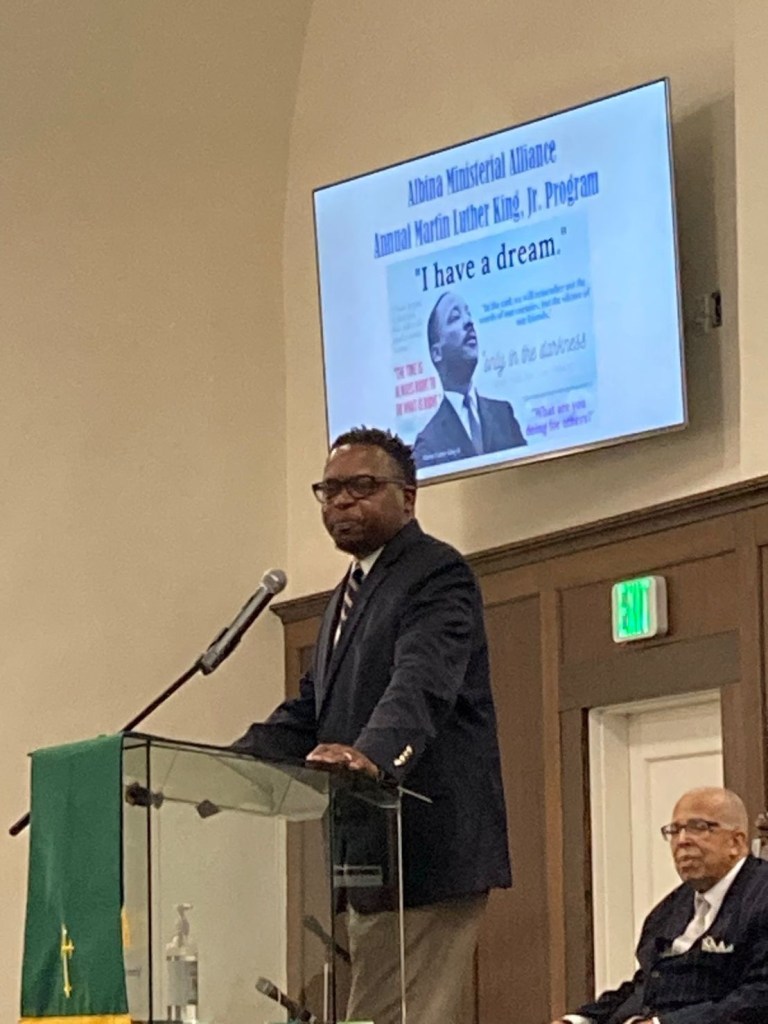
“Reverend Dr. Martin Luther King Jr. In the Civic and the Sacred: Not One or the Other but Both”-January 15, 2023 Albina Ministerial Alliance Annual MLK Worship Service, Allen Temple CME Church

Leave a comment

Filed under Uncategorized

TITLES

“I do not say you should not use them, should not possess them, should not crave them, but do not make the mistake of feeling that titles are going to help you, unless you have got strength aside from the title. No amount of titles will put brains into a person’s head if the brains are not there before.” – Booker T. Washington, “A Sunday Evening Talk,” January 10, 1909

Presidential Commentary by Dr. Brian Johnson

Hear this again and again: Positional and titular authority is the lowest form of authority. If a man or woman cannot nor does not command the respect of his supervisors, peers, colleagues and subordinates independent of a position or title, this man or woman is no greater than the man or woman who has no such position and title. Positions change, and the only permanence one can possess is that found in one’s own person in back of the position.

This is why the founding principal and president of Tuskegee University constantly impressed upon his students the need to constantly improve their own persons. Note the following: It is but half the task to secure the title or position. The most significant half is what one does with the title or position. (One must not only plan how to get the position or title, but what to do with the position and title when one gets it.) And the attention paid to one’s own person helps towards this end. Aside from acquiring credentials and competence, the comprehensive development of one’s CHARACTER is a third facet that can never be taken from the person in back of a position. (Character is not your highest moment or your lowest moment. Character is your most consistent moment.)

More importantly, Character easily transferable from position to position, unit to unit or organization-to-organization, which is why the singular, solitary focus upon a position and title (as opposed to the development of one’s own person) is unwise. For the man or woman who has “strength aside from the title” and who has “brains” in their “heads” will always possess these attributes without regards to a position or a title. (And they will always be desired and in demand.) And the founding principal and president of Tuskegee University who we celebrate in the centennial year since his passing (1915-2015) was not only such a man, but he also offered these wise “words” and set forth the accompanying “works” in his 34-year long presidency at the helm of Tuskegee (Institute) University (1881-1915).

Leave a comment

Filed under Uncategorized

Men’s Soccer Back-to-Back CCC Championship

So wonderful to celebrate our 2nd straight CCC conference championship for Men’s Soccer and grateful to receive the signed championship soccer ball with all the team signatures. #wpuknights #mensoccer

Leave a comment

Filed under Uncategorized

In A Rather Quiet Way

IN A RATHER QUIET WAY

Personal and Confidential

[To President William Howard Taft]

My dear Mr. President: In considering the matter of the new judge for the Northern District of Alabama, I hope you will bear in mind the interests of the Negro. The United States Courts have been, as it were, kind of “cities of refuge” for the colored people. I mean that in these courts they have been always sure of securing justice in cases that properly come under the jurisdiction of such courts by reason of the fact that the judges have been such broad and liberal men that the juries have represented a class of people who would see that a fair verdict was rendered.

Not only this, but in the United States Courts in the South Negroes have heretofore been place on the grand jury and petit jury and in this way they gotten recognition that they have not gotten in any other case. This matter, as small as it is, has gone to make them feel that they were citizens and has encouraged them not a little. With few exceptions, where narrow minded men have been made judges they have gradually used their influence in some way to keep Negroes off the juries and have made them feel that they had few rights in these courts.

Please do not take the time to answer this letter. – Yours very truly, Booker T. Washington, “May 6, 1909”

Presidential Commentary by Dr. Brian Johnson

After “integrity,” and “knowledge,” “influence” is the third greatest 9-letter word. And in this letter to the 27th President of the United States of America, William Howard Taft, Booker T. Washington once again demonstrates that the range of his “influence” extended to the very highest levels of American government. In earlier correspondence, President Taft, who succeeded President Theodore Roosevelt in 1909, made it crystal clear that the founding principal and president of Tuskegee (Institute) University would still be expected to play a similar major role in advising the President of the United States as he had done with President Roosevelt. (The correspondence reveals that Roosevelt not only recommended Washington’s pivotal role in consulting on major affairs but also Taft readily assented.) All the same, we learn in the letter to President Taft three very important considerations about the founding principal and president of Tuskegee University and his “influence.” First, we learn, contrary to popular opinion, he used his “influence” to address issues that concerned one of his most important constituents: African Americans. Here again, one would be remiss to think that Mr. Washington did not advocate on issues of importance. Rather, he moved “in a rather quiet way” as he indicated in a previous communiqué. (The loudest communication is not necessarily the most effective communication, and Mr. Washington’s direct correspondence with the President of the United States is effective communication.) Second, the “influence” of Mr. Washington’s correspondence was certain in that it was marked “personal and confidential.” This was not one of many letters that the President of the United State or any man or woman situated at the helm of a large organization receives that may or may not come to his attention or was handled through an intermediary. It is clear that Mr. Washington’s letters would be read by the President himself. So much so that Mr. Washington did not even need a reply: “Please do not take the time to answer this letter.” Third and last, Mr. Washington’s “influential” advocacy was owing to sound, sober and logical reasoning. His letter thoughtfully and dispassionately articulates the potential success for President Taft in following his suggestion based upon both past and present successes in similar matters. (No doubt Mr. Washington was likely part of such decisions during the Roosevelt Administration.) All three of these reasons-along with many, many more-are why Tuskegee University celebrates the “influence” of Booker T. Washington in this the centennial year (1915-2015) since his passing.

Leave a comment

Filed under Uncategorized

On Deion Sanders and the HBCU, PWI and African American Community

I have read many commentaries on Deion’s decision to go to Colorado. The most convincing assessment speaks to what was told to an already proud HBCU community (though not resourced heavily but understood in light of historical discriminations and a very proud HBCU educational, academic and intellectual tradition versus mere athletics and the decision he made two years later.)

The Deion situation is profoundly impactful for me personally and professionally. There is a delicate negotiation of personal and professional considerations that most persons who are not similarly situated in their professions simply have no idea about.

Albeit-my situations have not arisen to the prominence of Deion Sanders considering his wealth, fame, etc as a Professional athlete-what I will offer is that if you think the prestige of an institution-HBCU, PWI or otherwise- should take the place of your own Peace and Purpose, you would be greatly mistaken. (Many of you simply have no idea what a man in his position has to deal with.)

However, “integrity” is the greatest 9-letter word in my opinion and this is what is at issue. Unlike many HBCU presidents, he had the board’s backing without becoming a sycophant and the community’s backing (he never lived under the threat from board, Alumni or social media attaches that could lead to a firing or a “non renewal” of a contract.) He alone had the opportunity to do what many HBCU leaders dreamed
To do and he decided to do otherwise which is entirely his choice.

All the same, the lesson for those of us who are fortunate to have similar opportunities: let’s be mindful of the hopes in our word given to a community historically bereft of such hopes. Calling is not some mere capitalistic endeavor as many have now reduced it to. Calling comes from God and while it is not limited nor bound to location, it will be found in one’s words and works. (The root word of integrity is integer: Wholeness.) It is difficult to reconcile words to community members in the era of social media when your works
undermind these very words.

Deion is my brother but I think this moment is a watershed moment for our community to reconcile and come
To terms with what we view as success. 👏🏾🙌🏾👑

Leave a comment

Filed under Uncategorized

I CAN DO MORE GOOD HERE THAN ELSEWHERE

I CAN DO MORE GOOD HERE THAN ELSEWHERE

“Dear Sir: Your kind favor of May 2nd, asking if I could be induced to accept the position of President of Alcorn College is received. I am pleased to know that you should think of me in this connection, and of course feel complimented in the highest degree, but I think it best to say in the beginning that I do not think I could be induced to give up my present position. The salary you name is much larger than I am present receiving but I prefer to remain for the reason that I think for some years to come I can do MORE GOOD here than elsewhere, and for the further reason that there are a number of individuals throughout the North who have given and are giving rather large sums of money to this work, based on their faith in my devotion to this work […]”– “May 9, 1894,” Booker T. Washington

Presidential Commentary by Dr. Brian Johnson

Highly successful men and women of character, competence and credentials are rarely without suitors for their services. And the founding principal and president of Tuskegee Institute (University) was no exception. Mr. W.B. Murdock of Alcorn College approached Mr. Washington hoping that he “could be induced to accept the position of President of Alcorn College.” And what is most remarkable in Mr. Washington’s reply was not his gracious recognition of the “compliment,” but rather his reasons for not acquiescing to the offer and to remain at Tuskegee Institute (University): “[…] I prefer to remain for the reason that I think for some years to come I can do MORE GOOD here than elsewhere…”. Imagine that. A person electing to remain at an institution on the basis of the GOOD he or she might be able to do as opposed to having a larger salary? Perhaps this is an old-fashioned 19th Century notion or perhaps Mr. Washington and men and women of his ilk-unlike many in the present century-were men and women of purpose. And “purpose” is the single greatest 7-letter word.

Leave a comment

Filed under Uncategorized

WHEN EDUCATION WAS A NEW THING

WHEN EDUCATION WAS A NEW THING

“In the early days of freedom, when education was a new thing, the boy who went away to school had a very natural human ambition to be able to come back home in order to delight and astonish the old folks with the new and strange things that he had learned. If he could speak a few words in some strange tongue that his parents had never heard before, or read a few sentences out of a book with strange and mysterious characters, he was able to make them very proud and happy. There was a constant temptation therefore for schools and teachers to keep everything connected with education in a sort of twilight realm of the mysterious and supernatural. Quite unconsciously they created in the minds of their pupils the impression that a boy or a girl who had passed through certain educational forms and ceremonies had been initiated into some sort of secret knowledge that was inaccessible to the rest of the world. Connected with this was the notion that because a man had passed through these educational forms and ceremonies he had somehow become a sort of superior being set apart from the rest of the world […]” – Booker T. Washington, _My Larger Education__(1911)

Presidential Commentary by Dr. Brian Johnson

While the term “esoteric” is not entirely pejorative-it can mean that members within a certain profession or group understand and converse sharing many of the same assumptions or terminology-it is sometimes used to denote exclusivity meaning that information and knowledge is understood by a chosen few. In the present passage, the founding principal and president of Tuskegee University speaks to this latter formulation. Here he laments that often education-the act of teaching and learning-resembles the closing off of knowledge from others as opposed to its wide dissemination among many. Mr. Washington’s idea is that such knowledge ought to have relevancy and application for others beyond the sole possessor of this knowledge. Imagine that. The idea of education should not be exclusive to a limited few but should enlighten and have impact upon others in beneficial ways. Thus, not only are the recipients all the better for having received this knowledge but also the giver of this knowledge is made better. For this man or woman has completed the complete cycle of education. First you learn, master and apply for yourself. (It is is a poor teacher whose words do not resemble his or her works.) Then you proceed to teach others. And such an education can be found at many institutions of higher learning including Tuskegee Institute (University).

Leave a comment

Filed under Uncategorized

Be Sure My Yard is Well Cleaned

“[New York City Nov. 10, 1915] [To Alexander Robert Stewart] Be sure my yard is well cleaned.” – Booker T. Washington

Presidential Commentary by Dr. Brian Johnson 

In all likelihood, this was the final letter written by the eminent founding principal and president of Tuskegee Institute (University). (For Booker T. Washington died on Sunday morning November 14, 1915-not 5 days later-after requesting to return to Tuskegee, Alabama to spend his final days.) Until his death, Mr. Washington wrote several short letters with instructions to his colleagues in Tuskegee with the above being the last: “Be sure my yard is well cleaned.” While one may regard this final communiqué as someone who regarded his yard more important than his soul, this is not so. For this final writing was a reflection of his soul indeed-a soul devoted to his work.

Tales abound in the Tuskegee community about Mr. Washington’s intense devotion to work, and there is no greater joy for a man or woman than to be engaged in a line of work that honors both the souls of men and their own. Mr. Washington spent countless hours in the yard and in the garden working, when time and travels permitted. Mr. Washington took great pride in the now world-renowned “Oaks,”-the president’s home at the time, located on the Tuskegee University campus, the only national park on a fully functioning college campus.

Annually, thousands of visitors trek across the nation and the world to visit the home site of Tuskegee’s founding principal and president. So perhaps Mr. Washington’s final concern for his yard being cleaned was not only for that generation but also for the many future generations that would follow in the 100 years since his death.

Leave a comment

Filed under Uncategorized

Executive Council

EXECUTIVE COUNCIL

“I would not be doing my duty to the school did I permit the present state of things to exist, especially in view of the fact that I am compelled to be away from the school a large part of the year and I am compelled to perform my work almost wholly through the members of the Executive Council and there must be only such persons as I have my complete confidence in and share my desires as to the policy and work of the institution.” “March 26, 1895,” – Booker T. Washington

Presidential Commentary by Dr. Brian Johnson

Of the many important decisions leaders of large organizations must make, deciding upon one’s senior leadership team is perhaps the most important. For these men and women become extensions of a leader so that he or she might be in many places at once. And this is the founding principal and president of Tuskegee University’s idea when he writes the following: “…I am compelled to be away from the school a large part of the year and I am compelled to perform my work almost wholly through the members of the Executive Council and there must be only such persons as I have my complete confidence in and share my desires as to the policy and work of the institution.” First, Booker T. Washington’s travel often took him away from the home front so that he might represent the interests of the institution both near and abroad. No leader can ever feel comfortable when absent from the organization unless he or she is most certain that affairs will be conducted in a manner that reflects his or her management when they are present. Second, the broadest and widest tents have more than one pole. It is a poor leader who seeks to be the sole source or “pole” of leadership within an organization or unit. (How shall a tent become enlarged with only one pole?) The more poles, the larger the tent, and the selection of many poles enable a leader to expand and “work almost wholly through the members” of his or her “Executive Council.” Third, Mr. Washington suggested, “there must be only such persons as I have my complete confidence in and share my desires as to the policy and work of the institution.” Note, competence is good but character plus competence is better. (Here again, integrity is the greatest 9-letter word.) Men and women who work with integrity will perform their work in view of the organization’s mission and vision, its tradition and trajectory without regard to the presence or absence of the leader. Moreover, these men and women must possess the confidence of the leader. (How can a quarterback call plays in a huddle of teammates only to discover that the teammates are giving the plays to the opponent?) Much rather, teammates are selected on the basis of their commitment to a common goal, and a leader’s selection of teammates suggests much about who he or she has “complete confidence in,” and who “share[s] [his or her] desires.” For it is “the policy and work of the institution”-not the individual leader or team member-that makes for a highly functional and highly successful organization like Tuskegee Institute (University) during the 34-year tenure of Booker T. Washington.

Leave a comment

Filed under Uncategorized

THE SUPREME END OF EDUCATION

THE SUPREME END OF EDUCATION

“It seems to me that there never was a time in the history of the country when those interested in education should the more earnestly consider to what extent the mere acquiring of the ability to read and write, the mere acquisition of a knowledge of literature and science, makes men producers, lovers of labour, independent, honest, unselfish, and, above all, good. Call education by what name you please, if it fails to bring about these results among the masses, it falls short of its highest end…How I wish that from the most cultured and highly endowed university in the great North to the humblest log cabin school-house in Alabama, we could burn, as it were, into the hearts and heads of all that usefulness, that service to our brother, is the supreme end of education.” – Booker T. Washington, (1899) The Future of the American Negro

Presidential Commentary by Dr. Brian Johnson

Cornel West suggests the following about the “quantity” of educated persons in the present generation as opposed to the “quality” of the past generation in his best-selling work, (1994) Race Matters: “THERE has not been a time in the history of black people in this country when the quantity of politicians and intellectuals was so great, yet the quality of both groups has been so low…How do we account for the absence of the Frederick Douglasses, Sojourner Truths, Martin Luther King, Jrs., Malcolm Xs, and Fannie Lou Hamers in our time?” And perhaps the answer to Professor West’s rhetorical query resides in what the founding principal and president of Tuskegee (Institute) University wrote in the above passage: “…usefulness, that service to our brother, is the supreme end of education.” (Here again, Washington’s Tuskegee idea was not one based solely upon the work of one’s “hands”. Rather, the complete configuration of his conception of education-as ought be for all of education-was that of Heart (Character)-Head (Competence)-Hands (Capable). And once again, the little-discussed and deeply personal notion of the individual “heart” in modern education from which the “service” of the head and hands flow is likely why the “quality…has been so low.” The heart (character) is the seat of all an individual’s ambitions, ideas, motives and foci, and if the heart is not rooted in the idea of genuine and authentic service to mankind without respect to color, then the number of degrees, the name of the universities or the notoriety of the career matters little. And this is precisely why the “education”-not simply degree-received at Tuskegee University revolves around the university’s motto: Knowledge-Leadership-Service.

Leave a comment

Filed under Uncategorized

WPU Fall Enrollment 2022

Leave a comment

Filed under Uncategorized

Derek Luke-Spring 2022 Warner Pacific University Commencement Speaker

Award-winning actor, Derek Luke, will be this year’s spring Commencement speaker on Saturday May 7, 2022. The actor who is well known for his roles in Antoine Fischer, Captain America: The First Avenger, Friday Night Lights, Biker Boyz_ and Miracle at Saint Anna amongst many others will share about his Career and Calling and demonstrating excellence in Civic and Sacred Spaces. Derek’s faithful witness as he pursues passions in the movie industry will be such an instructive treat for our Spring #wpuknights graduates and our campus community. 👏🏾🙌🏾👑

Leave a comment

Filed under Uncategorized

Keynote Speaker: Salem-Keizer NAACP April 30, 2022

Leave a comment

Filed under Uncategorized

Rooms That You Do Not Like

“You are going to get rooms that you do not like. They will not be, perhaps, as attractive as your desire, or they will be too crowded. You are going to be given persons for roommates with whom you think it is going to be impossible to get along pleasantly, people who are not congenial to you. During the hot months your rooms are going to be too hot, and during the cold months they are going to be too cold. You are going to meet with all these difficulties in your rooms. Make up your mind that you are going to conquer them. I have often said that the students who in the early years of this school had such hard times with their rooms have succeeded grandly. Many of you now live in palaces, compared to the rooms, which those students had. I am sure that the students who attend this school find that the institution is better fitted every year to take care of them than it was the year previous.” “A Sunday Evening Talk: Some Rocks Ahead,” Booker T. Washington

Presidential Commentary by Dr. Brian Johnson  

Among the many priorities Mr. Washington had in relationship to his duties as president of Tuskegee Institute (University), fostering a relationship with his students was high among these. The Sunday evening talks were designed for students to engage the founding principal and president in less formal ways than at official gatherings such as convocations, commencements and formal student body association meetings. Moreover, he used these times to try to instill in them something of the “Tuskegee spirit.” Yet, try as one might-and in spite of the many positive aspects of the institution that are hardly ever touted-there are always areas of on-going concern for students, or “some…rocks ahead” for students within a university living-learning environment. Here, Mr. Washington addresses one of these: residential living. To be sure, this address was for Tuskegee Institute (University) students in the 19th century as opposed to the 21st century. (And it is clear that the 21st century institution has a fiscal duty to ensure the best facilities available to its students.) Notwithstanding, there are simply some matters in residential living that are common to all persons living within a university environment that are entirely unavoidable, and a student must simply “conquer them.” First, the room may not be as “attractive as you desire.” The living-learning environment is by no means the culmination of one’s career. It is a stop en route to a glorious career path that has as its ultimate destination a home purchase consistent with one’s desires and affordability. (This is often dependent upon your academic success as a student.) Second, “roommates” may not be “congenial.” Everyone recalls meeting strangers for the first time and though the initial meeting was uncomfortable, these strangers became life-long friends. (Many of our best, life-long friends are cultivated in the college and university living-learning environment, and had we not endured, we would have missed a valuable relationship that might be instrumental in our future successes.) Third, heating and air challenges are often the case even with respect to one roommate preferring it cold while the other hot. (Universities do their very best to address these situations upon proper reporting to the designated resident advisor, residential hall director, facilities director and Vice President for Student Success and Engagement. It is not the university president who one contacts for these matters until the lines of authority are exhausted.) Lastly, a balanced perspective recognizes that “many of you now live in palaces, compared to the rooms which [previous generations of] students had” and for most universities, “the students who attend this school find that the institution is better fitted every year to take care of them than it was the year previous.” While the “struggle” of residential living within a university environment is oft-times a real and verifiable one, students would do well to remember the following adage: “Obstacles are what you see when you take your eyes off the goal.” And the goal is the successful completion of a baccalaureate or post-baccalaureate degree-preferably a University baccalaureate or post-baccalaureate degree. And ultimately a career coupled with a calling fulling a great purpose: Careers fill Pockets; Calling fulfill People and Careers coupled with Calling fulfill great Purposes.

1 Comment

Filed under Uncategorized

“Would the Public Stand It?”

“If I am not mistaken, your views and those of my friend, Mr. Washington, are diametrically opposed, or at least in that you feel that his program in all particulars is not in harmony with the modern spirit.”-“Letter to W.E.B. Du Bois,” Richard Lloyd Jones, Editor, _Collier’s Weekly_ January 7, 1904

“I have been thinking over the invitation you gave in your letter to me to send you my ‘editorial thought.’ Have you ever thought of this: the color line is belting the world today; about it world interests are centering. Would it not be an interesting experiment to start in Collier’s a column-or half a column-called ‘Along the Color Line’ or the Voice of the Darker Millions’ and put therein from week to week or month to month note & comment on the darker races in America, Africa, Asia & c., from the standpoint of the serious student & observer-the spirit of it being informing & interpretive rather than controversial. Would it pay? Would the public stand it? I think I could edit such a column.”-“Letter to Richard Lloyd Jones,” W.E.B. Du Bois, January 30, 1904

W.E.B. Du Bois’s proposition to periodically “inform” white audiences who, at the time, were the primary readers of _Collier’s Weekly_ about African American social problems and “interpret” the “darker races” for them not only allowed him to avoid problems along the racial divide that explicitly incriminated white Americans; it also revealed his handling of white periodical editors to support reform ideals very similar to those introduced in “The Conservation of Races,” which was written during his tenure within the American Negro Academy. (Along with Alexander Crummell, Du Bois founded the academy to inspire reform ideals within the African American community while simultaneously fighting against vicious onslaughts attacking it.)

Similar handling would also lead to significant leadership roles in the Niagara Movement in 1905 and the NAACP in 1909. Besides Collier’s Jones, many progressive and religious white periodical editors were intrigued by a Harvard-trained African American scholarly figure like Du Bois who sought to “solve the Negro problem” in a manner quite unlike Booker T. Washington, the most well-known African American social leader during the period. After Washington’s infamous 1895 Exposition address in Atlanta, which led to his far more infamous Tuskegee policies emphasizing industrial training, Washington became the enemy of a fiery-but institutionally impotent-class of educated and socially progressive African Americans that included Du Bois. Until Du Bois’s periodical writings appeared in major white periodicals between 1897 and 1910, this group was largely silenced due to Washington’s enormous influence among white institutions, including national white periodicals.

As the first socially progressive African American with a Harvard Ph.D., Du Bois was the most successful spokesman among his educated (though to a lesser degree) African American peers. His success as spokesman, along with his belief that an advanced education was essential to real reform, garnered great interest in his writings from sympathetic white periodical editors.

Leave a comment

Filed under Uncategorized

AS THE BLACK CROW FLIES: W.E.B. DU BOIS

“I suppose you’d like to be a Crow and fly over the world and see just everything as I,-and maybe I wouldn’t like to be a dear Brownie!-but since Crows must be Crows and Folks must be Folks, I’ll try to tell you about some things I’ve seen on my flight over the seas!”-William Edward Burghardt Du Bois, _Crisis Magazine_ (July 1920)

While W.E.B. Du Bois’s own descriptions of the crow’s travels through “many and varied nests” appear to explain his idealistic search for a centralized place for his unique and innovative concerns as a scholar, the crow’s prophetic symbolism in relation to the periodical is far more enigmatic.

As an embodiment of Du Bois himself, the black crow bore a conspicuous resemblance to that of an Old Testament seer or prophet with only one distinction: a biblical seer or prophet possessed a providential mandate for his oracles and writings, whereas Du Bois’s authority-manifested most profoundly in periodical and utilitarian writing-proceeded from his standing as the first Harvard- and Berlin-trained African American sociologist.

Du Bois addressed African American social maladies using truths derived from sociological investigations in the African American community, which heretofore had never been attempted by an African American. He also possessed the unique advantage of being the most qualified African American to pursue African American social questions from an academic standpoint, and, among qualified sociologists, Du Bois was among the few whose work was wholly devoted to African American social problems for reform purposes.

The black crow embodied in Du Bois’s founding of _Crisis Magazine: A Periodical of the Darker Races_ in 1910 as an arm of the NAACP; with it Du Bois marshaled the periodical’s unique ability to tersely disperse his enormous academic breadth of knowledge for reform and uplift purposes for the national African American and the larger global black communities. By situating the “black” crow “high above,” “looking downward with sharp eyes,” and dropping “bits of news” to the ordinary “folks,” Du Bois was able to metaphorically describe his uniqueness as an African American scholar relaying pertinent historical and contemporary knowledge for the purposes of reforming African Americans.

Although the imagery surrounding the crow remains cryptic, it is certain that Du Bois was prescient enough to to know that the figure of the crow would personify an African American with unparalleled possibilities in the realm of utilitarian periodical writing that few could ignore, including major white editors and their national white audience.

From such progressive, liberal and religious platforms, Du Bois could finally be seen and finally disseminate what he saw in a manner that he could not through the many academic and scholarly works that many non-academics would never encounter. His most famous work, (1903) _The Souls of Black Folk_ contained 9 of the book’s 14 essays that were first published via periodical publication.

Finding alternative means for communicating to the masses information gleaned from many long years of study and research makes W.E.B. Du Bois a progenitor for modern-day social media pundits. One need only imagine how W.E.B. Du Bois might have utilized social media for the purposes of communicating his research.

1 Comment

Filed under Uncategorized

Hath He Hid Me

Isa 49:2

2 And he hath made my mouth like a sharp sword; in the shadow of his hand hath he hid me, and made me a polished shaft; in his quiver hath he hid me;

KJV

It should come as no surprise when God finally reveals to others those servants who He intends to use for His purposes; besides, what brilliant military strategist (or even CHESS strategist) allows his opponent to see the instrument that will ultimately prove to be their undoing? Consider Moses. Would the Egyptians have trained Moses in all their art and skill if they knew that he would be the Hebrews’ hoped-for deliverer? Consider Paul. Would Gamaliel and his contemporaries have trained Paul if they knew that he would be the communicator of some strange new doctrine? In many ways, two longstanding, revered institutions unwittingly assisted God in hiding, shaping, crafting and training men that would be later used for His purposes. Therefore, wonder and care not for the apparent obscurity of your present circumstances:

[…Who knoweth whether thou art come to the kingdom for such a time as this?] Esther 4:14

Leave a comment

Filed under Uncategorized

Were the Fewest

Deut 7:7

7 The LORD did not set his love upon you, nor choose you, because ye were more in number than any people; for ye were the fewest of all people:

KJV

In Paul’s letter to the Romans he reminded the brethren: “For ye see your calling, brethren, how that not many wise men after the flesh, not many mighty, not many noble, are called.” And the reminder is one that we would all do well to remember. For the state that we were in when our Lord sought us out and found us was not one of position, status, rank, stature, fortune or spiritual strength; rather we were altogether weak and in need. Consider King Saul. He was from the smallest of the tribes of Israel—the Benjamites, and was not thought to be worthy of being named as Israel’s first king; Yet when he became king and was in need he relied more upon the title he obtained rather than returning to the state he was in prior to receiving the title of king. Samuel reminded the king of this when remarked: “When thou was little in thine own sight, wast thou not made the head of the tribes of Israel, and the LORD anointed thee king over Israel?” What Saul failed to remember is one of the most recurring ideas found in scripture: With God, His strengths are most present in our weaknesses:

[And he said unto me, My grace is sufficient for thee: for my strength is made perfect in weakness. Most gladly therefore will I rather glory in my infirmities, that the power of Christ may rest upon me.] 2 Corinthians 12:9 KJV

Leave a comment

Filed under Uncategorized

Called to Preach

“The more we talked with the students who were then coming to us from several parts of the state, the more we found that the chief ambition among a large proportion of them was to get an education so that they would not have to work any longer with their hands. This is illustrated by a story told of a coloured man in Alabama, who, one hot day in July, while he was at work in a cotton field, suddenly stopped, and, looking toward the skies, said: ‘O Lawd, de cotton am so grassy, de work am so hard, and the sun am so hot dat I b’lieve dis darky am called to preach!” – Booker T. Washington “Up From Slavery” (1901)

Presidential Commentary by Dr. Brian Johnson 

In hindsight, it would be all too easy to take issue with Mr. Washington’s late 19th and early 20th century preoccupation with working “with the hands,” or his use of dialect to illustrate a noteworthy principle; however, if we were to suspend judgment we might find an important ideal revolving around notions of “calling,” “vocation,” and the requisite work required for success within a designated “field.” Though stated broadly and not ascribed to the entirety of the ministerial profession, Mr. Washington’s statement that some students elected not to continue working “with their hands”-opting instead to pursue ministry-has profound reverberations for the present.

To be sure, many students laudably elected to change their pursuit of one profession to another for a variety of reasons-including seeking congruence with their latent talent, skills and desires. All the same, there are many instances where a student may have not simply had the wherewithal to continue his or her labors due to the proverbial “price of the ticket.” And this is clearly Mr. Washington’s concern in this passage. One simply cannot expect to achieve enduring success in any endeavor or profession without first putting in the requisite work that is often designed to harden and prepare for subsequent experiences in the profession. For demonstrating a proven ability to overcome difficult circumstances-and preferably more than one-is infinitely more impactful than merely communicating the stories of others who have overcome.

Leave a comment

Filed under Uncategorized

Facts

“I have great faith in the power and influence of facts.” – Booker T. Washington, _Up From Slavery_(1901)

Presidential Commentary by Dr. Brian Johnson 

Men and women who possess leadership responsibilities beyond their own persons would be hard pressed to find any better ally or supporter than facts. And men and women of the ilk of Booker T. Washington, founding principal and president of Tuskegee (Institute) University, marshaled both favorable or unfavorable facts to similar ends. It is simply not true that one should keep one’s eyes open to favorable facts while closing one’s eyes to unfavorable facts. Mr. Washington’s penchant for earnestness, frankness and directness in his communications to donors and external constituencies always commingled both favorable and unfavorable facts. As to favorable facts, one ought always communicate what the organization does well in a clear, documentable and evidentiary fashion. (An outcomes-oriented organization need not rely upon fables when facts are present.) On the other hand, communicating unfavorable facts is equally important. Whether one concedes it or not, everyone knows when something “is not right.” A plain statement and admission of an organization’s current environment is one of the clearest telltale signs of organizational integrity. (Hear again, “integrity” is the single greatest 9-letter word.) For Mr. Washington did not merely state that all things were always favorable. (Why would anyone seek outside help if all things, as they currently exist, are favorable? Any petition for aid immediately pronounces the opposite. For no one asks for help when there is no need for it.) Instead, he oft-times made a plain statement of the organization’s current environment while positively projecting its target environment. In this regard all successful outside entities have empathy towards such an organization because a right understanding of one’s current environment with a view towards its target environment necessitates a commingling of both facts that are favorable and unfavorable.

Leave a comment

Filed under Uncategorized