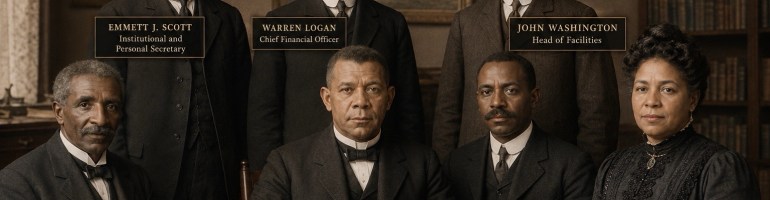
“I would not be doing my duty to the school did I permit the present state of things to exist, especially in view of the fact that I am compelled to be away from the school a large part of the year and I am compelled to perform my work almost wholly through the members of the Executive Council and there must be only such persons as I have my complete confidence in and share my desires as to the policy and work of the institution.” “March 26, 1895,” – Booker T. Washington
Of the many important decisions leaders of large organizations must make, deciding upon one’s senior leadership team is perhaps the most important. For these men and women become extensions of a leader so that he or she might be multiplied in many places at once. And this is the founding principal and president of Tuskegee University’s idea, as early as 1895, when he assembled what might now be considered a roster of high caliber senior executives who would be named forever in the annals of Tuskegee’s long and illustrious history. The list reads like a “who’s who’s” in African American higher educational history: Emmett J. Scott (Chief of Staff), Warren Logan (CFO), John H. Washington (Head of Grounds and Facilities), George Washington Carver (Head of Agriculture), and Robert R. Taylor (Head of Architecture). This list does not begin to include Washington’s illustrious wives and First Ladies, Deans of Chapel and Religious Life and the many eminent associates of the institution who played various roles in the institution’s success such as Thomas Fortune, and Paul Laurence Dunbar.
First, Booker T. Washington’s travel often took him away from the home front so that he might represent the interests of the institution both near and abroad. No leader can ever feel comfortable when absent from the organization unless he or she is most certain that affairs will be conducted in a manner that reflects his or her management when they are present. Second, the broadest and widest tents have more than one pole. It is a poor leader who seeks to be the sole source or “pole” of leadership within an organization or unit. (How shall a tent become enlarged with only one pole?) The more poles, the larger and more expansive the tent, and the selection of many poles enable a leader to expand and “work almost wholly through the members” of his or her “Executive Council.” Third, Mr. Washington suggested, “there must be only such persons as I have my complete confidence in and share my desires as to the policy and work of the institution.” Note, competence and credentials are good but character plus competence and credentials is far greater. (Here again, integrity is the greatest 9-letter word.) Men and women who work with integrity will perform their work in view of the organization’s mission and vision, its tradition and trajectory without regard to the presence or absence of the leader.
Moreover, these men and women must possess the confidence of the leader. (How can a quarterback call plays in a huddle of teammates only to discover that the teammates are giving the plays to the opponent?) Much rather, teammates are selected on the basis of their commitment to a common goal, and a leader’s selection of teammates suggests much about who he or she has “complete confidence in,” and who “share[s] [his or her] desires.” For it is “the policy and work of the institution”-not the individual leader or team member-that makes for a highly functional and highly successful organization like Tuskegee Institute (University) during the 34-year tenure of Booker T. Washington from 1881 to 1915.
Discover more from Brian Johnson, Ph.D.
Subscribe to get the latest posts sent to your email.
