Category Archives: Uncategorized

ASSOCIATE YOURSELF WITH PEOPLE OF GOOD QUALITY

“Associate yourself with people of good quality. It is better to be alone than in bad company.”-Booker T. Washington

The adage that one is known by the company he or she keeps is an oft-expressed one, but the founding principal and president of Tuskegee University, Booker T. Washington, extends the adage even further both in the aforementioned passage and in another commonly quoted passage: “You cannot hope to succeed if you keep bad company. As far as possible try to form the habit of spending your nights at home.” – Booker T. Washington, “A Sunday Evening Talk: On Influencing by Example.” Moreover, his additional suggestion to “try to form the habit of spending your nights at home” is a very practical one worth noting. Insofar as it is possible to discern from his autobiography, correspondence, letters, speeches-and more importantly his accomplishments-the man, Booker Washington, apparently did little else but read, write, work and stay at home with his family. And while it is easy to regard Tuskegee (Institute) University’s founding principal with an overwhelming sense of awe, one can begin to appreciate and understand him in view of his own self-discipline and self-sacrifice. (Everyone suffers but few suffer voluntarily. Yet, if one learns how to suffer, one will learn how to succeed.) One need not be reminded that everyone has the same 24 hours in a day, but how one spends those hours is what ultimately distinguishes men and women. (One would simply be amazed at how much more time can be committed to a meaningful mission or a purposeful project if time is not spent in (un)meaningful and (un)purposeful ones that do not result in progress.) Clearly, recreation, fun and leisure have their place but not if these things come at the expense of sustainable success. (Mr. Washington suggests that it is even better when one’s recreation, fun and leisure become part and parcel of one’s work.) For when an individual can transform his or her home into an extension of their workshop, they have the benefit of continuing, doubling and multiplying their labors when others have ceased from theirs.

Leave a comment

Filed under Uncategorized

SEARCH FOR TRUTH

“I have been a slave once in my life-a slave in body. But I long since resolved that no inducement and no influence would ever make me a slave in soul, in my love for humanity, and in my search for truth.” – Booker T. Washington, (1907) The Negro in the South

Presidential Commentary by Dr. Brian Johnson 

In a little-known, yet most noteworthy moment in the history of both American and African American literary history, Booker T. Washington jointly published the book _The Negro In the South (1907)_ . It contains 2 essays from himself and 2 other essays from none other than W.E.B. Du Bois. (And this was not their first co-publication. This would be the second book containing these two stalwarts in American and African American educational and intellectual history.) All the same, in the first of Mr. Washington’s two essays, he makes the distinction between being a “slave in body” versus being a “slave in soul.” Note the following concerning the remarks of the founding principal and president of Tuskegee (Institute) University: He made a strategic, calculated set of decisions to ensure that his outward circumstance would not determine his future circumstances. (And these decisions revolved around a “love for humanity” and a “search for truth”, which will always place the “lover” and “seeker” of such beyond the pale of those whose pursuits are self-interested, selfish and slavishly fearful.)

First, a lover of humanity is unafraid to come to learn to love others because he or she has first come to love himself. One can hardly come to love others if one does not possess a deep love for one’s self, and this includes learning to love both the learned and the ignorant. For a man or woman who ascended to leadership, as Mr. Washington had done, not only encountered both but had been both during his long ascent ‘Up From Slavery’. Second, the seeker of truth seeks after that which is right without regard to where this truth leads. Leo Tolstoy eloquently suggests the following about such a principle: “If you wish to know the truth, first of all free yourself from all considerations of self-interest.” Whether the truth Mr. Washington discovered was for the benefit or detriment to himself or not-“integrity” is the single greatest 9-letter word-this pursuit is without question what led to 34 years of ongoing, consistent and enduring success for Tuskegee (Institute) University. For unbroken, undivided and unwavering consistency and wholeness is perhaps the closest description of both “truth” and Mr. Washington’s presidency that served and will continue to serve generations of “humanity.” And this is why we celebrate his accomplishments in this the centennial year of his passing (1915-2015).

Leave a comment

Filed under Uncategorized

Warner Pacifc University Ranked #4 in Social Mobility (West Region) (2025)

Warner Pacific University ranked #4 in Top Performers for Social Mobility in the West Region:

https://www.usnews.com/best-colleges/rankings/regional-colleges-west/social-mobility

Leave a comment

Filed under Uncategorized

WPU Receives Second Consecutive Multimillion Dollar federal award

We are most fortunate to announce our second consecutive multi-million federal award: Warner Pacific has been awarded, for the second consecutive year, a five-year, multi-million dollar grant from the US Department of Education. This Hawkins Program grant aims to increase, and retain, the numberRead more here: https://www.warnerpacific.edu/warner-pacific-university-awarded-second-multi-million-dollar-grant/

Leave a comment

Filed under Uncategorized

IN A RATHER QUIET WAY

Personal and Confidential
[To William Howard Taft]

“My dear Mr. President: In considering the matter of the new judge for the Northern District of Alabama, I hope you will bear in mind the interests of the Negro. The United States Courts have been, as it were, kind of “cities of refuge” for the colored people. I mean that in these courts they have been always sure of securing justice in cases that properly come under the jurisdiction of such courts by reason of the fact that the judges have been such broad and liberal men that the juries have represented a class of people who would see that a fair verdict was rendered.

Not only this, but in the United States Courts in the South Negroes have heretofore been place on the grand jury and petit jury and in this way they gotten recognition that they have not gotten in any other case. This matter, as small as it is, has gone to make them feel that they were citizens and has encouraged them not a little. With few exceptions, where narrow minded men have been made judges they have gradually used their influence in some way to keep Negroes off the juries and have made them feel that they had few rights in these courts.-

Please do not take the time to answer this letter.”  – Yours very truly, Booker T. Washington, “May 6, 1909”

After “integrity,” and “knowledge,” “influence” is the third greatest 9-letter word. And in this letter to the 27th President of the United States of America, William Howard Taft, Booker T. Washington once again demonstrates that the range of his “influence” extended to the very highest levels of American government. In earlier correspondence, President Taft, who succeeded President Theodore Roosevelt in 1909, made it crystal clear that the founding principal and president of Tuskegee (Institute) University would still be expected to play a similar major role in advising the President of the United States as he had done with President Roosevelt. (The correspondence reveals that Roosevelt not only recommended Washington’s pivotal role in consulting on major affairs but also Taft readily assented.) All the same, we learn in the letter to President Taft three very important considerations about the founding principal and president of Tuskegee University and his “influence.”

First, we learn, contrary to popular opinion, he used his “influence” to address issues that concerned one of his most important constituents: African Americans. Here again, one would be remiss to think that Mr. Washington did not advocate on issues of importance. Rather, he moved “in a rather quiet way” as he indicated in a previous communiqué. (The loudest communication is not necessarily the most effective communication, and Mr. Washington’s direct correspondence with the President of the United States is effective communication.) Second, the “influence” of Mr. Washington’s correspondence was certain in that it was marked “personal and confidential.” This was not one of many letters that the President of the United State or any man or woman situated at the helm of a large organization receives that may or may not come to his attention or was handled through an intermediary. It is clear that Mr. Washington’s letters would be read by the President himself. So much so that Mr. Washington did not even need a reply: “Please do not take the time to answer this letter.” Third and last, Mr. Washington’s “influential” advocacy was owing to sound, sober and logical reasoning. His letter thoughtfully and dispassionately articulates the potential success for President Taft in following his suggestion based upon both past and present successes in similar matters. (No doubt Mr. Washington was likely part of such decisions during the Roosevelt Administration.) All three of these reasons-along with many, many more-are why Tuskegee University celebrates the “influence” of Booker T. Washington in this the centennial year (1915-2015) since his passing.

Leave a comment

Filed under Uncategorized

First Hand Knowledge

“Some years ago, in an effort to bring our rhetorical and commencement exercises into a little closer touch with real things, we tried the experiment at Tuskegee of having students write papers on some subject of which they had first-hand knowledge. As a matter of fact, I believe that Tuskegee was the first institution that attempted to reform its commencement exercises in this particular direction.” – Booker T. Washington, My Larger Education (1911)

Presidential Commentary by Dr. Brian Johnson 

What might now be considered as painstakingly obvious-the idea that an educated man or woman should be well-versed in having “first-hand knowledge”-Tuskegee University was a visionary institution in the education of her students under the leadership of its founding principal and president, Booker T. Washington. For the characteristic of possessing “first-hand knowledge” is the hallmark of the thoroughly educated man or woman based upon the following reasons: First, these young men and women will be not easily deceived and misled as they enter into their chosen field of study. Having already experienced in some measure-whether in matters great or small-the activities that will be required of them, they are knowledgeable and prepared to not only deal abstractly but practically. Second, they learn to discern second-hand knowledge (or worst hearsay) as men and women of intelligence. (Only the unintelligible rely upon knowledge that they have not vetted “first-hand” or experienced.) The mark of intelligence is but an extension of one’s integrity, the greatest 9-letter word, and if a man or woman would rely upon second-hand and/or piecemeal information in the employment of their duties in their chosen field of endeavor, they put their own work and reputation at risk through no other’s fault but their own. Third and last, “first-hand knowledge” separates one from peers and colleagues who have not undertaken the requisite work and suffering (endurance) necessary for gaining this knowledge. (Hear again, if one learns how to suffer and is willing to suffer well, one will learn how to succeed.) These men and women undertook to do what others were unwilling to do, afraid to do or simply too lethargic to do. The founder’s oft-repeated two most important qualities, “faith” and “hard work”, are both necessary but the latter-the second greatest 4-letter word-is what gives men and women the grand opportunity to separate themselves on the field of “first-hand knowledge.” (These men and women work while others talk.) You will not learn what you will not work to learn, and in this the centennial anniversary of Tuskegee University’s Booker T. Washington’s passing (1915-2015), we celebrate both the legacy and the institution of higher learning he “worked” for 34 years (1881-1915) to establish.

Leave a comment

Filed under Uncategorized

HEART-HEAD-HANDS

“We can fill your heads with knowledge, and we can train your hands to work with skill, but unless all this training of head and hand is based upon high, upright character, upon a true heart, it will amount to nothing. You will be no better off than the most ignorant.”-Booker T. Washington, A Sunday Evening Talk

Presidential Commentary by Dr. Brian Johnson

In this writer’s opinion, “integrity” is the greatest 9-letter word, “knowledge” is the second greatest, and “ignorance” is-by far-the worst and most dangerous. And the founding principal and president of Tuskegee (Institute) University, Booker T. Washington, gives on this Sunday evening talk his oft-repeated conception of “heart-head-hands” to help his students avoid the dread of becoming “no better off than the most ignorant.” One can easily seek the help of professors to develop one’s “head”. (These men and women have as their primary purpose to fill the “heads” of students with “knowledge”.) Likewise, professors are able to help make a student’s “hands”-or their work-“skill”[ful]. (Through repeated instruction and correction a student will either become skillful at their work or they will receive failing grades.) Yet, the matter of the “heart,” Mr. Washington suggests, is one matter where students must begin and complete this work largely alone. (Let no man or woman ever presume to become an expert on the subject of another’s heart.) Of all subject matters, it is the one that is deeply personal and unique to the individual. Whereas both the competencies of the “head” and the credentials of the “hands” lie in full view, the character of the “heart” is always hidden from view. Yet, without it, all else “will amount to nothing.” For Mr. Washington’s complete configuration of Heart-Head-Hands in education is akin to the strength necessary to shoot arrows a great distance even as [the] University has shot forth [its] sons and daughters…into rewarding and meaningful careers of service for over 133 years. The heart is the unseen and invisible strength that determines how far one can bend the bow to make the arrow go.

Leave a comment

Filed under Uncategorized

(OAICU) Oregon Alliance of Independent Colleges and Universities-Brian Johnson, Trustee

We’re grateful for President Brian Johnson of Warner Pacific University for his dedicated service on The Alliance’s Board of Trustees!

Dr. Johnson’s leadership extends far beyond his campus. He’s a champion for education on a national scale, serving on the board of All Hands Raised and as an evaluator for the Northwest Commission on Colleges and Universities (NWCCU). His commitment to diversity and inclusion is evident in his role as an Executive Committee member for the American Council of Education and a mentor for the HBCU Executive Leadership Institute. Learn more about President Johnson here: https://intersectionoffaithandlearning.com/about/

Leave a comment

Filed under Uncategorized

Spending Your Nights At Home

You cannot hope to succeed if you keep bad company. As far as possible try to form the habit of spending your nights at home.” – Booker T. Washington, “A Sunday Evening Talk: On Influencing by Example”

Presidential Commentary by Dr. Brian Johnson 

The adage that one is known by the company he or she keeps is an oft-expressed one, but the founding principal and president of Tuskegee University, Booker T. Washington, extends the adage even further both in the aforementioned passage and in another commonly quoted passage: “Associate yourself with people of good quality. It is better to be alone than in bad company.” Moreover, his additional suggestion to “try to form the habit of spending your nights at home” is a very practical one worth noting. Insofar as it is possible to discern from his autobiography, correspondence, letters, speeches-and more importantly his accomplishments-the man, Booker Washington, apparently did little else but read, write, work and stay at home with his family. And while it is easy to regard Tuskegee (Institute) University’s founding principal with an overwhelming sense of awe, one can begin to appreciate and understand him in view of his own self-discipline and self-sacrifice. (Everyone suffers but few suffer voluntarily. Yet, if one learns how to suffer, one will learn how to succeed.) One need not be reminded that everyone has the same 24 hours in a day, but how one spends those hours is what ultimately distinguishes men and women. (One would simply be amazed at how much more time can be committed to a meaningful mission or a purposeful project if time is not spent in (un)meaningful and (un)purposeful ones that do not result in progress.) Clearly, recreation, fun and leisure have their place but not if these things come at the expense of sustainable success. (Mr. Washington suggests that it is even better when one’s recreation, fun and leisure become part and parcel of one’s work.) For when an individual can transform his or her home into an extension of their workshop, they have the benefit of continuing, doubling and multiplying their labors when others have ceased from theirs.

Leave a comment

Filed under Uncategorized

A DIFFICULT TASK

My dear Dr. Grimke: You cannot realize how much satisfaction your kind words of congratulation bring to me. I know that no utterance comes from your lips that are not sincere. The reception given my words at Atlanta has been a revelation to me. I had no idea that a Southern audience would treat a black man’s utterances in the way that it did. The heart of the whole South now seems to be turned in a different direction. You can easily see that I had rather a difficult task. First I wanted to be very sure to state the exact truth and of not compromising the race. Then there were some things that I felt should be said to the colored people and some others to the white people; and aside from these considerations I wanted to so deport myself as not to make such an impression as would prevent a similar opportunity being offered to some other colored man in the south.” – September 24, 1895, Booker T. Washington

Presidential Commentary by Dr. Brian Johnson 

In the days and weeks following Booker T. Washington’s “Atlanta Exposition Address (1895),” he received several commendations and congratulatory messages from a host of well wishers for this now historic address. In addition to remarks received from Francis James Grimke who was instrumental in the founding of the NAACP, W.E.B. (William Edward Burghardt) Du Bois-his noted rival-remarked, “My Dear Mr. Washington: Let me heartily congratulate you upon your phenomenal success at Atlanta-it was a word fitly spoken.” In deed and in truth, the founding principal and president of Tuskegee Institute (University) “had rather a difficult task” in delivering such an address that has profound reverberations, even in this present century. Mr. Washington’s detractors-including many who praised him in private-decried against the address calling it the “Atlanta Compromise” because of its emphasis upon industrial education and developing economic independence for African-Americans as opposed to pressing for social justice during that volatile period. Yet, what many failed to appreciate then about Washington-and fail to appreciate now about men and women in leadership situated similar to Washington-is that such men and women have multiple constituencies and audiences to appeal to. In 1895, in the Deep South, where Mr. Washington had spent 15 years building an institution of higher learning for formerly enslaved African-Americans, he needed to be especially keen, prudent and cautious about enflaming the fires of lynching, unprovoked beatings and murder, and the burning down of his facilities during a dark and infamous period in American history that is all too well documented. (For this man, unlike many of his detractors was in a position of leadership over students whose parents entrusted them to him, and if the institution were burned to the ground with several casualties because he spoke what others thought he should speak, one need only have a rudimentary historical imagination to understand the consequences of this.) On the other hand, he could hardly deny that the racial atrocities and social injustices committed against African-Americans solely based upon their ancestry and skin color could go unnoticed or unspoken on such a prominent platform. Thus, he-like most persons who have ever successfully led or spoken to diverse and multiple constituencies-followed a three-prong approach in his address: 1. “First [he] wanted to be very sure to state the exact truth…” (One will never go awry in speaking a plain statement of facts to audiences without regard to how such facts are received. As J.K. Miller wrote: “It is not the truth that people cannot handle. It is the consequences that stem from that truth.”) 2. Second, “there were some things that I felt should be said to the colored people and some others to the white people;”(It is a poor, paltry and partial speaker or leader indeed who makes one-dimensional arguments and directs messages of truth to one racial, socioeconomic, ethnic or cultural group or another.) The greatest speakers and leaders transcend such categorizations and will inevitably share truth that falls wherever it may. Third, “aside from these considerations [he] wanted to so deport [himself] as not to make such an impression as would prevent a similar opportunity being offered to some other colored man in the south.” (Make no mistake, one’s words and actions in leadership always set precedents for those who come afterward. While one’s conscience and sense of “speaking one’s mind” may lead one to offer a torrent of remarks without regard to one’s constituency, the prudent leader exercises restraint for he or she knows that his words and leadership impacts someone other than himself.) And this final regard is the hallmark of Booker T. Washington’s leadership at the helm of Tuskegee Institute (University). Possessing real and actual responsibility with respect to others deepens one’s commitment and capacity for serving others and lessens one’s commitment and capacity for serving one’s self.

Leave a comment

Filed under Uncategorized

LEARN TO LOVE LABOUR

“…I not only learned that it was not a disgrace to labour, but learned to love labour, not alone for its financial value, but for labour’s own sake and for the independence and self-reliance which the ability to do something which the world wants done brings.” – Booker T. Washington, Up from Slavery (1901)

Presidential Commentary by Dr. Brian Johnson 

While any man or woman who has acquired any measure of success in their chosen field of endeavor has learned that they must labour (work), the founding principal and president of Tuskegee University extends this notion further. Booker T. Washington suggests that one must “learn to love labour (work)”, and he provides three attendant fruits beyond “financial value’ for those who have “learned to love labour (work).”

First, those who love to work have learned the intrinsic value of the work itself-“for labour’s own sake.” The discovery of one’s passion often comes through the repeated doing and subsequent mastery of a particular task in a particular field that eventually leads to an intrinsic joy in doing what one may eventually become successful doing. Some people learn to love what they do well but this comes only after one actually tries to do something. (The “passion” to do something often leads to “success” and can lead to an individual’s eventual coming to understand their personal sense of “calling.”)

Second, “independence” and “self-reliance” is also a result of “learning to love labour (work).” Knowledge obtained in the wise doing (labour) of any task-wisdom is but knowledge applied-is transferrable to any environment. Such a man or woman possesses that which cannot ever be taken from him or her. (Knowledge is the chief asset in an rapidly changing 21st century politically, economic and increasingly pluralistic society and herein is the basis of their “independence” and “self-reliance”.) While these men or woman certainly do not become an island to themselves, they know “how,” “what,” “when,” “where” and “who” to seek additional knowledge from to complement their own. (These men and women can readily identify what “knowledge,” the second greatest 9-letter word, looks like because they have it themselves.)

Lastly, the “love of labour” has perhaps the most important fruit: “the ability to do something which the world wants done…” All of our work (labour) means little if it does not result in service to others. Better still, when this work serves not only those in the present generation but in subsequent generations, such work has the opportunity to stand rank and file with men and women like Booker T. Washington whose work at Tuskegee University in the centennial year of his passing (1915-2015) is still “something which the world wants” and that the world needs.

Leave a comment

Filed under Uncategorized

INFLUENCE

INFLUENCE

Personal and Confidential

[To William Howard Taft]

“My dear Mr. President: In considering the matter of the new judge for the Northern District of Alabama, I hope you will bear in mind the interests of the Negro. The United States Courts have been, as it were, kind of “cities of refuge” for the colored people. I mean that in these courts they have been always sure of securing justice in cases that properly come under the jurisdiction of such courts by reason of the fact that the judges have been such broad and liberal men that the juries have represented a class of people who would see that a fair verdict was rendered.

Not only this, but in the United States Courts in the South Negroes have heretofore been place on the grand jury and petit jury and in this way they gotten recognition that they have not gotten in any other case. This matter, as small as it is, has gone to make them feel that they were citizens and has encouraged them not a little. With few exceptions, where narrow minded men have been made judges they have gradually used their influence in some way to keep Negroes off the juries and have made them feel that they had few rights in these courts.

Please do not take the time to answer this letter. – Yours very truly, Booker T. Washington, “May 6, 1909”

Presidential Commentary by Dr. Brian Johnson

After “integrity,” and “knowledge,” “influence” is the third greatest 9-letter word. And in this letter to the 27th President of the United States of America, William Howard Taft, Booker T. Washington once again demonstrates that the range of his “influence” extended to the very highest levels of American government. In earlier correspondence, President Taft, who succeeded President Theodore Roosevelt in 1909, made it crystal clear that the founding principal and president of Tuskegee (Institute) University would still be expected to play a similar major role in advising the President of the United States as he had done with President Roosevelt. (The correspondence reveals that Roosevelt not only recommended Washington’s pivotal role in consulting on major affairs but also Taft readily assented.) All the same, we learn in the letter to President Taft three very important considerations about the founding principal and president of Tuskegee University and his “influence.” First, we learn, contrary to popular opinion, he used his “influence” to address issues that concerned one of his most important constituents: African Americans. Here again, one would be remiss to think that Mr. Washington did not advocate on issues of importance. Rather, he moved “in a rather quiet way” as he indicated in a previous communiqué. (The loudest communication is not necessarily the most effective communication, and Mr. Washington’s direct correspondence with the President of the United States is effective communication.) Second, the “influence” of Mr. Washington’s correspondence was certain in that it was marked “personal and confidential.” This was not one of many letters that the President of the United State or any man or woman situated at the helm of a large organization receives that may or may not come to his attention or was handled through an intermediary. It is clear that Mr. Washington’s letters would be read by the President himself. So much so that Mr. Washington did not even need a reply: “Please do not take the time to answer this letter.” Third and last, Mr. Washington’s “influential” advocacy was owing to sound, sober and logical reasoning. His letter thoughtfully and dispassionately articulates the potential success for President Taft in following his suggestion based upon both past and present successes in similar matters. (No doubt Mr. Washington was likely part of such decisions during the Roosevelt Administration.) All three of these reasons-along with many, many more-are why Tuskegee University celebrates the “influence” of Booker T. Washington in this the centennial year (1915-2015) since his passing.

Leave a comment

Filed under Uncategorized

A YOUNG MAN WHO HAS STARTED WRONG

A YOUNG MAN WHO HAS STARTED WRONG

“I remember one young man in particular who graduated from Yale University and afterward took a post-graduate course at Harvard, and who began his career by delivering a series of lectures on “The Mistakes of Booker T. Washington.” It was not long, however, before he found that he could not live continuously on my mistakes. Then he discovered that in all his long schooling he had not fitted himself to perform any kind of useful and productive labour. After he had failed in several other directions he appealed to me, and I tried to find something for him to do. It is pretty hard, however, to help a young man who has started wrong.” – Booker T. Washington, (1911) _My Larger Education_

Oliver Wendell Holmes, Sr. offers the following concerning men and women whose actions are similar to the young man described in Booker T. Washington’s aforementioned passage: “Controversy equalizes fools and wise men in the same way – and the fools know it.” And the founding principal and president of Tuskegee (Institute) University provides several important lessons about both the young man-as well as all men and women of his ilk-who seek to establish their name and reputation on the basis of disparaging the name and reputation of others-particularly those whose accomplishments they will only be brought in close proximity to only upon the basis of “controversy.” First, Mr. Washington never ever mentions this young man’s name. While this unidentified young man knew full well that persons might give him a hearing-not upon the basis of his own person and accomplishments-but based upon the person and accomplishments of his topic, “The Mistakes of Booker T. Washington,” identifying or responding to this young man provided not a single, solitary benefit to Mr. Washington and Tuskegee. Second, Mr. Washington understood that the young man’s premises were flawed from the onset, and it is the clearest telltale example of Mr. Washington’s oft-repeated phrase, “Let examples answer.” To be sure, the actions of no man or woman are all “good” or all “bad.” (This is naïve, simplistic and child-like thinking.) Yet, in the face of the clear, overwhelming and documentable evidence that testify to the good that Mr. Washington had done locally, regionally and nationally, this young man titled his lecture series according to what he perceived were the mistakes of Mr. Washington. Here again, what one consistently reads and hears, one will consistently become. And this young man ought to have taken heed to how and to what he was hearing for it ultimately led to what he had become. (For this young man’s attempt to categorize and confine a man of Booker T. Washington eminence and accomplishments to a series of perceived mistakes that his limited training, limited knowledge and limited life experience identified did nothing but demonstrate his failure to understand the significance of the (2) greatest 9-letter words and the single, most dangerous 9-letter word: 1. “Integrity” 2. “Knowledge” 3. “Ignorance;”) Finally, we should consider Mr. Washington’s demonstration of another one of his famous aphorisms: “I let no man drag me down so low as to make me hate him.” The very same young man who sought to disparage and defame Mr. Washington later sought him for assistance, and Mr. Washington “tried to find something for him to do.” (This dynamic needs no additional commentary.) Yet what is deserving of additional commentary is that this young man might have spent his time and work writing, lecturing and building his own legacy and life worth reading as opposed to seeking to denigrate another’s whose legacy and life of building Tuskegee (Institute) University spanned 34 years (1881-1915) and remains and is read to this very day.

Leave a comment

Filed under Uncategorized

11th Thing Podcast w/ Dr. Brian Johnson: Leadership and Power Dynamics

In this sixth episode in the series on organisational power, special guest distinguished professor, scholar and president of Warner Pacific University, Dr Brian Johnson, delivers a masterclass on ‘power dynamics’.
The episode delves into the complexity of power dynamics as well as the nuanced personal and professional relationships that underpin them. Drawing on decades of professional experience, including in senior and executive roles, Dr Johnson specifically highlights the importance of humility and integrity as essential ingredients for healthy and productive power dynamics.


So, make sure you listen in to next episode of the 11th thing podcast, hosted by me Paul Aladenika with my special guest, distinguished professor, scholar and president of Warner Pacific University, Dr Brian Johnson.

https://podcasts.apple.com/us/podcast/power-dynamics/id1673812660?i=1000662953878

Leave a comment

Filed under Uncategorized

Grace and Truth

John 1:17
17 For the law was given by Moses, but grace and truth came by Jesus Christ.
KJV

All of human history looked toward, and now looks backward to the earthly arrival of Jesus Christ, the Son of God. And prior to his arrival, there was no more perfect and comprehensive moral code in the history of mankind than the law that was given by Moses. Yet, in spite of its many virtues, the law of Moses could never give (nor effectively demonstrate) what Christ alone could: Grace and Truth. For the grace of God’s Spirit (granted to Christ without measure) not only empowered the Son of God to fulfill the law, but would also be granted to all who would believe in the One God sent to do likewise. And in possessing and giving the requisite grace to fulfill the law, Christ effectively fulfilled the Truth of the law (in the spirit, not simply the letter). (For Christ would not simply teach and demonstrate the fulfillment of the law, “Thou shalt not commit adultery,”) He would instruct, model and grant grace to know (and do) the Truth of this law: (No man should even allow his eyes to lust after another woman.) For Truth (Godly truth) is something much higher (and deeper) than laws, rites and rituals, which only foreshadow, typify or provide natural expressions for spiritual truth. And Godly spiritual truths are God’s Truth embodied (and perfected) in Jesus Christ, and we can never hope to live according to God’s Truth without first receiving the Grace of Jesus Christ to do so:

“And the Word was made flesh, and dwelt among us, (and we beheld his glory, the glory as of the only begotten of the Father,) full of grace and truth.” John 1:14

Leave a comment

Filed under Uncategorized

Begin At The Bottom; then Keep Rising

“I used to picture the way that I would act under such circumstances; how I would begin at the bottom and keep rising until I reached the highest round of success.” – Booker T. Washington, Up From Slavery (1901)

Presidential Commentary by Dr. Brian Johnson 

Robert Hedrick’s translation of Xenophon’s Cyrus The Great: The Arts of Leadership and War captures a rather profound and startling idea about the power of both the mind and imagination in one’s youth. This is particularly evidenced in Mr. Washington’s autobiographical telling of the time spent in his youth thinking of his future: “I created an empire in my thoughts long before I began to win an empire in reality.” The founding principal and president of Tuskegee (Institute) University, Booker T. Washington, tells of not having many flesh-and-blood examples of “success” due to both his poverty and enslavement. Yet, while his “hands” might have been bound, his “heart” and his “head” were certainly not. Though he might have seen but dimly into what his future held, he “used to picture the way [he] would act under such circumstances.” (Note, one can hardly go where one cannot see one’s self beforehand going. And one can hardly do what one cannot see one’s self beforehand doing.) “Vision” is the greatest 6-letter word, and “leader” is the second greatest 6-letter word in this writer’s opinion. And Mr. Washington possessed “vision” enough for himself-without regard to what others might have seen-to see himself as a “leader,” which he later realized for some 34 years at the helm of Tuskegee (Institute) University.

Leave a comment

Filed under Uncategorized

Rev. Dr. Benjamin Mays and W.E.B. Du Bois

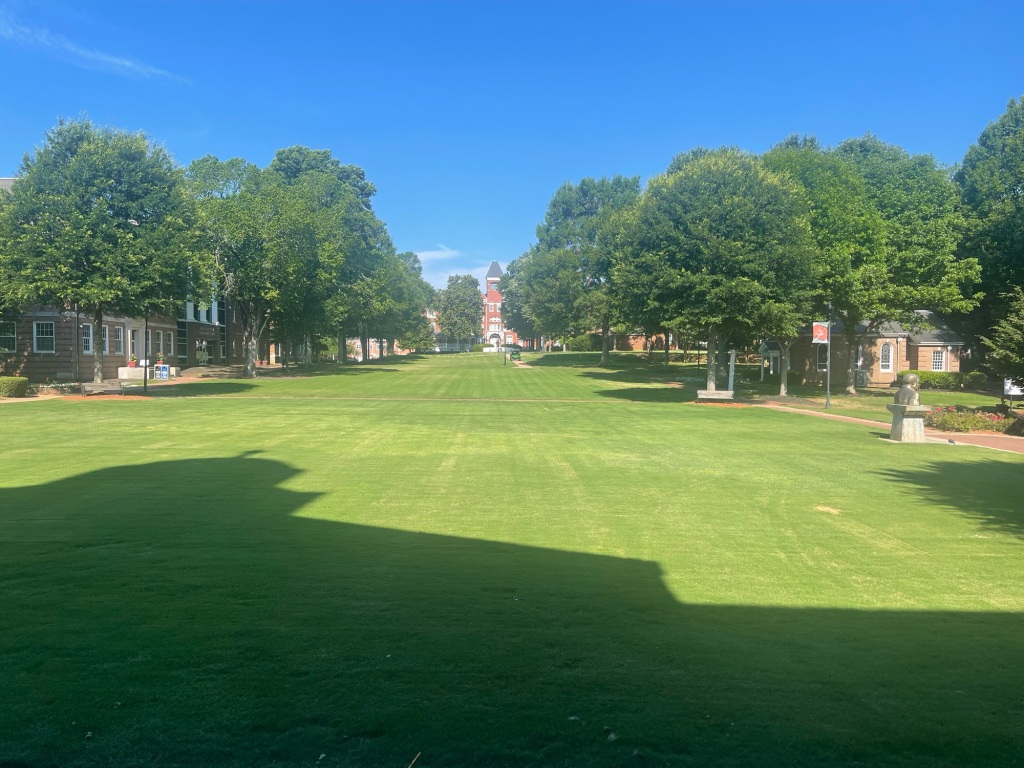
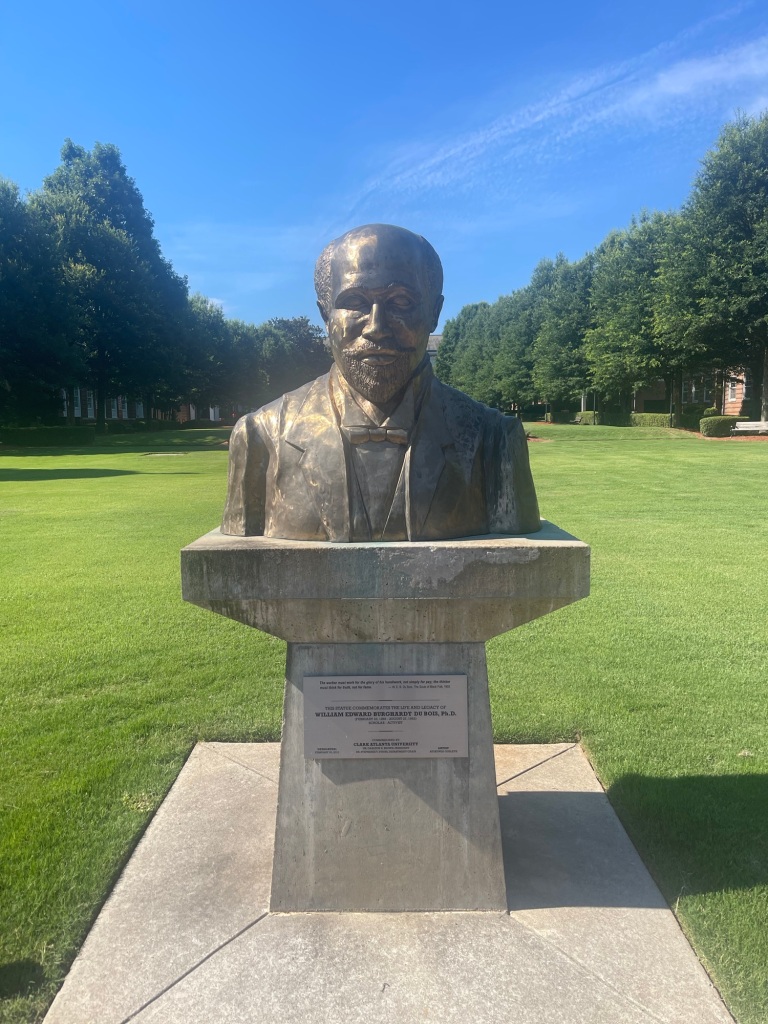
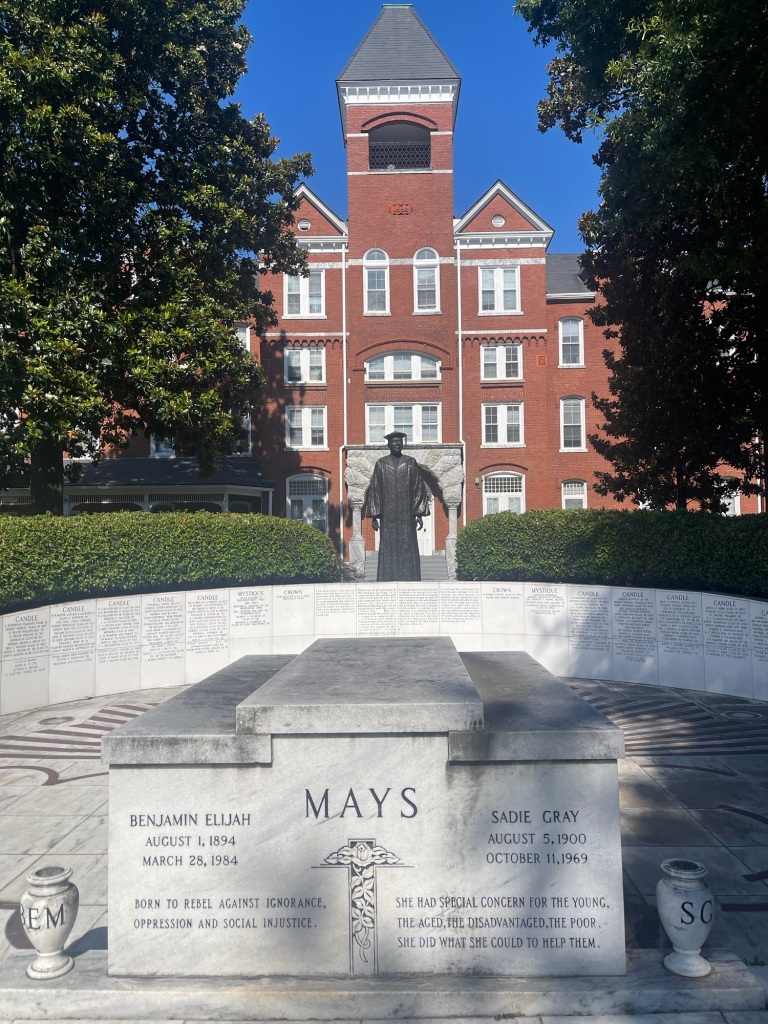
On the campuses of Morehouse and Clark Atlanta University whose lawns are adjoining and of course I had to make the pilgrimage in the southern heat to visit the grave and statue of Reverend Dr. Benjamin Mays and the bust of William Edward Burghardt Du Bois. (May we all Live Up To and Live Into their Words and Works-not one or the other but both.)

Leave a comment

Filed under Uncategorized

WPU Launches New Strategic Plan: WITH PURPOSE

Leave a comment

Filed under Uncategorized

June Newsletter President Message

Leave a comment

Filed under Uncategorized

GIFTS TO MAKE UP THE LOSS

GIFTS TO MAKE UP THE LOSS

“Dear Mr. Logan: I am very sorry about the loss of the barn and especially the cows and feed. We have needed for some time a larger and better barn and now I hope we shall get it. I leave matters regarding the barn to your judgment. I am going to have the loss published in all the papers and I hope there will be gifts to make up the loss. Will write more fully later. Yours truly.” – “November 24, 1895,” Booker T. Washington

Presidential Commentary by Dr. Brian Johnson

One can either confront challenging situations with a sense of despondency and despair or with a sense of unbridled hope and optimism, and the founding principal and president of Tuskegee Institute (University) chose the latter in the incident of “the loss of the barn.” Without question, the loss of a barn in the late 19th century was a significant financial loss. Mr. Logan, Mr. Washington’s treasurer-a modern-day chief financial officer-had indicated to him in a prior communication that the “insurance” loss was totaled at “fifteen hundred.” All the same, note Mr. Washington’s response to his CFO. First, he empathized with his colleague over the loss. He knew that Mr. Logan was both faithful and loyal to the university, and that had probably taken the loss personally. He recognized this in Mr. Logan but did not dwell up the darkness; he proceeded to the decision. Second, Mr. Washington took action. Creatively, he turned a negative incident and made it positive. He went to the papers to publicize the loss. One’s supporters-true supporters in both words and works-are often anxious to provide support if they are able to understand what the difficulties are. Lastly, he possessed hope that the loss might be leveraged into gain. He hoped that “there will be gifts to make up the loss.” Here again, the “Wizard of Tuskegee” was not merely a manager of the macro (public and visible) matters confronting the institution. Behind the curtains, indeed, he was a wizard at communications via the media to leverage a negative into a positive, which is the attribute of every successful leader of any successful organization.

1 Comment

Filed under Uncategorized

TWO HUNDRED AND FORTY-NINE DOLLARS

TWO HUNDRED AND FORTY-NINE DOLLARS

“My dear Mr. Rockefeller: I am sorry that the amount left over after the completion of Rockefeller Hall is not as large as I thought it would be, still I take great pleasure in returning to you in the enclosed check Two Hundred and Forty-nine ($249.00) Dollars. You do not know how very grateful we are to your father for this generous help. It has made a very large number of our boys much happier and placed them in a position to do better work than they have ever done before. I hope at some time your father can see the school that he has done so much to put upon its feet. The students and teachers would give him a great welcome if he could ever see his way clear to come. Yours very truly.”-“June 11, 1903,” – Booker T. Washington

Presidential Commentary by Dr. Brian Johnson

We find repeatedly in Booker T. Washington’s letters and writings to major donors and foundations three characteristics that are often looked at long before such donors and foundations make commitments to institutions and the men and women who lead them: Accountability, Stewardship and Sustainability. As to accountability, donors and foundations do not simply give to institutions and positions but to the persons in back of them. Firstly, accountability is akin to transparency. The founding principal and president of Tuskegee (Institute) University did not merely make requests for such donations, but he clearly expressed for what reason he was making such a request and for what purpose shall the donation be put to. Mr. Washington apologized in part that the request he had made was beyond what he anticipated: “I am sorry that the amount left over after the completion of Rockefeller Hall is not as large as I thought it would be…” (Here again, “integrity” is the single greatest 9-letter word and Mr. Washington was clearly panged that somehow his estimation was slightly above what he had communicated. A man of conscience, he did not think this a small matter to make such an apology. Rather he admitted this oversight on behalf of either himself or the institution.) Secondly, stewardship is the silentsister of accountability. As a “steward” indeed-anothergreat 7-letter word-he indicated thus: “…I take great pleasure in returning to you in the enclosed check Two Hundred and Forty-nine ($249.00) Dollars.” This man made no presumption that the additional $249.00 might have been spent for other purposes or placed within another institutional account to be used for other purposes. (He adhered to the twin sisters, accountability and stewardship, in all of his dealings so that there would be no questioning either his “integrity” or his “knowledge,” the second greatest 9-letter word.) Lastly, Sustainability is a nearly absent consideration for those engaged in the advancement and development of an organization. Donors and foundations seek to be associated with success and continued success. One gives to what can be sustained. (Has anyone ever given his or her dollars to an individual or an organization merely to waste without any sustaining power?) Givers desire to be continuous contributors to the on-going work and success of an individual and organization. As the individual and organization’s success is sustained, so is the reputation of both the giver and the gift. Hence, the founding principal and president’s parting request for Mr. Rockefeller to visit the campus directly: “I hope at some time your father can see the school that he has done so much to put upon its feet. The students and teachers would give him a great welcome if he could ever see his way clear to come.” Booker Washington knew that such men and organizations desired to “see” for themselves the effects of their giving; For what is sustainable can not only be seen,but also supplemented with future gifts for continuous, on-going success.

Leave a comment

Filed under Uncategorized

GOOD BUSINESS REPUTATION

GOOD BUSINESS REPUTATION

“…I have tried to pursue the policy of acting in a business-like prompt way especially when we are able to pay. I wish you would take up all these small accounts that are overdue and settle them. It is doubly necessary that an institution that depends for its living on begging money should keep a good business reputation. It is much more necessary than for an institution doing a strictly commercial business. It does not take long for a rumor to get circulated in any community to the effect that we are not businesslike and this hurts us in getting funds. For all these reasons it is very necessary that all the matters I am referring to in this letter be carefully, systematically and promptly attended to in your office. Some of the letters regarding the bills that I refer to I enclose.”– Booker T. Washington, “February 13, 1915”

Presidential Commentary by Dr. Brian Johnson

As the founding principal and president of Tuskegee (Institute) University, Booker T. Washington, repeatedly demonstrated during his 34-year long administration, the stewardship of one’s existing resources goes hand-in-hand with the petitioning of additional resources. And Mr. Washington here again describes, in what would be the last year of his life, an important philanthropic consideration between a non-profit institution like Tuskegee University-and similarly situated higher education institutions-as opposed to a for-profit “commercial business.” A non-profit institution seeks to serve a higher and greater good, and while profit and revenue are supremely important drivers in such institutions, its focus upon an area of societal need such as higher education makes profit generation only one of several considerations unlike “commercial business”. And this is why non-profit institutions rely upon philanthropic (fundraising) gifts to help support their efforts to serve the larger good. (In the case of Mother Tuskegee, the education and the comprehensive development of her students is the highest and larger good.) Notwithstanding, such a noble aim does not exempt a non-profit institution from “keep[ing] a good business reputation” particularly when it continuously seeks “funds” to support its mission and vision-its tradition and trajectory. Without respect to an institution’s noble ambitions, if it does not manage its existing resources in a manner that demonstrates that it can manage additional resources, it “hurt[s]” itself “in [the] getting [of] funds.” And Mr. Washington tells us precisely why it becomes “difficult” for others to give to it: “It does not take long for a rumor to get circulated in any community to the effect that we are not businesslike…” Moreover, if such a “rumor” is circulated in the kind of “community” that can actually provide a non-profit institution with major, transformational assistance in the pursuit of its noble aims then the hurt is extremely harmful. For no corporation, foundation, organization, entity or individual donor who has successfully stewarded its own fiscal resources will give them to another who has not successfully stewarded its own-however small or meager. These entities are also accountable to their own stakeholders, customers and constituents who rightly question where their gifts are directed, and stakeholders rest easier knowing that major gifts from entities they are vested in are going to non-profit institutions who will steward them appropriately. And Mr. Washington, who Tuskegee University celebrates in the centennial year since his passing (1915-2015), was the recipient of many such major, transformational gifts because he “carefully, systematically and promptly attend[ed]” to the stewardship of Mother Tuskegee’s resources from 1881-1915.

Leave a comment

Filed under Uncategorized

SPENDING YOUR NIGHTS AT HOME

SPENDING YOUR NIGHTS AT HOME

“You cannot hope to succeed if you keep bad company. As far as possible try to form the habit of spending your nights at home.” – Booker T. Washington, “A Sunday Evening Talk: On Influencing by Example”

Presidential Commentary by Dr. Brian Johnson

The adage that one is known by the company he or she keeps is an oft-expressed one, but the founding principal and president of Tuskegee University, Booker T. Washington, extends the adage even further both in the aforementioned passage and in another commonly quoted passage: “Associate yourself with people of good quality. It is better to be alone than in bad company.” Moreover, his additional suggestion to “try to form the habit of spending your nights at home” is a very practical one worth noting. Insofar as it is possible to discern from his autobiography, correspondence, letters, speeches-and more importantly his accomplishments-the man, Booker Washington, apparently did little else but read, write, work and stay at home with his family. And while it is easy to regard Tuskegee (Institute) University’s founding principal with an overwhelming sense of awe, one can begin to appreciate and understand him in view of his own self-discipline and self-sacrifice. (Everyone suffers but few suffer voluntarily. Yet, if one learns how to suffer, one will learn how to succeed.) One need not be reminded that everyone has the same 24 hours in a day, but how one spends those hours is what ultimately distinguishes men and women. (One would simply be amazed at how much more time can be committed to a meaningful mission or a purposeful project if time is not spent in (un)meaningful and (un)purposeful ones that do not result in progress.) Clearly, recreation, fun and leisure have their place but not if these things come at the expense of sustainable success. (Mr. Washington suggests that it is even better when one’s recreation, fun and leisure become part and parcel of one’s work.) For when an individual can transform his or her home into an extension of their workshop, they have the benefit of continuing, doubling and multiplying their labors when others have ceased from theirs.

Leave a comment

Filed under Uncategorized

A THOUSAND MILES AWAY

“[…] After the man was shot his son brought him to my house for help and advice, (and you can easily understand that the people in and about Tuskegee come to me for help and advice in all their troubles). I got out of bed and went out and explained to the man and his son that personally I would do anything I could for them but I could not take the wounded man into the school and endanger the lives of students entrusted to my care to the fury of some drunken white men. Neither did I for the same reason feel that it was the right thing to take him into my own house. For as much as I love the colored people in that section, I can not feel that I am in duty bound to shelter them in all their personal troubles any more than you would feel called to do the same thing in Washington. I explained my position fully to the man and his son, and they agreed with me as to the wisdom of my course. And I now state what I have not to any one before. I helped them to a place of safety and paid the money out of my own pocket for the comfort and treatment of the man while he was sick. Today I have no warmer friends than this man and his son. They have nothing but the warmest feelings of gratitude for me and are continually in one way or another expressing this feeling. I do not care to publish to the world what I do and should not mention this except for this false representation. I simply chose to help and relieve this man in my own way rather than in the way some man a thousand miles away would have had me do it.” – Booker T. Washington, “To Francis James Grimke,” November 27, 1895

Presidential Commentary by Dr. Brian Johnson

A man of Booker T. Washington’s eminence, position and stature was often criticized on a great many matters from persons who perhaps had his interest-or their own-at heart, but were wholly removed from the facts. Often in the case of leadership-particularly in the leadership of a vast organization such as Tuskegee Institute (University)-one must exercise tremendous restraint in responding to erroneous opinions, ill-informed recommendations or ill-advised suggestions. However, Mr. Washington’s response to what he perceived was a “false representation” of his character was another matter altogether.

During the difficult period of “Jim Crow,” many persons-white and black-held opinions about how the Tuskegee Principal should respond and react to racial atrocities as described in his letter to Grimke. In the present circumstance, Mr. Washington is responding to a letter from Grimke wherein the writer indicated that someone-“whose name [he had] forgotten”-relayed the circumstances of this event during a Bethel literary society meeting in Atlanta and that the founding Principal “refused to allow him to be brought in or the physician to attend him.” To Grimke’s credit, he went on to inform Mr. Washington that he felt it his “duty to apprise [him] of what was said.”

All the same, aside from Mr. Washington’s detailed correspondence communicating the circumstances aright to Mr. Grimke, he went on to provide additional facts concerning his activities that were intentionally not designed for public consumption or publication. It would be remiss to think or believe that Mr. Washington’s advocacy of industrial education or internal uplift and reform, was free from sympathetic interest to the political matters of his day.

Rather, Mr. Washington’s approach-as sound approaches often are-was marked by tact, sagacity and, most importantly, prudence. For Mr. Washington’s true audience was not political constituents who suggested what ought be done but the father and the son who were the beneficiaries of what needed to be done.

Leave a comment

Filed under Uncategorized

Calling is not Confined to Kin

Here is my latest article in Bill Winston’s Joseph Business School Magazine: “Out of Our Kin: Into Our Sacred Civic Callings”

https://indd.adobe.com/view/737e7141-b4eb-4003-9748-ac959c5f02b5

1 Comment

Filed under Uncategorized

Faith in Facts

FAITH IN FACTS

“I have great faith in the power and influence of facts.” – Booker T. Washington, Up From Slavery (1901)

Presidential Commentary by Dr. Brian Johnson

Men and women who possess leadership responsibilities beyond their own persons would be hard pressed to find any better ally or supporter than facts. And men and women of the ilk of Booker T. Washington, founding principal and president of Tuskegee (Institute) University, marshaled both favorable or unfavorable facts to similar ends. It is simply not true that one should keep one’s eyes open to favorable facts while closing one’s eyes to unfavorable facts. Mr. Washington’s penchant for earnestness, frankness and directness in his communications to donors and external constituencies always commingled both favorable and unfavorable facts.

As to favorable facts, one ought always communicate what the organization does well in a clear, documentable and evidentiary fashion. (An outcomes-oriented organization need not rely upon fables when facts are present.) On the other hand, communicating unfavorable facts is equally important.

Whether one concedes it or not, everyone knows when something “is not right.” A plain statement and admission of an organization’s current environment is one of the clearest telltale signs of organizational integrity. (Hear again, “integrity” is the single greatest 9-letter word.)

For Mr. Washington did not merely state that all things were always favorable. (Why would anyone seek outside help if all things, as they currently exist, are favorable? Any petition for aid immediately pronounces the opposite. For no one asks for help when there is no need for it.) Instead, he oft-times made a plain statement of the organization’s current environment while positively projecting its target environment.

In this regard all successful outside entities have empathy towards such an organization because a right understanding of one’s current environment with a view towards its target environment necessitates a commingling of both facts that are favorable and unfavorable.

1 Comment

Filed under Uncategorized

“W.E.B. Du Bois in African American Intellectual and Christian History,” George Fox University President’s Lecture

View President Johnson’s lecture, “W.E.B. Du Bois in African American Intellectual and Christian History,” at George Fox University here: https://vimeo.com/914646303

https://vimeo.com/914646303?share=copy&fbclid=IwAR15O_4DvSuhX9Lv1ue5udNJdBsx_0S9FJRja80oFwCn8yKOhLdTPgKTJeI_aem_AVEwOz2FTQQmEJ83m_ITLqlgtl3DxclVm6LAfOlm5rc9QGU_w326RbBGqZhA3dCsUJA

1 Comment

Filed under Uncategorized

“W.E.B. Du Bois in African American Intellectual and Christian History,” at George Fox University live here:

View President Johnson’s lecture, “W.E.B. Du Bois in African American Intellectual and Christian History,” at George Fox University here: https://vimeo.com/914646303

https://vimeo.com/914646303?share=copy&fbclid=IwAR15O_4DvSuhX9Lv1ue5udNJdBsx_0S9FJRja80oFwCn8yKOhLdTPgKTJeI_aem_AVEwOz2FTQQmEJ83m_ITLqlgtl3DxclVm6LAfOlm5rc9QGU_w326RbBGqZhA3dCsUJA

Leave a comment

Filed under Uncategorized

30 Students

30 Students

“My dear friend Mr. Briggs: I will open school the 1st Monday in July. Judging from present prospects I shall have about thirty students the first day and a steady increase…” – Booker T. Washington, June 28, 1881

Presidential Commentary by Dr. Brian Johnson

On June 28, 1881, a 25-year old Booker T. Washington had enrolled 30 students before Tuskegee Institute (University) was officially founded on July 4, 1881. While this was clearly a noteworthy moment at the onset of his presidency, this is not what is most startling about the first of many achievements that this young president would accomplish during his subsequent 34-years at the helm of Tuskegee (Institute) University. This young man’s single most signal historic achievement-in this writer’s opinion-occurred on June 24,1881, which is the date that this student and teacher who had been trained by General Samuel Armstrong of Hampton Institute, arrived in Tuskegee, Alabama. (We know this because on June 25, 1881 Mr. Washington wrote to James Fowler Baldwin Marshall the following: “Dear friend: Arrived here yesterday.”) And it was on that day that a “Copernican Revolution” in the landscape of higher education occurred, not only in Tuskegee but in the history of the world. For this young man’s arrival (to start an institution of higher learning for newly freed African Americans) reverberated and transcended not simply the city of Tuskegee and the county of Macon, but the entire world. These 30 men and women who were likely still using skill sets acquired during enslavement would now be afforded the opportunity to use these skills to gain their own economic and intellectual independence. They need not work for their former masters with little distinction in pay from the time of physical bondage. After the training of their hearts, heads and hands within this new institution of higher learning called Tuskegee Normal School (Institute) University, they could now use their own skill sets to start their own businesses and offer their services in a much more economically viable exchange between formerly enslaved men and women and their former masters. And this perhaps ranks atop of the many other significant reasons why we celebrate Booker T. Washington in this the centennial year (1915-2015) since his passing.

Leave a comment

Filed under Uncategorized

Dr. Brian Johnson to Lecture on W.E.B. Du Bois at George Fox University

https://www.georgefox.edu/news-releases/brian_johnson_lecture.html

Leave a comment

Filed under Uncategorized

Heart-Head-Hands

HEART-HEAD-HANDS

“We can fill your heads with knowledge, and we can train your hands to work with skill, but unless all this training of head and hand is based upon high, upright character, upon a true heart, it will amount to nothing. You will be no better off than the most ignorant.” – Booker T. Washington, A Sunday Evening Talk


Presidential Commentary by Dr. Brian Johnson

In this writer’s opinion, “INTEGRITY” is the greatest 9-letter word, “KNOWLEDGE” is the second greatest, and “IGNORANCE” is-by far-the worst and most dangerous. And the founding principal and president of Tuskegee (Institute) University, Booker T. Washington, gives on this Sunday evening talk his oft-repeated conception of “heart-head-hands” to help his students avoid the dread of becoming “no better off than the most ignorant.”

One can easily seek the help of professors to develop one’s “head”. (These men and women have as their primary purpose to fill the “heads” of students with “knowledge”.) Likewise, professors are able to help make a student’s “hands”-or their work-“skill”[ful]. (Through repeated instruction and correction a student will either become skillful at their work or they will receive failing grades.) Yet, the matter of the “heart,” Mr. Washington suggests, is one matter where students must begin and complete this work largely alone.

(Let no man or woman ever presume to become an expert on the subject of another’s heart.) Of all subject matters, it is the one that is deeply personal and unique to the individual. Whereas both the competencies of the “head” and the credentials of the “hands” lie in full view, the “heart” is always hidden from view. Yet, without it, all else “will amount to nothing.”

For Mr. Washington’s complete configuration of Heart-Head-Hands in education is akin to the strength necessary to shoot arrows a great distance even as Booker T. Washington shot forth the sons and daughters of Booker into rewarding and meaningful careers of service for over 133 years. The heart is the unseen and invisible strength that determines how far one can bend the bow to make the arrow go.

Leave a comment

Filed under Uncategorized

Capitol Hill and White House Visits

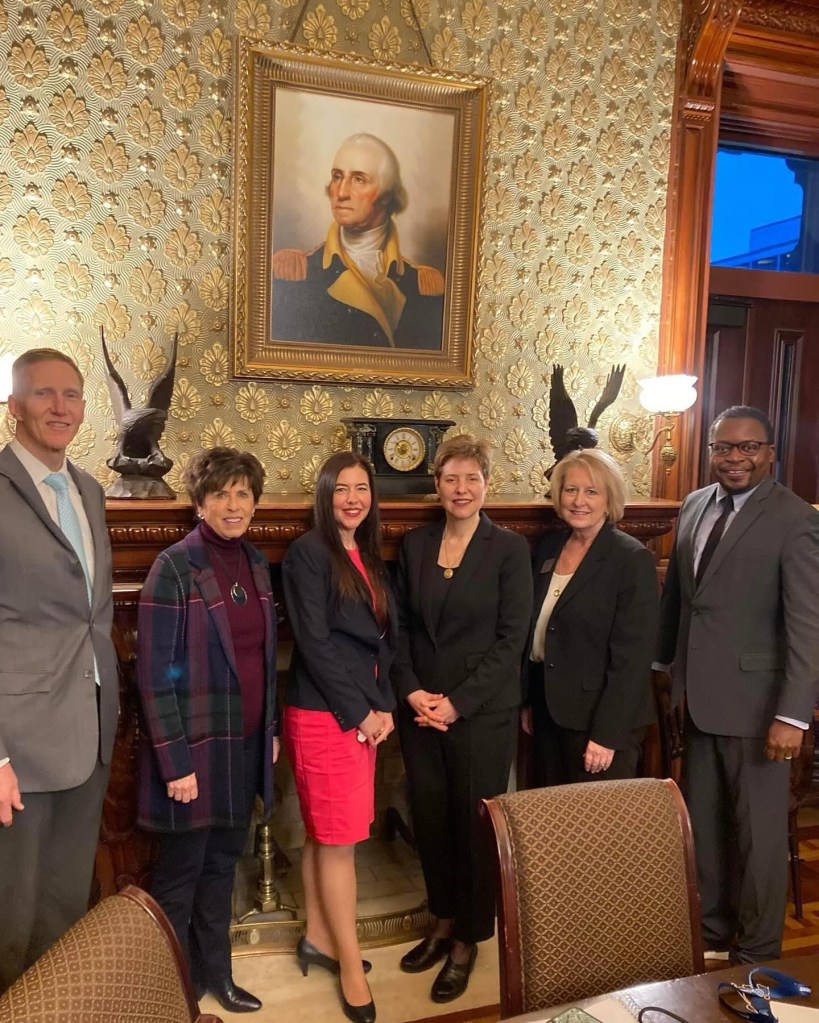
Great Day on Capitol Hill and at White House visiting Oregon senators and White House officials on our forthcoming grants and congressional requests. #wpuknights

Leave a comment

Filed under Uncategorized

Did Not Answer Him A Word

Did Not Answer Him a Word

1 Kings 18:21

21 And Eli’jah came near to all the people, and said, “How long will you go limping with two different opinions? If the LORD is God, follow him; but if Ba’al, then follow him.” And the people did not answer him a word.

KJV

Commentary by Brian Johnson, Ph.D.

Seldom will one receive confirmation from others about a God-given purpose for your life without some tangible sign or demonstration. Even the man of God, Elijah, experienced the same.For before the fire of the Lord fell upon Elijah’s burnt sacrifices in his competition with Baal’s prophets, “the people did not answer him a word.” To be sure, such demonstrations here within our own time need not be equally miraculous. Yet and still, whosoever would desire to have others to sign on or confirm a God-given purpose that has been assigned to you and no other, let this man or woman be prepared to show forth signs, wonders and evidence that demonstrate to all involved (including one’s opponents) that what he or she speaks is so. Consider Moses and Aaron.

The two went first–not to the people–but the elders, for in doing so, they would not usurp the authority of those who were in leadership. These elders had been laboring as leaders while the people were suffering in bondage, and deserved such honor. (If one has been truly sent by God, he or she will need no “gimmick,” but a plain demonstration of what God has spoken and done (words and works) and it will be all that is necessary to convince mature elders who had to acknowledge that what Moses and Aaron had spoken was so. Lastly, having their vision (bore witness to, not approved) by men, they proceeded to the people, for it would be their willingness to follow that is the single most important value for he or she that makes a claim about their own visionary leadership. (For God ideas are vision, and good ideas are simply good ideas.)

“And at the time of the offering of the oblation, Eli’jah the prophet came near and said, “O LORD, God of Abraham, Isaac, and Israel, let it be known this day that thou art God in Israel, and that I am thy servant, and that I have done all these things at thy word. Answer me, O LORD, answer me, that this people may know that thou, O LORD, art God, and that thou hast turned their hearts back.” Then the fire of the LORD fell, and consumed the burnt offering, and the wood, and the stones, and the dust, and licked up the water that was in the trench. And when all the people saw it, they fell on their faces; and they said, “The LORD, he is God; the LORD, he is God.”

Leave a comment

Filed under Uncategorized

Titles

TITLES

“I do not say you should not use them, should not possess them, should not crave them, but do not make the mistake of feeling that titles are going to help you, unless you have got strength aside from the title. No amount of titles will put brains into a person’s head if the brains are not there before.” – Booker T. Washington, “A Sunday Evening Talk,” January 10, 1909

Presidential Commentary by Dr. Brian Johnson

Hear this again and again: Positional and titular authority is the lowest form of authority. If a man or woman cannot nor does not command the respect of his supervisors, peers, colleagues and subordinates independent of a position or title, this man or woman is no greater than the man or woman who has no such position and title. Positions change, and the only permanence one can possess is that found in one’s own person in back of the position.

This is why the founding principal and president of Tuskegee University constantly impressed upon his students the need to constantly improve their own persons. Note the following: It is but half the task to secure the title or position. The most significant half is what one does with the title or position. (One must not only plan how to get the position or title, but what to do with the position and title when one gets it.) And the attention paid to one’s own person helps towards this end. Aside from acquiring credentials and competence, the comprehensive development of one’s CHARACTER is a third facet that can never be taken from the person in back of a position. (Character is not your highest moment or your lowest moment. Character is your most consistent moment.)

More importantly, Character is easily transferable from position to position, unit to unit or organization-to-organization, which is why the singular, solitary focus upon a position and title (as opposed to the development of one’s own person) is unwise. For the man or woman who has “strength aside from the title” and who has “brains” in their “heads” will always possess these attributes without regards to a position or a title. (And they will always be desired and in demand.) And the founding principal and president of Tuskegee University who we celebrate in the centennial year since his passing (1915-2015) was not only such a man, but he also offered these wise “words” and set forth the accompanying “works” in his 34-year long presidency at the helm of Tuskegee (Institute) University (1881-1915).

Leave a comment

Filed under Uncategorized

BECOMES A TREE

Becometh a Tree

Matt 13:31-32
31 Another parable put he forth unto them, saying, The kingdom of heaven is like to a grain of mustard seed, which a man took, and sowed in his field:
32 Which indeed is the least of all seeds: but when it is grown, it is the greatest among herbs, and becometh a tree, so that the birds of the air come and lodge in the branches thereof.
KJV

COMMENTARY BY BRIAN JOHNSON, Ph.D.

Throughout scripture, trees often represent that which has come into full maturity, thus providing fruit to feed upon, lodging to rest within, shade to comfort and a host of other uses. And the mustard tree is no exception. Most are well aware that the mustard seed is a very tiny seed, which upon first inspection does not appear to be able to eventually become a tree some 9-15 feet tall. However, the intrinsic qualities of this seed are equally remarkable. The seed is persistent and possesses a vigor and vitality that responds best in hostile climates and conditions. It seems to function best where it appears least likely to flourish. No less is the case when we begin with a seed of faith for the desires of our hearts. (For who hath despised the day of small beginnings?) Faithfulness in character, wisdom, service, vocation, finances, family, and a host of other things is not an overnight process. (Rather, the path of the just is as the shining light, that shineth more and more unto the perfect day.)

Leave a comment

Filed under Uncategorized

Warner Pacific University President Named CIC Pioneering President

Warner Pacific University’s President, Brian Johnson, Ph.D. has been named a “Pioneering President” by the Council of Independent Colleges, recognized for his leadership in navigating WPU’s unique dual identity, strategic recovery post-pandemic, and personal journey as the first African American president in WPU’s history. Dr. Johnson is honored to share insights at the national summit, supported by a Mellon Foundation grant, to establish a roadmap for future groundbreaking leaders in higher education. Read more here:

https://www.warnerpacific.edu/dr-brian-l-johnson-named-a-pioneering-president-by-council-for-independent-colleges/

WarnerPacificUniversity #WPU #WithPurpose #CouncilofIndependentColleges #PioneeringPresident #HigherEducation #President #University #ChristCentered #MinorityServing

Leave a comment

Filed under Uncategorized

Dr. Brian Johnson Named (CIC) Pioneering President

Leave a comment

Filed under Uncategorized

On John Silvanus Wilson’s Hope and Healing

Delighted to have read his new book and listen to John Silvanus Wilson’s (former President of Morehouse College) panel on the same topic at this year’s CIC Council of Independent Colleges President’s Institute Conference: Hope and Healing: Black Colleges and the Future of American Democracy A very thorough discussion in the book on the legacies of Booker T. Washington, W.E.B. Du Bois, Tuskegee University (Institute) and the future of Black Colleges.

1 Comment

Filed under Uncategorized

Some Strange Tongue

“In the early days of freedom, when education was a new thing, the boy who went away to school had a very natural human ambition to be able to come back home in order to delight and astonish the old folks with the new and strange things that he had learned. If he could speak a few words in some strange tongue that his parents had never heard before, or read a few sentences out of a book with strange and mysterious characters, he was able to make them very proud and happy. There was a constant temptation therefore for schools and teachers to keep everything connected with education in a sort of twilight realm of the mysterious and supernatural. Quite unconsciously they created in the minds of their pupils the impression that a boy or a girl who had passed through certain educational forms and ceremonies had been initiated into some sort of secret knowledge that was inaccessible to the rest of the world. Connected with this was the notion that because a man had passed through these educational forms and ceremonies he had somehow become a sort of superior being set apart from the rest of the world […]” – Booker T. Washington, _My Larger Education__(1911)

Presidential Commentary by Dr. Brian Johnson 

While the term “esoteric” is not entirely pejorative-it can mean that members within a certain profession or group understand and converse sharing many of the same assumptions or terminology-it is sometimes used to denote exclusivity meaning that information and knowledge is understood by a chosen few. In the present passage, the founding principal and president of Tuskegee University speaks to this latter formulation. Here he laments that often education-the act of teaching and learning-resembles the closing off of knowledge from others as opposed to its wide dissemination among many. Mr. Washington’s idea is that such knowledge ought to have relevancy and application for others beyond the sole possessor of this knowledge. Imagine that. The idea of education should not be exclusive to a limited few but should enlighten and have impact upon others in beneficial ways. Thus, not only are the recipients all the better for having received this knowledge but also the giver of this knowledge is made better. For this man or woman has completed the complete cycle of education. First you learn, master and apply for yourself. (It is is a poor teacher whose words do not resemble his or her works.) Then you proceed to teach others. And such an education can be found at many institutions of higher learning including Tuskegee Institute (University).

Leave a comment

Filed under Uncategorized

Winter 2023 Commencement Warner Pacific University

Another WPU Commencement in the books:
“Careers fill Pockets; Callings fulfill People; Careers linked to Callings fulfill great Purposes for People.” #wpuknights #withpurpose #warnerpacificuniversity #wpucommencement

1 Comment

Filed under Uncategorized

SPENDING YOUR NIGHTS AT HOME

SPENDING YOUR NIGHTS AT HOME

“You cannot hope to succeed if you keep bad company. As far as possible try to form the habit of spending your nights at home.” – Booker T. Washington, “A Sunday Evening Talk: On Influencing by Example”

Presidential Commentary by Dr. Brian Johnson

The adage that one is known by the company he or she keeps is an oft-expressed one, but the founding principal and president of Tuskegee University, Booker T. Washington, extends the adage even further both in the aforementioned passage and in another commonly quoted passage: “Associate yourself with people of good quality. It is better to be alone than in bad company.” Moreover, his additional suggestion to “try to form the habit of spending your nights at home” is a very practical one worth noting. Insofar as it is possible to discern from his autobiography, correspondence, letters, speeches-and more importantly his accomplishments-the man, Booker Washington, apparently did little else but read, write, work and stay at home with his family. And while it is easy to regard Tuskegee (Institute) University’s founding principal with an overwhelming sense of awe, one can begin to appreciate and understand him in view of his own self-discipline and self-sacrifice. (Everyone suffers but few suffer voluntarily. Yet, if one learns how to suffer, one will learn how to succeed.) One need not be reminded that everyone has the same 24 hours in a day, but how one spends those hours is what ultimately distinguishes men and women. (One would simply be amazed at how much more time can be committed to a meaningful mission or a purposeful project if time is not spent in (un)meaningful and (un)purposeful ones that do not result in progress.) Clearly, recreation, fun and leisure have their place but not if these things come at the expense of sustainable success. (Mr. Washington suggests that it is even better when one’s recreation, fun and leisure become part and parcel of one’s work.) For when an individual can transform his or her home into an extension of their workshop, they have the benefit of continuing, doubling and multiplying their labors when others have ceased from theirs.

Leave a comment

Filed under Uncategorized

Thanksgiving Message November 2023

Leave a comment

Filed under Uncategorized

NO INFLUENCE WOULD EVER MAKE ME A SLAVE IN SOUL

NO INFLUENCE WOULD EVER MAKE ME A SLAVE IN SOUL

“I have been a slave once in my life-a slave in body. But I long since resolved that no inducement and no influence would ever make me a slave in soul, in my love for humanity, and in my search for truth.” – Booker T. Washington, (1907) The Negro in the South

Presidential Commentary by Dr. Brian Johnson

In a little-known, yet most noteworthy moment in the history of both American and African American literary and intellectual history, Booker T. Washington jointly published the book, The Negro In the South (1907) containing 2 essays from himself and 2 other essays from none other than W.E.B. Du Bois. (And this was not their first co-publication. This would be the second book containing these two stalwarts in American and African American educational and intellectual history.) All the same, in the first of Mr. Washington’s two essays, he makes the distinction between being a “slave in body” versus being a “slave in soul.” Note the following concerning the remarks of the founding principal and president of Tuskegee (Institute) University: He made a strategic, calculated set of decisions to ensure that his outward circumstance would not determine his future circumstances. (And these decisions revolved around a “love for humanity” and a “search for truth”, which will always place the “lover” and “seeker” of such beyond the pale of those whose pursuits are self-interested and selfish.) First, a lover of humanity is unafraid to come to learn to love others because he or she has first come to love himself. One can hardly come to learn others if one does not possess a deep love for one’s self, and this includes learning to love both the learned and the ignorant. For a man or woman who ascended to leadership, as Mr. Washington had done, not only encountered both but had been both during his long ascent Up From Slavery. Second, the seeker of truth seeks after that which is right without regard to where this truth leads. Leo Tolstoy eloquently suggests the following about such a principle: “If you wish to know the truth, first of all free yourself from all considerations of self-interest.” Whether the truth Mr. Washington discovered was for the benefit or detriment to himself or not-“integrity” is the single greatest 9-letter word-this pursuit is without question what leads to 34 years of ongoing, consistent and enduring success for Tuskegee (Institute) University. For unbroken, undivided and unwavering consistency and wholeness is perhaps the closest description of both “truth” and Mr. Washington’s presidency that has served and will continue to serve generations of “humanity.” And this is why we celebrate his accomplishments in this the centennial year of his passing (1915-2015).

Leave a comment

Filed under Uncategorized

November 14, 1915

“[New York City Nov. 10, 1915] [To Alexander Robert Stewart] Be sure my yard is well cleaned.” – Booker T. Washington

Presidential Commentary by Dr. Brian Johnson 

In all likelihood, this was the final letter written by the eminent founding principal and president of Tuskegee Institute (University). (For Booker T. Washington died on Sunday morning November 14, 1915-not 5 days later-after requesting to return to Tuskegee, Alabama to spend his final days.) Until his death, Mr. Washington wrote several short letters with instructions to his colleagues in Tuskegee with the above being the last: “Be sure my yard is well cleaned.” While one may regard this final communiqué as someone who regarded his yard more important than his soul, this is not so. For this final writing was a reflection of his soul indeed-a soul devoted to his work.

Tales abound in the Tuskegee community about Mr. Washington’s intense devotion to work, and there is no greater joy for a man or woman than to be engaged in a line of work that honors both the souls of men and their own. Mr. Washington spent countless hours in the yard and in the garden working, when time and travels permitted. Mr. Washington took great pride in the now world-renowned “Oaks,”-the president’s home at the time, located on the Tuskegee University campus, the only national park on a fully functioning college campus.

Annually, thousands of visitors trek across the nation and the world to visit the home site of Tuskegee’s founding principal and president. So perhaps Mr. Washington’s final concern for his yard being cleaned was not only for that generation but also for the many future generations that would follow in the 100 years since his death.

Leave a comment

Filed under Uncategorized

“Out of Your Kin and Into Your Call” (Rev. 5:9-10) Dr. Brian Johnson, Mid-American Christian University Chapel November 2, 2023

Mid-American Christian University 70th Anniversary Chapel, Dr. Brian Johnson speaker: “Out of Your Kin and Into Your Call” November 2. 2023


https://youtu.be/tGT9IMeHgGY

Leave a comment

Filed under Uncategorized

JUDGMENTS OF OLD

Judgments of Old

Ps 119:52

52 I remembered thy judgments of old, O LORD; and have comforted myself.

KJV

One way to have a glimpse into what God is doing now in our individual, national and global affairs is to carefully consider what He has already done in the affairs of those individuals, nations and generations who have gone before us. And there is no better record of God’s activities among men than to consider the judgments of old found in scripture. To be sure, having a glimpse does not amount to absolute certainly about God’s present plans and purposes (for such omniscience belongs solely to God), it simply confirms what God declares about himself, “I am the LORD, I change not.” This is what the psalmist is comforted by when He remembers these judgments. By considering the many fulfilments of God’s holy promises–regarding obedience and disobedience–it has the effect of both assuring and comforting us about the integrity and endurance of God’s Word, particularly when we align ourselves with those things that pleased Him in times past; For what pleased Him or displeased Him in times past is what pleases Him and displeases Him now. Therefore remember his marvellous works that he hath done; his wonders, and the judgments of his mouth. There has not failed one word of all his good promise.

Leave a comment

Filed under Uncategorized

Partnership with Mark Cuban Foundation

https://m.facebook.com/story.php?story_fbid=pfbid035xuAdZbPubLcuK2JvgSEA7PDBqE1P9YCrnMTm6gkvHC4z26XJSC67zr9JXWEvJv4l&id=1175555448

Leave a comment

Filed under Uncategorized

President October Message

Leave a comment

Filed under Uncategorized

A Cool $3M for Warner Pacific University

https://www.bizjournals.com/portland/news/2023/10/17/warner-pacific-3m-grant.html

Leave a comment

Filed under Uncategorized

The Tuskegee spirit

The “Tuskegee spirit”

“It seems appropriate during these closing days of the school year to re-emphasize, if possible, that for which the institution stands. We want to have every student get what we have-in our egotism, perhaps-called the “Tuskegee spirit”; that is, to get hold of the spirit of the institution, get hold of that for which it stands; and then spread that spirit just as widely as possible, and plant it just as deeply as it is possible to plant it.” “Last Words: A Sunday Evening Talk,” – Booker T. Washington

Presidential Commentary by Dr. Brian Johnson

Upon the last Sunday evening talk given at the close of the academic year, Booker T. Washington encouraged his hearers to come to learn of, embrace and finally disseminate the “Tuskegee spirit.” (There is something different about Tuskegee University.) It cannot be singularly explained by the eminence of its founding principal and president. It cannot be explained by the eminence of George Washington Carver. It cannot be explained by the aura associated with the “Tuskegee Airmen” whose feats are now known and respected worldwide. One simply cannot come upon the campus of Tuskegee University and not immediately be confronted with an overwhelming sense of the past meeting the present in deeply profound ways. For the “Tuskegee spirit” is what bounds not only its students and alumni but also its faculty, staff, administrators and presidents. It is a living, breathing pride in its beginnings, its present and its future-a future that is interwoven within the lives of every individual that has come upon the grounds of this sacred land. The “Tuskegee spirit” is none other than the spirit of a people-a great people embodying the very best and brightest in any and every tradition the world has ever known.

Leave a comment

Filed under Uncategorized