Category Archives: Uncategorized

On The Passing of Rodney Rogers

Rodney Rogers recently passed. He was a Durham native hailing from inner city Durham North Carolina-specifically MacDougal Terrace. He eventually went on to play for Wake Forest University where he was ACC rookie of the year in 1991 then ACC player of the year in 1993 and had a reputable 12-year career in the NBA culminating in the sixth man of the year award in 2000.

Most cannot appreciate growing up in inner city Durham North Carolina and observing a verifiable hero who was assured to transcend the environments many of us were born into. Affectionately known as “T Tot” for those of us who grew up with him, he was arguably, the only person we knew who would make a life most would describe as recognizable. Though humble–T Tot was bigger, stronger and any other word you wish to describe him–yet knowing this he went out of his way to be one of us.

I was on the middle school football team with Tot at Holton Middle School which is now an alternative school. He was in 8th grade and I was in 7th. T-Tot played quarterback as well as starring on the basketball team. His aura was such that at least for me it was overwhelming. (T TOT was late for a game we played on the jamboree held at North Carolina Central University. They sent someone to pick him up and the whole team waited until his arrival.) Yet, no one cared. We weren’t gonna win without him. (Although Roger’s Herr Middle School beat us soundly with many of the teammates–including the Hunter twins, Ronnie and Tony, cousins of my my best friend growing up Neal Hunter–he would eventually join at Hillside High School where he played football and eventually starred as a 9th grader when the legends began.) Those who grew up with him in MacDougal Terrace would definitely stand to differ as his feats began well before even this time.

For me, playing with T TOT was a life changing experience. One such event demonstrates this. We were playing Oxford and T TOT and the first teamers had pushed the score so far that the 7th graders like me could get in. (I was second or even third team end receiver.) When the second team was called, I was able to play. I had only played twice 7th grade year.

We ran an out and the back up quarterback Wayne Harrington, “Wild Man,” called a play designated for me. It was an 10 yard and out to the right. We ran the play. Wild Man hit me. I caught it. (I froze in fear) and did not run though there was an entire field in front of me. I was eventually tackled. (I can’t tell you how often I allowed fear to stop me.)

The next day at school, I ran into TOT and he said: “BJ why didn’t you keep running?’ I looked at him and could not answer a word and actually left him hanging because I could not even begin to hold a conversation with someone I had such a profound respect for. I could later remember when he was was in 12th grade playing basketball and I was in the 11th grade playing for Durham High School, another defunct school in Durham, North Carolina and later rebranded as the Durham School of the Arts. (Hillside with Andre McCollum, Larry Johnson and Rodney were beating everyone in our PAC 6 conference.) None of us could match their talents except our own Antonio O’Neal at Durham High who didn’t have sufficient help.

T TOT caught the ball and they were winning by like 20 or more points and I alone was defending the basket during garbage time. (He lost it out of bounds.) Similarly, I flashed backed to 7th graders and I know I had no idea how I could ever confront him on a breakaway. I later recalled speaking with him joking that “he was lucky he lost the ball.” He only smiled and grinned.

I share this because his impact on forging the identities of those in inner city Durham and all who had any proximity to him was such that it was a life changing experience. (This man was a living hero and everyone perhaps besides his closest friends and family can remember what he said to them or their brief interaction with him.)

I took from T TOT the need to be strong, courageous and fearless which eventually led me to my faith. I did not keep running in 7th grade or when I was glad–and clearly fearful—that he lost the ball out of bounds in 11th grade when he was a senior in-route to Wake Forest University; All the same, Rodney Rogers inspired in me and all who grew up with him in Durham, North Carolina to live life unafraid and to learn to “keep running.”

Leave a comment

Filed under Uncategorized

One Generation Gathers…The Next Generation Builds

“Phillips Brooks gave expression to the sentiment: ‘One generation gathers the material, and the next generation builds the palaces.’ As I understand it, he wished to inculcate the idea that one generation lays the foundation for succeeding generations.” – Booker T. Washington, Future of the American Negro (1899)

Presidential Commentary by Dr. Brian Johnson 

Any institutional or organizational leader would be remiss–no fool hearted–if he or she did not first look to, then build upon and, finally, greatly improve upon the foundation of the past–particularly when that foundation is as solid and substantive as that which is founded in 1881 at Tuskegee (Institute) University. (And this writer believes that the founding principal and president of Tuskegee, Booker T. Washington, was prescient enough to know that his was a foundation that any man or woman could build “palaces upon.”)

Preparation, planning, purpose and performance are the hallmarks of sound management practices in any leadership and management paradigm, and a leader must not only prepare and plan on how to ascend to institutional leadership, but what to do with it once he or she gets it. One certain way of doing this is to return to the founder’s “foundation.” Booker T. Washington laid a rock-solid foundation based upon personal and organizational “integrity,” the greatest 9-letter word.

In perusing through some 34 years of this man’s letters, books and correspondence, one finds that “integrity” is the most consistent and persistent attribute permeating within each writing or speech. Whether writing or speaking to persons small or great, he installed a vision on the basis of being truthful, honest and earnest in all his dealings, and such attributes appealed to both external and internal constituents alike-particularly when seeking major, transformational gifts like Booker T. Washington secured. (The best institutional leaders and organizations are “transparent,” “consistent,” “communicative,” and “collaborative”.)

What the man, Booker Washington, spoke, wrote and did concerning Tuskegee University in one arena was consistent with what he spoke, wrote and did concerning Tuskegee University in another arena, thus forming an unbroken chain of integrity on which he built the foundation of Tuskegee. This integrity extended not only to the world-renowned bricks of Tuskegee’s oldest buildings, but also to the foundational philosophy of Tuskegee University and its founder.

Leave a comment

Filed under Uncategorized

Jewish Federations-General Assembly-Brian Johnson, Ph.D.

Look forward to being in DC with colleagues and sharing with the #generalassembly on these important topics for our time.

Leave a comment

Filed under Uncategorized

SPEAKING THE TRUTH IN LOVE

“But speaking the truth in love, may grow up into him in all things, which is the head, even Christ:” Ephesians 4:15

In this particular passage, Paul in his letter to the Ephesians distinguishes the ministry of called and chosen church leaders (apostles, prophets, evangelists, pastors and teachers) from those who would “deceive” others through “cunning,” “craftiness” and “sleight” (Ephesians 4:14). Yet, even in this, the apostle’s distinction –“speaking the truth in love”–has often been distorted. For deception often feigns the attributes of “love” at the expense of communicating “truth”.

Somehow the notion of “speaking the truth in love” has been stripped of “truth” in deference to how “truth” makes the recipient feel or how it is delivered. (Who has ever received correction and did not “smart at the rod”? Or in postmodern terms, who has not felt pain upon being corrected or having the truth spoken to him or her?)

While it is important to communicate with as much gentleness and kindness as one can muster, it is no small wonder to observe “truth” being so stripped of its power and potency in our time owing to postmodern notions of how it makes the recipient feel. (It even gives deceivers greater advantage and greater opportunity, for these have the opportunity to deceive as long as they do not make the hearers feel bad.) All the same, perhaps the most signal way in rightly distinguishing Paul’s ministry from others is simply this: Those who love the most, speak the most truth.

Still further, in his letter to the Hebrews, Paul extends this notion when he speaks more extensively about “fathers” who “correct” and “discipline” sons for their benefit (Hebrews 12: 5-11): “For whom the Lord loveth he chasteneth and scourgeth every son whom he receives” (Hebrews 12:6). And finally we need not look any further than the Lord in his dealings with men who like a parent seeks to raise his children by “speaking the truth in love.” Through John the Revelator, he writes, “As many as I love, I rebuke and chasten…” (Revelation 3:19a).”

Notwithstanding the need to communicate in “love, joy, peace, long suffering, gentleness, goodness, faithfulness, meekness and self-control,” (Galatians 5:22), if the message of “love” is devoid of “truth,” it is wantingly winsome at best–and deceitfully destructive-at worst.

Leave a comment

Filed under Uncategorized

THINGS OLD AND NEW

Matt 13:51-52

51 Jesus saith unto them, Have ye understood all these things? They say unto him, Yea, Lord.

52 Then said he unto them, Therefore every scribe which is instructed unto the kingdom of heaven is like unto a man that is an householder, which bringeth forth out of his treasure things new and old.

KJV

Let no man or woman resign themselves strictly to the New Testament study of the Kingdom of God and Christ “…for the testimony of Jesus is the spirit of prophecy.” Revelation 19:10: For the instructed scribe should communicate truths proceeding from both the “law and the prophets” (Old Testament) as well as the New Testament. Quite telling, Jesus is not speaking to scribes and Pharisees when he utters these remarks, but his disciples.

The Hebrew word for “scribe” is caphar (saw-far) and it means to mark, record through recounting and/or celebration. And for all of Christ’s disciples (including ourselves) one’s recounting and celebration of the gospel may prove infinitely more valuable to others (and ourselves) when we can convey both Christ’s ministry, crucifixion and resurrection, as well as, those things that foretold (and confirmed) him before he appeared through types and testimonies that prefigured him. One of his disciples John even revealed him since his resurrection and ascension through the book of Revelation. And the Apostle Paul did as much.

While imprisoned in Rome, he called an assembly to come to him and there “he expounded and testified the kingdom of God, persuading them concerning Jesus, both out of the law of Moses, and out of the prophets” (Acts 28:23). Paul would have been keenly aware that the Christ himself exhorted, “Think not that I am come to destroy the law or the prophets: I am not come to destroy but fulfill.” (Matthew 5:17). Thus, he confirmed that every “jot” (the smallest Hebrew letter) and “tittle” (a Hebrew pen stroke) “shall in no wise pass from the law, til all be fulfilled” (Matthew 5:18).

It is no small wonder then that Moses and Elijah would be the representatives who appeared to him and “talked with him” on the mount of transfiguration (Luke 9:29-30). For in so doing, both the testimony of the law and the testimony of the prophets (all the prophets in the Old Testament) received great honor in pointing to the coming of Jesus. And just think how many more “treasures” shall we “bring forth” when communicating “things old and new” concerning the fullness of Jesus’ testimony in the earth and the heavens?

Notwithstanding, bringing forth things old and new will not convince many-including testimonies of the resurrection of Jesus Christ-which was the response to Paul, the disciples and scribes of all ages. The Lord testified as much when he relayed the testimony of Lazarus and the rich man when the latter desired that someone be sent back to his brothers so they might not come to the place he had been sent in the afterlife. Jesus relays the following in Luke 16:29-31:

“Abraham saith unto him, they have Moses and the prophets; let them hear them. And he said, nay, father Abraham: but if one went unto them from the dead they will repent. And he said unto him, if they hear not Moses and the prophets, neither will they be persuaded, though one rose from the dead.”

Leave a comment

Filed under Uncategorized

That I May Build It

Nehehmiah 2:4,5
4 Then the king said unto me, For what dost thou make request? So I prayed to the God of heaven.
5 And I said unto the king, If it please the king, and if thy servant have found favour in thy sight, that thou wouldest send me unto Judah, unto the city of my fathers’ sepulchres, that I may build it.
KJV

Nehemiah’s prayer to God and his request of the king for the rebuilding of the walls at Judah was not a self-directed spiritual exercise serving his own selfish interests. For Nehemiah did not pray God that the Most High himself or the king would rebuild the walls in Judah; nor did he lament because the people would not rebuild the walls; Instead Nehemiah sought favour so that he might be sent into Judah to do the work and “build it.”

And Nehemiah’s actions were all the more noteworthy when one considers the circumstances that Nehemiah found himself in. He was in no mean (lowly) position, for he was the King’s cupbearer. And while he might have used the position to ensure his own present and future security (having audience with both the king and queen), he was lamenting (not over himself) but over what was taking place among God’s own people, Nehemiah’s people. (Note the following: Though he possessed a position of privilege and preferment, he used his singular opportunity to make a request to the king to do something for others and not himself.)

Nehemiah’s interests were purely invested in the advancement of people and not himself. And those to whom the Lord has granted vision and strength enough to accomplish His purposes, will be the very same who the Lord will grace and grant the necessary favour for the fulfilling of it.

Beyond this, while the king may indeed have been the earthly instrument to grant Nehemiah’s request, Nehemiah’s first and primary petition (and likely a very persistent petition) was to the “God of Heaven.” Similar to rise of Joseph by Pharoah, the king of Babylon’s granting of favour to Ezra, the favor of Daniel with two kings of the Babylonians and a third, Darius, as representative of the Medes and Persians and still another king of Babylon, Evil-merodach, concerning the “lifting up the head of Jehoiachin” from prison-presciently and prefiguring the deliverance of Israel after their 70 year captivity prophesied through Jeremiah in Jeremiah 29:10-11-God often uses those who for reasons beyond (and within) their intentions to bring about His purposes on behalf of those who pursue purposes on behalf of people:

“Thus saith Cyrus king of Persia, The Lord God of heaven hath given me all the kingdoms of the earth; and he hath charged me to build him an house at Jerusalem, which is in Judah.”-Ezra 1:2

Leave a comment

Filed under Uncategorized

TWO LINES OF WORK: BOOKER T. WASHINGTON, W.E.B. DU BOIS AND CHRISTIAN PRAGMATISM (A REFLECTION)

I remember my first day as president of Tuskegee University in April 2014. The heat in Macon County, Alabama pressed heavy, the buildings bore the weight of deferred maintenance, and the faculty, staff, students, and the Tuskegee community—fiercely loyal but growing weary with multiple presidents since 2010—carried questions in their eyes. The institution would be soon placed accreditation warning, which was noted in a foreboding accreditation letter placed on my desk on the day of my arrival based upon its recently submitted 5-year report. Newspapers wondered whether Tuskegee, once the pride of Black higher education, could endure.

As I stood before the gathered community that day, I felt two shadows at my back. One was Booker T. Washington, who had walked those same grounds a century earlier as its first principal and president—I had been the seventh—proclaiming that faith meant building bricks, raising barns, and cultivating dignity through labor. The other was W.E.B. Du Bois insisting that education must elevate the mind and sharpen intellect through reading, writing and thinking.

Between those two legacies and within my own Christian faith, I had to lead. The great temptation of American memory has been to tell the story of Booker T. Washington and W.E.B. Du Bois as permanent enemies. Washington the Conservative builder, Du Bois the radical agitator. Washington the accommodator, DuBois the prophet. Such binaries are convenient for textbooks and contemporary debate, but they are rarely faithful to the lives of real men who bore the burden of being leaders in the nadir of American race relations.

(Most are not aware that the two consented to book co-authorship containing their individual essays, Du Bois taught one summer at Tuskegee, they both dined together at Washington’s “The Oaks,” and there is a great deal of correspondence between the two in Du Bois’s earlier career before their very public disagreements. Perhaps most of all, most do not know of their profound agreement regarding the need for reform within the African American community just as much as the need for protest on behalf the community-this dual sword was also at the core of Alexander Crummell’s American Negro Academy that Du Bois co-founded.)

Looking back, I see that Washington and Du Bois, so often portrayed as opposites, are better read together. Their synthesisis what I call Christian pragmatism. Washington’s ethic of discipline and labor, paired with Du Bois’s ethic of disciplined thought, shows that Christian leadership begins not with charisma but with character demonstrating itself in words and works. Washington laid bricks and built an institution for his primary vocation, Du Bois wrote scholarly books as well as periodicals for his. Each knew that conviction must become tangible work. In their lives, theology became vocational—even avocational—practice.

Moreover, Washington built schools to strengthen communities; Du Bois developed leaders to confront injustice. Both understood that Christian pragmatism requires not only inward piety but outward service. Washington’s faith was primarily demonstrated through the work of institution building though his oratorical prowess and writings were equally potent. He believed that institutions themselves could be sacraments of faith. His life testified that you could preach as much with a plow as with a pulpit. “Cast down your bucket where you are,” he once told a generation of Black Americans.

It was not resignation but a summons to cultivate dignity, usefulness, and permanence in a hostile land. That conviction steadied me when I faced Tuskegee’s accreditation warning. This was not glamorous work (for as I write elsewhere in a forthcoming work, MONDAY COMETH for all HBCU and small college presidents after the pomp and circumstance of homecoming, social media posts, football games, on campus incidents, alumni and weekend celebrations.)

It meant combing through financial ledgers, aligning governance structures, and insisting on collaboration and accountability at every level. It meant unglamorous meetings with auditors, trustees, consultants, and accrediting agencies. But I knew: if Tuskegee lost its accreditation, generations of Black students would lose opportunity.

In that labor, Washington was with me. To build, even against the odds, was an act of faith. Washington’s Christian faith was less concerned with doctrinal creeds, “exposition, testifying and persuading” (Acts 28:23)—though his Christian faith was well documented—than with the moral formation that comes through work. He believed that labor, performed faithfully and with dignity, could itself be a sermon. The plow, the hammer, and the brick were not merely tools of economic survival but sacraments of public witness.

His message to Black Americans was clear: do not despise the day of small beginnings (Zechariah 4:10). Lay foundations. Till soil. Build schools. Repair what is broken. He urged his people to cultivate faith by cultivating institutions that would outlast a single lifetime.This was the grammar of Washington’s faith, and it steadied me at Tuskegee. To face financial precarity was not glamorous work, but Washington reminded me it was holy work.

It was the work of repair, the planting of seeds, the raising of structures that others would inherit. Washington’s voice reminded me that Christian pramatism in higher education requires not only celebratory vision and self-aggrandizement via social media but the discipline of repairing hurting institutions.

Yet Washington alone could not carry me. Du Bois also walked beside me. His Christian pragmatism was marked not solely by church membership but by intellectual seriousness. Although this engagement was largely through words—his scholarly books and, especially, his periodical writing was the site of most of these commentaries on the black community—in addition to these he was the founder of Crisis Magazine which is still in existence. (Yet, to be clear, he moved very sharply from youthful piety in congregationalist and—even highly Puritanical–Great Barrington, Massachusetts to seasoned agnosticism at the time of his passing in Ghana, Africa.) Du Bois who gave birth to the Harlem Renaissance within the pages of Crisis was roundly criticized by these authors for being too high-handed and moralistic. I and other Du Bois scholars roundly acknowledge this.

All the same, he doubted, he wrestled, and he demanded that any faith worth holding withstand the sharp edge of reason. In my two books on Du Bois, Du Bois on Reform: Periodical-based Leadership for African Americans (2005) and W.E.B. Du Bois: Toward Agnosticism (2008) I came to see his skepticism as a kind of reverence: an unwillingness to trivialize truth. For him, education was sacred because it formed minds capable of wrestling with the highest questions.

When I later became president of Warner Pacific University, a small Christian, minority-serving college in Portland, Oregon, I carried Du Bois with me again.

Warner faced declining enrollment, waning missional alignment and shifting accreditation sanctions owing to the enrollment. Transformation required not just fiscal discipline but also intellectual courage—reimagining how a Christian institution could serve first-generation students, rural white students, and communities of color in a progressive-oriented city such as Portland.

That intellectual labor bore fruit. Warner regained full membership in the Council of Christian Colleges and Universities (CCCU), became the first four-year university in Oregon to secure a multimillion-dollar Title V grant, and later received a multimillion-dollar Title II Augustus F. Hawkins grant in consecutive years. Those victories were institutional, yes, but they were also spiritual: they testified that Christian pragmatism is as much about profession as it is about spreadsheets.

Du Bois embodied a different grammar of Christian faith from Washington. His was a restless Christianity—marked by doubt, questioning, and ultimately, by agnosticism. And yet, in that very struggle, he offered a lesson for the Christian: that the life of the mind is not an enemy to faith but a form of reverence in its own right.

Du Bois’s intellectual engagement was uncompromising. He demanded that truth be tested, that claims of faith withstand the scrutiny of reason, that education stretch the human soul toward its highest possibilities. His insistence on intellectual rigor was, at its core, a deeply moral conviction: that Black life in America—as well as the Christian church—was worthy of the most serious thought, reflection and deliberation.

As I look back on Warner Pacific’s ongoing transformation, I see how Du Bois’s intellectual discipline challenged me to imagine more: not only helping preserve the institution which all participated in but rethinking its purpose. In that sense, Du Bois became for me less a skeptic to be resisted than a teacher to be followed insofar as faithfulness to reason is concerned—insisting that thought itself can be an act of faith.

This is what I carried as a president but more importantly as a Christian: the conviction that to lead and live is to integrate faith and reason (faith and learning), heart, hands and head, institution and idea (mission), always with an eye toward the flourishing of others.

When I left Tuskegee in July 2017, its accreditation warning had been lifted. When I left Warner Pacific in August 2025, it was financially stronger, more regionally and nationally recognized, and newly invested in by federal support. These outcomes were not my doing alone—hardly—but the fruit of a tradition I inherited—the tradition of Washington’s labor and Du Bois’s thought, refracted through my own Christian faith and Christian and African Americanintellectual tradition.

Today, when I mentor young leaders, I tell them: Washington and Du Bois are not enemies to be chosen between but teachers to be held together. From Washington we learn that to repair an institution is holy work. From Du Bois we learn that to engage ideas with seriousness is holy work. And from Christ we learn that service—whether with bricks or with books—exists to serve others.

I began my presidency at Tuskegee with two shadows at my back. I carry them still. And in their company, I continue to believe: the work of building, thinking, writing, repairing and leading for the good of others is not only possible—it is a civic and sacred calling.

In my years at Tuskegee and later Warner Pacific University, I came to realize that these legacies cannot be separated.

Washington’s grammar of building taught me that accreditation warnings and financial reforms could themselves be holy work.

Du Bois’s grammar of intellectual engagement taught me that survival was not enough—institutions must also nurture minds capable of deep thought, critical reflection, and moral courage even with the advent of (A.I. Artificial Intelligence).

This synthesis—discipline and dignity, questioning and thought, words and work (integrity)—is what I call Christian pragmatism. It does not pit faith against reason or action against reflection but integrates them in service.

Isaiah’s vision of rebuilding and restoring reminds us that God’s people are called not only to mend walls but also to renew minds. In Washington’s bricks and Du Bois’s questions, I see a Christian pragmatism that calls Christians to both. One repaired the waste places through labor; the other renewed the life of a people through thought. Without respect to one’s vocation, “[Paul] planted, Apollos watered; but God gave the increase. (1 Corinthians 3:6)”

My hope for Christians today (African American and White alike, even hearkening back to the formation of the American Republic and the founding of the Republican-Democratic parties through the divergent and polemic views of Alexander Hamilton and Thomas Jefferson) is that they will embrace this dual inheritance. To labor faithfully like Washington and to think seriously like Du Bois is to embody a Christian pragmatism that strengthens institutions, nurtures communities, and prepares people to flourish.

That, I believe, is the work of Christian Pragmatism (or whatever one chooses to name it for one’s own faith tradition) for all believers and non believers alike demonstrating itself in both words and works in this time.

1 Comment

Filed under Uncategorized

TWO LINES OF WORK: BOOKER T. WASHINGTON, W.E.B. DU BOIS and CHRISTIAN PRAGMATISM

Looking forward to speaking at the 2025 CCCU Imago Dei Conference at Indiana Wesleyan University https://www.cccu.org/cccu_event/2025-cccu-imago-dei-conference/
I will be speaking on the following: “Two Kinds of Work: Booker T. Washington, W.E.B. Du Bois and Christian Pragmatism”

Leave a comment

Filed under Uncategorized

A FAMINE

Amos 8:11-12

11 Behold, the days come, saith the Lord GOD, that I will send a famine in the land, not a famine of bread, nor a thirst for water, but of hearing the words of the LORD:
12 And they shall wander from sea to sea, and from the north even to the east, they shall run to and fro to seek the word of the LORD, and shall not find it.
KJV


There is a far more severe a censure from heaven than the mere withholding of one’s bread and water, for when the words of the Lord are withheld, there will be a famine of the worst kind. For to be without the light of God’s Word is to be within darkness, and thus unable to see clearly into the direction of God’s choosing. (And the ability to see, perceive and recognize God’s will is the one area that no man or woman can ever live successfully without.)

Without the ability to seek God’s counsel at the mouth of His prophet Amos and similar prophets-for at the time there would only be the law of Moses and the prophets- they “wandered,” “ran to and fro,” and still did “not find it.” For the people well understood that having access to the words of the Lord were far more valuable than any temporal treasure such as food and drink. Jesus shared as much during his earthly ministry: “man shall not live by bread alone, but by every word that proceedeth out of the mouth of God” Matthew 4:4

And while the prophet Amos shared about a time when there would be “a famine of the hearing the words of the Lord,” this was also the condition of God’s people when He called Samuel, the seer and prophet. Scripture records that during His calling as a child in service to Eli “the word of the Lord was precious [rare] in those days” 2 Samuel 3:1. Though “Samuel did not yet know the Lord neither was the word of the Lord revealed unto him,” 2 Samuel 3:7 he would eventually become a prophet to all Israel “for the Lord revealed Himself to Samuel in Shiloh by the Word of the Lord” 2 Samuel 3:21.

Unlike the time of the law and prophets and until the fullness of the canon of scripture came, contemporary believers possess an opportunity much greater than Amos and Samuel to hear the “words of the Lord” and it is an opportunity we would do well to consider and not always neglect:

“We have also a more sure word of prophecy; Whereunto ye do well that ye take heed, as unto a light that shineth in a dark place, until the day dawn, and the day star arise in your hearts:”-2 Peter 1:19

“All scripture is given by inspiration of God, and is profitable for doctrine, for reproof, for correction, for instruction in righteousness.”-2 Timothy 3:16

Leave a comment

Filed under Uncategorized

Politics

Personal and Private
Dear Sir: I am not active in politics and do not expect to be, and have no claim upon your time or attention. I simply write to assure you that I am doing in a rather quiet way whatever I can in connection with our mutual friend, Mr. Clarkson, to bring about your nomination for the presidency at St. Louis Convention […]. “April 10, 1896,” Booker T. Washington

Presidential Commentary by Dr. Brian Johnson  

 Booker T. Washington possessed many detractors who railed against the founding principal and president of Tuskegee (Institute) University for not being “active in politics.” In spite of this, we repeatedly find in his letters and correspondence that he was simply not “active” in the precise manner at the precise time that persons wanted him to be. Such was the case in his communication to William Boyd Allison.

Although Mr. Washington was not loud, boisterous nor public in communicating the whole of his ideas and activities, he moved “in a rather quiet way” as demonstrated in this letter marked “personal and private.” Unlike those without such responsibilities, many leaders of large and vast organizations like Booker T. Washington are not at liberty to publicly communicate all of their opinions or activities directed towards particular ends. Whether in the 19th century where leaders communicated through pen and paper or in the 21st century where men and women communicate via email or social media, you will rarely find the most effective leaders revealing the whole of their minds and the whole of their undertakings upon a matter. (The weightier their position, the weightier their word.)

It is a small and insignificant thing for a person who possesses no public reputation or great authority to offer opinion on highly charged political matters. Yet for a man in Booker T. Washington’s position, every move and word was scrutinized because of the eminence of his role and institution. For some 34 years, he was not simply Booker Washington; He was Booker Washington, principal and president of Tuskegee (Institute) University. As such, prudence dictated that he move “in a rather quiet way” in “politics” and on a great majority of matters for a great majority of his 34 years at the helm of Tuskegee (Institute) University.

Leave a comment

Filed under Uncategorized

The Bond of Perfectness

The Bond of Perfectness

Col 3:12-14
12 Put on therefore, as the elect of God, holy and beloved, bowels of mercies, kindness, humbleness of mind, meekness, longsuffering;
13 Forbearing one another, and forgiving one another, if any man have a quarrel against any: even as Christ forgave you, so also do ye.
14 And above all these things put on charity, which is the bond of perfectness.
KJV


In spite our preoccupations with spiritual gifts, these are (by no means) indications that he or she that employs them are mature (perfect). For “charity [love]…is the bond of perfectness” and is the first named “fruit of the Spirit” in Galatians 5:22. All the same, the Apostle Paul provides the most telling theological exposition of this truth when he informs the Corinthians, “And though I have the gift of prophecy, and understand all mysteries, and all knowledge; and though I have all faith, so that I could remove mountains, and have not charity, I am nothing.” To be sure, Paul also informs the Romans that the “gifts and callings of God are without repentance,” but make no mistake, giftings (without charity) never amounts to perfection (maturity). And though we find this illustrated in the lives of Peter, Sampson, Gideon and a host of other biblical personages, perhaps the clearest example of such is Joseph.

Joseph possessed an unimpeachable character throughout his life. Yet while still a child, and in possession of a great variety of giftings (i.e. visions, dreams, prophesy, interpretation and revelation), Joseph did not always demonstrate charity (love). For scripture records a number of his uncharitable acts: He brought an “evil report” to his father about his brothers; He “vaunteth” himself when he reported to his father and brothers his dream. And finally, he “sought after his own” in doing so. (For what edification is it to one’s fellows to report to them the manner in which God will exalt you, except it be for selfish vain glory?) These were uncharitable acts, and as such they were not the “bond of perfectness” (maturity).

Nonetheless, Joseph would eventually move “on unto perfection,” (not simply relishing in giftings) when he demonstrated charity (love) towards Pharaoh, Egypt, the surrounding countries, and his brothers. For in interpreting Pharaoh’s dream, he would not be prideful regarding his gift of interpretation, for he remarked: “It is not in me: God shall give Pharaoh an answer of peace.” He would cover the transgression of his brothers with mercy and forgiveness and not give an evil report (though he discerned and was aware of their transgression): “So now it was not you that sent me hither, but God.” And finally, though his brothers would in fact bow down before him, it was not for the purpose of his own exaltation, but for others: “God sent me before you to preserve you a posterity in the earth, and to save your lives by a great deliverance.” In the end, Joseph’s giftings would not be the principle marker of his notoriety, but his charity (love), “the bond of perfectness (maturity).”

1 Corinthians 3:11 “When I was a child, I spake as a child, I understood as a child, I thought as a child: but when I became a man, I put away childish things […] And now abideth faith, hope, charity, these three; but the greatest of these is charity.”

1 Comment

Filed under Uncategorized

11th Thing Podcast with Paul Aladenika: Leadership and Power Dynamics

So, make sure you listen in to next episode of the 11th thing podcast, hosted by me Paul Aladenika with my special guest, distinguished professor, scholar and president of Warner Pacific University, Dr Brian Johnson.

Leave a comment

Filed under Uncategorized

10th Tuskegee University President Investiture

Congratulations to the 10th President of Tuskegee University, Dr. Mark Brown and my college Alpha Phi Alpha Fraternity brother on his investiture.

The second picture is Shemeka and I next to her First Lady portrait this morning in chapel to hear my good friend and pastor, Tuskegee alum, Bill Winston concluding 10th Tuskegee President investiture weekend.

1 Comment

Filed under Uncategorized

Unknown…Yet Well Known: A Commentary on Moses’ Calling

“As unknown, and yet well known; as dying, and, behold, we live; as chastened, and not killed;” 2 Corinthians 6:9, KJV 1900

Within this chapter, the apostle Paul discusses the experiences of “ministers of God” who were living out their “callings” with an implicit contrast to others who were largely unaware of such similar difficulties and were simply striving for success and achievement without the inherent “purpose” seeking found in fulfilling a “calling.” And one such paradoxical experience is “being unknown yet well known.” The desire to become “well known” is a common desire for it aligns very deeply with the Apostle John’s admonition in one of his letters to avoid seeking the “pride of life” (1 John 2:16 ). And restraining from this all too human desire to seek glory for ourselves while simultaneously embracing a “calling” is a tempting one but necessary. For “calling” at its core seeks to first bring glory to God and secondarily “service” to others as its ultimate “purpose.” (And perhaps the most helpful biblical personage to help us understand this notion of being “unknown” yet well known” is the “calling” of Moses.)

Like ministers or those labouring in their “calling” with a paradoxical lack of success or notoriety, this very period often deepens “calling”‘and strengthens one within it. From every appearance (besides their very notable and public successes) Paul and Moses appear to be “unknown,” “poor,” “dying,” “chastened,” and a host of other things prior to their now more “well known” and well deserved reputations. Yet even when they were “unknown”-The people constantly spoke of stoning Moses in spite of his many miracles and Paul eventually died for his faith–these men were “rich” “alive” and “unkilled” during a lifetime of fulfilling their callings. This is called paradox which means a statement like “unknown but well known” may appear to be contradictory but in fact it reveals a deeper truth. The parallel to Paul’s ministry was that Moses is more well known after his miracles and great leadership but that was at 80 years old when yet before that time he was relatively “unknown” as a leader in Egypt and as a “shepherd” in Midian. In spite of this, this period of being unknown proved to be used by God for Moses’ ministry even though when he was in Egypt and Midian he was despised in part by both Egyptians and Hebrews.

While the complete telling of Moses’ life can be found throughout the Bible, the book of Exodus provides perhaps the most biographical material pertaining to his “calling.” We are mostly familiar with his fleeing from Egypt at age 40, his “calling” at the burning bush at 80 and another subsequent 40 years of leading a trying and turbulent people which led to his passing at 120. Yet, it is within this first stage—his time in Egypt—that we come to appreciate the experience of being “unknown yet well known.”

While extremely significant—and this is putting it in the mildest terms—it is simply not true that all of his personal acquaintance with miracles, mature graces in character and deep humility were the only tools the Lord used as he followed his “calling” wherein he became “well known” throughout the ages as the king of Jeshurun, a prophet to Israel, the great lawgiver and scribe of the first 5 books of the Bible (the Pentateuch). The Lord also employed his personal experiences prior to this great “calling” when he was “unknown” in Egypt and Midian. For it was there where he led Egyptian armies in war as a young leader and in Midian where he became familiar with the rigors of living in the desert becoming familiar with the natural mysteries of the mountains, sea and desert.

Yet in spite of this “unknown” pedigree of experiences—prior to receiving his “calling”—he is largely “well known” for the great miracles wrought by his hand in leading the people of Israel out of the land of Egypt. What we find in the biography of Moses is what we often find in ourselves and our own experiences. God wastes nothing in both the “unknown” and “well known” individual experience when “calling” us-causing “all things to work together for good to them that love God, to them who are the called according to his purpose.” Romans 8:28

Leave a comment

Filed under Uncategorized

Interview on “The Gre8tness Router Podcast” w/ Brian Johnson, Ph.D.

Thursday, September 11th. Episode No. 0017: The Greatest Seven Letter Word can be found anywhere podcasts are available by searching “The GR8TNESS Router” or by visiting thegr8tnessrouter.com.

Leave a comment

Filed under Uncategorized

A Commentary on Discerning Calling: Prove the Good, Acceptable and Perfect Romans 12:2

“And be not conformed to this world: but be ye transformed by the renewing of your mind, that ye may prove what is that good, and acceptable, and perfect, will of God.” (Romans 12:2, KJV 1900)

For most, coming to and discerning one’s “calling’ is by no means an overnight process; Rather, for believers and unbelievers alike, it is lifelong—whether one is pursuing it or not. And perhaps one sure way of searching forward to discover one’s “calling” and the “will of God” is to begin by searching backwards to “prove what is that good, acceptable and perfect will of God.”

To be clear, one cannot develop a formulaic, mathematical and rational approach for discerning the “calling” that this writer believes every person possesses. (And it is unique and it is not to be compared to another except insofar as it conforms–albeit far from it–from the Lord. Read Hebrews 5:8-10.) Chiefly there is a call to the Lord and secondarily to one’s purpose here in the earth in response to Him: “For as the heavens are higher than the earth, so are my ways higher than your ways and my thoughts than your thoughts.” Isaiah 55:9 (To even attempt to address such a wide chasm between our own understanding and His can often appear unknowable and it necessitates first and foremost a personal relationship with the Creator.)

All the same, there are many inexhaustible principles that we might glean from in helping us to discern “calling” and one of these is “proving” in Romans 12:2 which contextually occurs —similar to the call of Isaiah—in the prior verse Romans 12:1. Like Isaiah, one’s “reasonable service” is confession, separation and ongoing commitment that precedes discovering “calling” See my commentary on Isaiah’s calling: https://intersectionoffaithandlearning.com/2025/09/09/send-me-a-commentary-on-calling/

“Proving” involves finding evidence for, having witnesses to, and objective (not opinion) facts that give transparent confirmation to an assertion. And one way to discover one’s calling is to observe and prove (for one’s self) attributes, giftings, passions, interests, successes, talents etc that have been resident with you since one’s youth. (It is never too late to undertake and fulfill one’s highest “calling to God” and one’s secondarily “calling” concerning what you are to do in response to this “calling.”)

Notwithstanding, this “proving” (as with most principles) contains 3 important constraints when considering them within a perceived “calling”. These might be framed into the following queries: “Is it good?” “Is it acceptable?” “Is it perfect?” (The latter being does it possess the intrinsic and latent qualities of a talent or giftedness that has been given to you effortlessly and was not obtained on one’s own.) This would be akin to a fish being created to swim and not climb a mountain like a mountain goat.

It would be beyond the scope of any single commentary to begin to determine those “good,” “acceptable,” and “perfect” things that have been given to us for “calling” in “service” to others which is part and parcel of everyone’s “purpose.” Yet one singular place to begin discerning whether one is in “lockstep” with one’s “calling” is “proving” what has preceded (and perhaps overlooked) in the past to determine how to bring forth “calling” in the present.

Leave a comment

Filed under Uncategorized

Send Me: A Commentary on Isaiah’s Calling

5 Then said I, Woe is me! for I am undone; because I am a man of unclean lips, and I dwell in the midst of a people of unclean lips: for mine eyes have seen the King, the LORD of hosts.
6 Then flew one of the seraphims unto me, having a live coal in his hand, which he had taken with the tongs from off the altar:
7 And he laid it upon my mouth, and said, Lo, this hath touched thy lips; and thine iniquity is taken away, and thy sin purged.

8 Also I heard the voice of the Lord, saying, Whom shall I send, and who will go for us? Then said I, Here am I; send me.
Isaiah 6:5-8


In an earlier commentary I write upon the “calling” of Saul (Paul) of Tarsus: https://intersectionoffaithandlearning.com/2025/09/09/who-art-thou-lord/

Though Paul’s “calling” and conversion offers a useful place for believers and unbelievers alike to begin understanding their own sense of “calling,” the prophet Isaiah’s “calling” does so in similar fashion.

Although there have been men and women throughout scripture who have been privy to eternal majesties and have been assigned to spectacular missions by God himself, their qualifications were not much different than our own. James writes of the prophet Elijah “that he was a man subject to like passions even as we are.” Notwithstanding, the virtue and nobility of those men and women selected by God for magnificent purposes lie not in the fact that they were sinless and perfect like our Lord, but within the fact that they were deeply aware of, and admitted their own sinfulness when others were not and would not. We see this here explicitly in the “calling” of Isaiah.

Although Isaiah’s vision of the throne and his subsequent response, “Here am I; send me” is quite familiar to most, what’s most impressive about the prophet is his acknowledgement of his own “unclean lips,” and God’s subsequent purging of his sin with “live (fiery) coals.”

And herein lies in Isaiah’s “calling” two important elements for coming to understand one’s “calling”: 1. A candid, frank and transparent acknowledgement of one’s own mortality and frailties in face of His immorality and perfection 2. Purging through the fire of enduring what this awareness inevitably brings and will continue to bring while responding to this “calling.”

For what was Isaiah’s first response to this charge, invitation, summons, or “calling” to the Lord’s queries: “Whom shall I send and Who shall go for us?” Isaiah was firstly completely assured of his own forgiveness for his weaknesses and shortcomings wrought in deep humility and awareness that all that is good and that God will do through him in this “calling” is from the LORD, and having been “sent” he experienced “purging” often through “suffering” prior to and continuously while serving others.

2 Comments

Filed under Uncategorized

Who Art Thou, Lord?: A Commentary on Paul’s Calling

4 And he fell to the earth, and heard a voice saying unto him, Saul, Saul, why persecutest thou me?  

5 And he said, Who art thou, Lord? And the Lord said, I am Jesus whom thou persecutest: it is hard for thee to kick against the pricks.

6 And he trembling and astonished said, Lord, what wilt thou have me to do? And the Lord said unto him, Arise, and go into the city, and it shall be told thee what thou must do. (Acts 9:4-6, KJV 1900)

Here the calling came in the form of a question: “Saul, Saul, why persecutest thou me?” The most familiar “callings” recorded in scripture are those to Noah, Abraham, Moses, Samuel, David, Isaiah, Jeremiah, Ezekiel and Jesus’ 12 disciples; Yet, perhaps the most popular—and most pragmatic and prescriptive—for modern and postmodern believers and even unbelievers alike seeking to understand their “calling” is the call of Saul of Tarsus “who is also called Paul” (Acts 13:9). [My commentary on the call of Isaiah is also instructive for coming to understanding “calling”: https://intersectionoffaithandlearning.com/2025/09/09/send-me-a-commentary-on-calling/%5D

Sermons and writings abound concerning Paul’s persecution of Christians, a great light shining about he and his companions, his becoming blind, his recovering from blindness and of course the Lord’s appearance to Paul “as one born out of due time” (1 Corinthians 15:8). Yet, Paul’s inquiries of the LORD: 1. WHO ART THOU? 2. WHAT WILT THOU HAVE ME TO DO? provides a treasure trove for helping others to plainly understand the concept of “calling” for the believer and unbeliever alike.

First, he inquires “who art thou?” One can hardly follow someone that one is unacquainted with and through simply second hand information; (This happens most often in modern and postmodern society and in the social media age where innuendo, celebrity or some other virtue is ascribed to someone only to learn that quite the opposite is true because one did not seek to learn, know and long deliberate about such personages for one’s self.)

The gospel has been communicated similarly in what might be described as both first-hand, second-hand even third-hand testimony, which has been done for over 2000 years first by eyewitnesses (including Paul) but a host of subsequent believers. (Most of whom had not laid physical eyes upon the Lord.) Yet without respect to how and by whom one has heard of Him, it is a matter of personal, intimate and continuous inquiry to understand who is this Lord who does the “calling.”

Secondly, Paul inquires, “What wilt thou have me to do?” A full reading of Acts chapters 9, 26 and frankly the entire book of Acts—as well as Paul’s letters to the churches—reveal the complete telling of how it was “told” to him. There was the Lord who revealed to Ananias at some distant location what his plans were for Paul (which Ananias certainly shared with Paul upon his first meeting him), there were his discussions and confrontations with Peter and other disciples and finally it was the Lord himself who continually revealed himself to Paul with further instructions by “appearing” unto him whether by word, vision or revelation (or something other no doubt being consistent with scripture).

Yet is very likely that none of these things would have been revealed to Paul—believers or unbelievers alike—had he not asked perhaps the two most singularly important questions one must ask to learn and discern one’s “calling”: “Who are you Lord?” “And what will you have me to do?”

1 Comment

Filed under Uncategorized

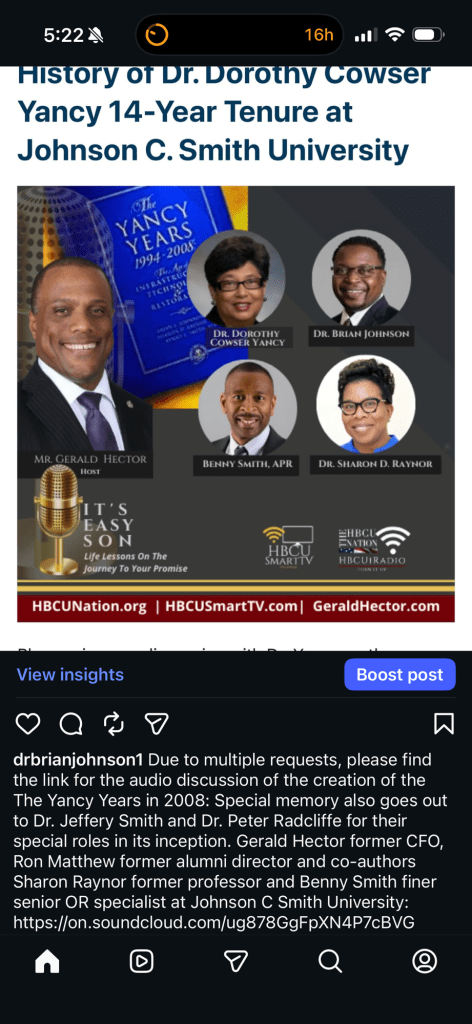
The Yancy Years (2008): Excerpt from Coming to Civic and Sacred Calling (1995-2025): A 30-Year Reflection on Faith and Learning

When I arrived at Johnson C. Smith University in 2007 as an Associate Vice President for Academic Affairs, Associate Professor of English and subsequently a chief of staff, it was as though my professional and personal identities were finally catching up to one another. A native of inner-city Few Gardens in Durham, North Carolina, 1995 graduate of Johnson C. Smith University, the boy who had once written “A Young Man Apart, A World Apart”-a title given by the editors in the Raleigh News and Observer on August 31, 1995-was now the man entrusted with forming other “young men (and women) apart” — students who carried the weight of broken neighborhoods and unspoken expectations, yet stood on the threshold of intellectual discovery.

At Smith, under the presidency of Dr. Dorothy Cowser Yancy, I experienced what it meant to serve at a historically Black college that was also religiously-affiliated with the Presbyterian Church. Dr. Yancy had created a culture of academic rigor coupled with an unapologetic affirmation of HBCU identity. In that environment, I felt license to pursue what had always been my deepest interest: the intersection of faith and learning as lived out in Black intellectual history.

From Teacher to Scholar

2008 was also the year I published in The Journal of Blacks in Higher Education: “The Role of Higher Education in the Religious Transformation of W.E.B. Du Bois.” It was a work of historical scholarship, but it was also personal. In tracing Du Bois’s journey from youthful piety to seasoned agnosticism, I was retracing my own questions: Can education erode faith, or can it refine it? Does exposure to the academy inevitably lead to skepticism, or might it cultivate a deeper belief?

My later book, W.E.B. Du Bois: Toward Agnosticism (1868–1934), would expand on this theme. But the 2008 article was my first formal articulation of a lifelong preoccupation: Du Bois as both exemplar and warning. He was the consummate scholar, the brilliant social critic, and yet a man who could not reconcile the church’s hypocrisy with its message. To study him was to be both inspired and haunted.

The Yancy Model

Under Dr. Yancy’s leadership, I began to see what it looked like to embody a kind of Washingtonian pragmatism in higher education. She was a builder in her own right — fiercely strategic, deeply committed to student outcomes, unapologetically insistent that HBCUs deserved their place at the table of American higher learning. Yet make no mistake she was a first-rate scholar, the first African American woman to achieve tenure at Georgia Tech and a Du Boisian political scientist. I describe her as a philosophical-pragmatist-professor turned President whose brilliance and sagacity is not staged but represents the very best and brightest of organic Black intellectualism. (I chronicled her 14-year presidential history in 2008, The Yancy Years: The Age of Infrastructure, Technology and Restoration hailing from her rearing in Ball Play, Alabama and named her as my very first commencement speaker in summer 2014 when I had been named 7th President of Booker T. Washington’s Tuskegee University on April 28, 2014. The following spring it would be the First Lady of the United States of America, Michelle Obama.)

Watching her, I learned that administration is itself a kind of ministry. One can shape lives not only through lectures and essays but through budgets, policies, and institutional culture. Washington had understood this at Tuskegee; Yancy modeled it at Smith.

At the same time, my Du Bois work forced me to probe the underbelly of such pragmatism. Was Washington’s emphasis on labor and industrial training sufficient without a broader intellectual and spiritual vision? Was Du Bois right to critique its limitations?

The Yancy years, then, were a crucible. I was standing between Washington and Du Bois, between building and questioning, between pragmatism and critique — but always, I hoped, under the light of Scripture.

Faith at the Crossroads

It was in this period that my Logia instincts began to take shape, even if they were not yet named as such. When I taught students the speeches of Washington or the essays of Du Bois, I often found myself turning, almost unconsciously, to biblical parallels:
• Washington’s Atlanta Compromise Address as a kind of Jeremiah call — urging the people to plant gardens and build houses in exile.
• Du Bois’s The Souls of Black Folk as an echo of the Psalmist’s lament — “By the rivers of Babylon, there we sat and wept.”

It became increasingly clear to me that the story of Black higher education could not be told apart from Scripture. Washington and Du Bois may not have fully agreed on the role of faith, but their struggles were framed within a culture where the Bible was always present, whether embraced or resisted.

Apart No Longer

Looking back, I see the Yancy years as a decisive step in my own journey from being “a young man apart” to being a man who could interpret apartness for others. At Smith, I was no longer simply the boy trying to bridge worlds. I had become the professor, scholar, administrator culminating into a president who could show students how Washington built with his hands, how Du Bois wrestled with his mind, and how both men — knowingly or not — stood in relation to the God of Scripture.

If 1995 was my Genesis, then 2025 my Revelation— the moment I realized that higher education itself is a field of Calling, and that to stand at the intersection of faith and learning was not to choose between Washington and Du Bois but to walk with both of them into a wilderness still seeking its Promised Land.

Leave a comment

Filed under Uncategorized

The Tuskegee Spirit: Homecoming

“It seems appropriate during these closing days of the school year to re-emphasize, if possible, that for which the institution stands. We want to have every student get what we have-in our egotism, perhaps-called the “Tuskegee spirit”; that is, to get hold of the spirit of the institution, get hold of that for which it stands; and then spread that spirit just as widely as possible, and plant it just as deeply as it is possible to plant it.” “Last Words: A Sunday Evening Talk,” Booker T. Washington

Presidential Commentary by Dr. Brian Johnson  

Upon the last Sunday evening talk given at the close of the academic year, Booker T. Washington encouraged his hearers to come to learn of, embrace and finally disseminate the “Tuskegee spirit.” (There is something different about Tuskegee University.) It cannot be singularly explained by the eminence of its founding principal and president. It cannot be explained by the eminence of George Washington Carver. It cannot be explained by the aura associated with the “Tuskegee Airmen” whose feats are now known and respected worldwide. One simply cannot come upon the campus of Tuskegee University and not immediately be confronted with an overwhelming sense of the past meeting the present in deeply profound ways. For the “Tuskegee spirit” is what bounds not only its students and alumni but also its faculty, staff, administrators and presidents. It is a living, breathing pride in its beginnings, its present and its future-a future that is interwoven within the lives of every individual that has come upon the grounds of this sacred land. The “Tuskegee spirit” is none other than the spirit of a people-a great people embodying the very best and brightest in any and every tradition the world has ever known.

Leave a comment

Filed under Uncategorized

Of Some..And Others

Jude 22-23
22 And of some have compassion, making a difference:
23 And others save with fear, pulling them out of the fire; hating even the garment spotted by the flesh.
KJV
 
Among believers and unbelievers alike there are found two general classes of people who walk contrary to the doctrines of Christ–those who do so ignorantly, not understanding the doctrine aright, and those who do so willfully and intentionally by providing some rational justification for their actions.

And here Jude provides two separate prescriptions for such classes: For the first class, he encourages long-suffering enduring and (non-judgmental) compassion and love which is what may invite such persons to consider their lives in light of God’s truth, doing so “in meekness instructing those that oppose themselves; if God peradventure will give them repentance to the acknowledging of the truth; And that they may recover themselves out of the snare of the devil, who are taken captive by him at his will. (2 Timothy 2:25)”

For the second class, the expression “save with fear” suggests that such believers or unbelievers must be confronted with boldness and truth for their ways. (Though much in contemporary Christianity resists such confrontation, this ought not be the case. For there are a great many people whose deeds will lead them directly into destruction and our failure to confront them boldly—though in many cases will by no means prevent it—will be the kindest act of love they have ever received. (Even as a parent that corrects their children when they have received nothing but praise, adulation and well wishes from others for the very same actions.) For this kind of confrontation will often prove to be what “pull[s] them out of the fire.”

Even so, though they reject and ignore such words, such a confrontation will forever be lodged within their conscience, and with this awareness will Christ remind them on that day. Still further, such a demonstration ought be done so with deep and abiding love for the person, yet not for the “garment spotted by the flesh.” For one’s garment whether clean or unclean, typifies righteousness and unrighteousness of one’s works throughout scripture, and in the case of both unbelievers and (faltering believers) we can only stand before God in the righteousness of Jesus Christ in whom we are created unto good works:

Let us be glad and rejoice, and give honour to him: for the marriage of the Lamb is come, and his wife hath made herself ready. And to her was granted that she should be arrayed in fine linen, clean and white: for the fine linen is the righteousness of saints. (Revelation 19:7)
 

Leave a comment

Filed under Uncategorized

Warner Pacific University Reopens Renovated Library

1 Comment

Filed under Uncategorized

Otto F. Linn Library Renovation Dedication Ceremony April 11, 2025

2 Comments

Filed under Uncategorized

Tuskegee University Honors Tuskegee University former First Lady-Mrs. Shemeka Barnes Johnson

https://www.facebook.com/share/v/1E2XC128oQ/?mibextid=wwXIfr

Leave a comment

Filed under Uncategorized

I Used To Picture The Way I Would Act

” I used to picture the way that I would act under such circumstances; how I would begin at the bottom and keep rising until I reached the highest round of success.” – Booker T. Washington, Up From Slavery (1901)

Presidential Commentary by Dr. Brian Johnson

Robert Hedrick’s translation of Xenophon’s Cyrus The Great: The Arts of Leadership and War captures a rather profound and startling idea about the power of both the mind and imagination in one’s youth. This is particularly evidenced in Mr. Washington’s autobiographical telling of the time spent in his youth thinking of his future. Hedrick translates Cyrus as follows: “I created an empire in my thoughts long before I began to win an empire in reality.” The founding principal and president of Tuskegee (Institute) University, Booker T. Washington, tells of not having many flesh-and-blood examples of “success” due to both his poverty and enslavement. Yet, while his “hands” might have been bound, his “heart” and his “head” were certainly not. Though he might have seen but dimly into what his future held, he “used to picture the way [he] would act under such circumstances.” (Note, one can hardly go where one cannot see one’s self beforehand going. And one can hardly do what one cannot see one’s self beforehand doing.) “Vision” is the greatest 6-letter word, and “leader” is the second greatest 6-letter word in this writer’s opinion. And Mr. Washington possessed “vision” enough for himself-without regard to what others might have seen-to see himself as a “leader,” which he later realized for some 34 years at the helm of Tuskegee (Institute) University.

Leave a comment

Filed under Uncategorized

THE POWER TO READ AND CIPHER INTELLIGENTLY

“(4) I felt some concern lest at Tuskegee the manual labor side had an excessive development as compared with the mental labor side, or in other words, lest industrial training should unduly impair academic training. Is it not important the graduates of Tuskegee should have acquired not only a trade or an art, but the power to read and cipher intelligently, and a taste for reading? Otherwise the isolated negro farmer or mechanic will not prove to be capable of progress. The world changes so fast nowadays that the man or woman who does not read will be left behind, no what the calling. The academic side of Tuskegee ought there to give all its graduates a competent mental equipment and especially to implant the purpose to improve continually.”-“From Charles W. Elliott to Booker T. Washington,” September 7, 1906

Os Guinness poses the following rhetorical query in his (2022) _The Great Quest: Invitation to the Examined Life and a Sure Path to Meaning_: “Do you agree with Bertrand Russell’s famous dictum that “what science cannot discover, man cannot know”?

Upon Booker T. Washington’s invitation to visit the Tuskegee Institute campus and offer his assessment of the institution, Charles W. Elliot, President of Harvard University, who served for a record-setting 40 years, offered this 4th suggestion amongst five additional ones on how the institution might continuously make improvement beyond its tremendous successes under the administration of Booker T. Washington. (While Elliott and Harvard had honored Booker T. Washington with an honorary degree in 1896, it does not appear that Mr. Washington was present during the visit but he did respond in a letter dated October 20, 1906. A forthcoming commentary will discuss Washington’s response.) Notwithstanding his other recommendations to Washington and Washington’s response, Elliott’s present recommendation is one whereby modern American colleges and institutions have been confronted with: The neglect of the liberal arts.

To be sure, institutions like Tuskegee that experienced tremendous growth through its STEM-related fields ought be commended for they have ensured that they have contributed research, innovation and employment for many students. Moreover, STEM-related fields have contributed to society in far too many ways to be recounted here. All the same, “academic training” in the liberal arts which also contributes to human “progress” ought not be neglected. (This is Mr. Elliott’s reminder to Mr. Washington.) The ability to “read and cipher intelligently” is the hallmark of a traditional liberal arts education and it is tantamount to STEM-related fields’ knowledge creation. (In fact, it is the “A” that gives “STEAM” to STEM.) It is necessary for the researcher and scientist to consider the impact of their important scientific discoveries and advancing technology upon societal interests. And in incredibly powerful ways, reading, writing and thinking fostered in the liberal arts help to determine whether such advances are consistent with long-held traditions and values that society should adopt. The liberal arts also help determine whether to undertake certain scientific and technological advances and whether should we.

Leave a comment

Filed under Uncategorized

On the Passing of former English Colleague Ann Ferguson (Gordon College)

Professor Ferguson, my English department colleague from 2003-2006, was so very kind to my family while we were at Gordon College. She invited us to her home for Thanksgiving in 2005 when were in Wenham, Massachusetts and could not return south for Thanksgiving. I have thought of her often. (And one of my favorite memories was spending the weekend with her and colleagues at her cabin in Maine in 2004. I had one of my greatest meditations while there. Her cabin was on a river and you could hear the rustling waters in the night and morning. Meka was pregnant with Nathan and Asa was young. I did not wish to leave her home alone with them. She and my colleagues encouraged me to go. It turned out to be such a deeply moving experience.) Both of these experiences including my favorite picture with my boys was wrought through this lovely woman. This is deep reminder to live a life with purpose knowing we are not dealing with mere “mortals” but “immortals” as C.S. Lewis offers.

Leave a comment

Filed under Uncategorized

AFTER I GOT SO THAT I COULD READ A LITTLE

“After I got so that I could read a little, I used to take a great deal of satisfaction in the lives of men who had risen by their own efforts from poverty to success. It is a great thing for a boy to be able to read books of that kind. It not only inspires him with the desire to do something and make something of his life, but it teaches him that success depends upon his ability to do something useful, to perform some kind of service that the world wants.” – Booker T. Washington, My Larger Education (1901)

Presidential Commentary by Dr. Brian Johnson 

The great scholar, literary critic and ‘Narnia’ chronicler, C. S. Lewis, remarks about the value of books upon a young boy or girl’s imagination: “Since it is so likely that (children) will meet cruel enemies, let them at least have heard of brave knights and heroic courage. Otherwise you are making their destiny not brighter but darker.” Here again, what one consistently reads, one consistently becomes; Just imagine what one might become when one reads about the lives of great men and women from the time of one’s youth even into one’s mature years. This is what the founding principal and president of Tuskegee (Institute) University recommends, and it is a recommendation that we would do well to not only just follow, but continuously follow. First, the world needs verifiable, authentic and organic heroes, not simply scripted and fictional ones. Men and women whose lives are grounded in believable and relatable life experiences that one can readily identify with provides great grounds for hope for those who have similar experiences. Second, one can learn from the mistakes made in the lived lives of others. It is simply not true that one must repeat the mistakes of others. (Instead, you read and learn from them.) The triumphant records of men and women that also record both their foibles and follies are useful for persons of any century to learn, discern and comprehend that what happened before may very well occur again. Third, the lived lives of men and women who are no longer amongst us are permanent, indelible and fixed records that will remain ever unchanged. (One may repeatedly interpret and re-interpret their deeds done but there will be no adding or taking away from them.) And this final thought is one that certainly motivated men and women of the class of Booker T. Washington and should motivate us as well. For Booker T. Washington knew that one has but one life to live, and there would be no do over. When future chroniclers composed the narrative of his life, he wanted to be certain that it contributed to making someone else’s “destiny brighter” not “darker.” The founding principal and president of Tuskegee (Institute) University did not simply write correspondence, books and speeches worth reading; he lived a life worth reading not only in his generation but also in the many future generations to come.

Leave a comment

Filed under Uncategorized

Warner Pacific University 2024 Annual Report

Leave a comment

Filed under Uncategorized

(CIC) Council of Independent Colleges and Universities-“Pioneering Presidents Convening”

https://cic.edu/research/hiring-and-supporting-a-pioneering-president/

Leave a comment

Filed under Uncategorized

First Pitch New Era in Warner Pacific University Baseball

Leave a comment

Filed under Uncategorized

Heart-Head-Hands

“We can fill your heads with knowledge, and we can train your hands to work with skill, but unless all this training of head and hand is based upon high, upright character, upon a true heart, it will amount to nothing. You will be no better off than the most ignorant.” – Booker T. Washington, A Sunday Evening Talk

Presidential Commentary by Dr. Brian Johnson 

In this writer’s opinion, “integrity” is the greatest 9-letter word, “knowledge” is the second greatest, and “ignorance” is-by far-the worst and most dangerous. And the founding principal and president of Tuskegee (Institute) University, Booker T. Washington, gives on this Sunday evening talk his oft-repeated conception of “heart-head-hands” to help his students avoid the dread of becoming “no better off than the most ignorant.” One can easily seek the help of professors to develop one’s “head”. (These men and women have as their primary purpose to fill the “heads” of students with “knowledge”.) Likewise, professors are able to help make a student’s “hands”-or their work-“skill”[ful]. (Through repeated instruction and correction a student will either become skillful at their work or they will receive failing grades.) Yet, the matter of the “heart,” Mr. Washington suggests, is one matter where students must begin and complete this work largely alone. (Let no man or woman ever presume to become an expert on the subject of another’s heart.) Of all subject matters, it is the one that is deeply personal and unique to the individual. Whereas both the competencies of the “head” and the credentials of the “hands” lie in full view, the character of the “heart” is always hidden from view. Yet, without it, all else “will amount to nothing.” For Mr. Washington’s complete configuration of Heart-Head-Hands in education is akin to the strength necessary to shoot arrows a great distance even as Tuskegee University has shot forth the sons and daughters of Booker into rewarding and meaningful careers of service for over 133 years. The heart is the unseen and invisible strength that determines how far one can bend the bow to make the arrow go.

Leave a comment

Filed under Uncategorized

Booker T. Washington among American Heroes Honorees

Booker T. Washington among Honorees.

https://trumpwhitehouse.archives.gov/presidential-actions/executive-order-building-national-garden-american-heroes/

Leave a comment

Filed under Uncategorized

A WONDER

A Wonder

Ps 71:7

7 I am as a wonder unto many; but thou art my strong refuge.

KJV

Though believers may face very open and conspicuous (fortuitous and unfortuitous) happenings as they pursue God’s purposes for their lives, we should not quickly dismiss such happenings as signs of uncertainty and God’s displeasure with them, for more often than not these men and women are being made “a wonder unto many.”

Such was the case with Abraham, Jacob, Judah, Joseph, Peter, Paul (and even the Lord) who were all subject to circumstances that did not always conform to what their contemporaries believed to be God’s will for their lives. Yet the author of this psalm–King David–was perhaps the most notable wonder of all. Here was a man who having been anointed king while yet a teenager—in addition to his later slaying of the giant Goliath—experienced many contradictions (triumphs and disappointments) throughout his life that made him a “wonder to many.”

Shortly after triumphing over Goliath, he was persecuted by the once favored King Saul; Though he stumbled in committing adultery with Bathsheba, and lost the child of their union, they were immediately restored with Solomon. When he committed sin by numbering the people, he willingly offered himself and his household as a substitute for the sufferings; As a result, the angel of the LORD’s hand was stayed and David was allowed to sacrifice burnt offerings instead. In the end, these apparent contradictions (and many others) were not intended to demonstrate that men and women should live lives free from imperfection (or perceived imperfection in the case of the Saviour’s crucifixition, for the Savior’s death was for the salvation of men) but to demonstrate His enduring love and mercy to them that love Him:

1 Timothy 4:9 “This is a faithful saying, and worthy of all acceptation, that Christ Jesus came into the world to save sinners; of whom I am chief. Howbeit for this cause I obtained mercy, that in me first Jesus Christ might shew forth all longsuffering, for a pattern to them which should hereafter believe on him to life everlasting.”

Leave a comment

Filed under Uncategorized

Not for Price or Reward

NOT FOR PRICE NOR REWARD

Isaiah 45:13

13 I have raised him up in righteousness, and I will direct all his ways: he shall build my city, and he shall let go my captives, not for price nor reward, saith the LORD of hosts.

KJV

Commentary by Brian Johnson, Ph.D.

Replete in biblical history is the Lord’s raising up of men and women up in [His] righteousness to advance His purposes. And one of their most glaring characteristics is that they did so “not for price, nor reward.”

To be sure, the man or woman who advances God’s purposes will forever be blessed in return, for the Lord is never “unrighteous to forget works and labours of love.” Yet and still, the heart’s motive of such men and women is to seek God’s glory, not their own.

And Isaiah speaks here of Cyrus, a type of Christ, who was raised up to commission the rebuilding of the Lord’s temple and to deliver God’s people from the Babylonians. And we should all consider this. Cyrus though prophesied by God through Isaiah did not know God.

Further, we should note Andrew Johnson’s commentary, “The Medes and Persians came together as an alliance. Darius the Mede was put in place as King over Babylon. But the Persian King was Cyrus.” Although Cyrus was not a member of God’s own people, and his achievements often unheralded, were it not for Cyrus, the treasures of the temple would not have been restored, cedars from Lebanon would not have been provided and the work of Ezra and others would not have been initiated. And he did so, not for price, nor reward:

Psalm 115:1 “Not unto us, O LORD, not unto us, but unto thy name give glory, for they mercy, and for thy truth’s sake.”

Leave a comment

Filed under Uncategorized

How Mission & Purpose Drive Educational Excellence – with Dr. Brian Johnson⁠, President, ⁠Warner Pacific University⁠

https://www.edupexperience.com/BrianJohnson/

Leave a comment

Filed under Uncategorized

“Tell John What Ye Have Seen and Heard: Words and Works” Luke 7:19-23 (WPU Chapel) 2-18-25

Leave a comment

Filed under Uncategorized

These Were More Noble

“These were more noble than those in Thessalonica, in that they received the word with all readiness of mind, and searched the scriptures daily, whether those things were so.”-Acts 17:11

God has always placed a remnant of the “noble” who would not be swayed by the passing opinions of the day-from prophetical, personal, professional or political-in social media or public commentary: “[For] they received the word with all readiness of mind and searched the scriptures daily whether those things were so.”

Imagine how often commentary from pundits and-would be prophets alike-are promoted as promise without an objective and eternal standard against which to weigh their opinions against. All the same, scripture does not forbid public utterances. The apostle Paul urged the brothers that we “despise not prophesying…but to prove all things.” 1 Thessalonians 5:20-21

(So just how does one prove opinions and views in a society where we are encouraged to live with so many varying pronouncements of truth?) Centuries earlier, Isaiah the prophet answers this quite profoundly in Isaiah 8:20: “To the law and the testimony. If they speak not according to His word there is no light in them.”

The Christians of Berea were not as those of Thessalonica who took every opinion of proverbial prophet, priest or politician as truth. Rather, they went to the “law and the testimony” to see “if these things were so.” The admonition in this passage is to become studious not withstanding the celebrity, popularity or prominence of the position or the person behind the position. For God first spoke through His word then wrote through Moses, exhibited His power in Elijah then personified in Christ His grace and truth for the manifestation of all things in “spirit and truth.”

Leave a comment

Filed under Uncategorized

The Power to Read and Cipher Intelligently

“(4) I felt some concern lest at Tuskegee the manual labor side had an excessive development as compared with the mental labor side, or in other words, lest industrial training should unduly impair academic training. Is it not important the graduates of Tuskegee should have acquired not only a trade or an art, but the power to read and cipher intelligently, and a taste for reading? Otherwise the isolated negro farmer or mechanic will not prove to be capable of progress. The world changes so fast nowadays that the man or woman who does not read will be left behind, no what the calling. The academic side of Tuskegee ought there to give all its graduates a competent mental equipment and especially to implant the purpose to improve continually.”-“From Charles W. Elliott to Booker T. Washington,” September 7, 1906

Os Guinness poses the following rhetorical query in his (2022) _The Great Quest: Invitation to the Examined Life and a Sure Path to Meaning_: “Do you agree with Bertrand Russell’s famous dictum that “what science cannot discover, man cannot know”?

Upon Booker T. Washington’s invitation to visit the Tuskegee Institute campus and offer his assessment of the institution, Charles W. Elliot, President of Harvard University, who served for a record-setting 40 years, offered this 4th suggestion amongst five additional ones on how the institution might continuously make improvement beyond its tremendous successes under the administration of Booker T. Washington. (While Elliott and Harvard had honored Booker T. Washington with an honorary degree in 1896, it does not appear that Mr. Washington was present during the visit but he did respond in a letter dated October 20, 1906. A forthcoming commentary will discuss Washington’s response.) Notwithstanding his other recommendations to Washington and Washington’s response, Elliott’s present recommendation is one whereby modern American colleges and institutions have been confronted with: The neglect of the liberal arts.

To be sure, institutions like Tuskegee that experienced tremendous growth through its STEM-related fields ought be commended for they have ensured that they have contributed research, innovation and employment for many students. Moreover, STEM-related fields have contributed to society in far too many ways to be recounted here. All the same, “academic training” in the liberal arts which also contributes to human “progress” ought not be neglected. (This is Mr. Elliott’s reminder to Mr. Washington.) The ability to “read and cipher intelligently” is the hallmark of a traditional liberal arts education and it is tantamount to STEM-related fields’ knowledge creation. (In fact, it is the “A” that gives “STEAM” to STEM.) It is necessary for the researcher and scientist to consider the impact of their important scientific discoveries and advancing technology upon societal interests. And in incredibly powerful ways, reading, writing and thinking fostered in the liberal arts help to determine whether such advances are consistent with long-held traditions that help determine not only whether to undertake certain scientific and technological advances but whether should we.

Leave a comment

Filed under Uncategorized

Peace, Peace

Peace, Peace
Jer 8:11
11 For they have healed the hurt of the daughter of my people slightly, saying, Peace, peace; when there is no peace.
KJV

In our attempts to utter words that will heal the hurts of others let us not do so by saying, “Peace, peace; when there is no peace;” For in so doing, we may often find ourselves (intentionally or unintentionally) discovered as menpleasers who deceive the people for self preservation and not speakers of truth. (And such was the case with Hananiah and the prophets that dwelled in Judah during the time when the Babylonian armies came to lay siege upon Judah and carry many back to Babylon). These men declared, “Ye shall not serve the king of Babylon,” when God through the prophet Jeremiah declared, “And now have I given all these lands unto the hand of Nebuchadnezzar the king of Babylon, my servant; and the beasts of the field have I given him also to serve him. And all nations shall serve him […]”

To be sure, the God of all loving-kindness and mercy would later inform the people through Jeremiah, “That after seventy years be accomplished at Babylon I will visit you, and perform my good word toward you, in causing you to return to this place.” Yet and still, this would by no means occur until the people experienced a period of difficulty, and in this the would-be prophets of God greatly erred in their pronouncements of peace that could only “have healed the hurt of the daughter of my [God’s] people slightly.” For according to God’s design, it would not be “peace, peace” that would heal the hurt of His people, but “no peace.” And in suggesting otherwise these prophets were discovered to be something worse than false prophets, but deceivers. For no matter how plausible the intention, all words that are communicated in opposition to God’s word, His truth and His purposes is a lie:

[Even the prophet Jeremiah said, Amen: the LORD do so: the LORD perform thy words which thou hast prophesied, to bring again the vessels of the LORD’s house, and all that is carried away captive, from Babylon into this place. Nevertheless hear thou now this word that I speak in thine ears, and in the ears of all the people; The prophets that have been before me and before thee of old prophesied both against many countries, and against great kingdoms, of war, and of evil, and of pestilence. The prophet which prophesieth of peace, when the word of the prophet shall come to pass, then shall the prophet be known, that the LORD hath truly sent him.]
KJV Jeremiah 28:6

Bran Johnson Ph.D.

Leave a comment

Filed under Uncategorized

Warner Pacific Restored as Governing Institution by CCCU Council of Christian Colleges and Universities

Leave a comment

Filed under Uncategorized

SPENDING YOUR NIGHTS AT HOME

You cannot hope to succeed if you keep bad company. As far as possible try to form the habit of spending your nights at home.” – Booker T. Washington, “A Sunday Evening Talk: On Influencing by Example”

Presidential Commentary by Dr. Brian Johnson 

The adage that one is known by the company he or she keeps is an oft-expressed one, but the founding principal and president of Tuskegee University, Booker T. Washington, extends the adage even further both in the aforementioned passage and in another commonly quoted passage: “Associate yourself with people of good quality. It is better to be alone than in bad company.” Moreover, his additional suggestion to “try to form the habit of spending your nights at home” is a very practical one worth noting. Insofar as it is possible to discern from his autobiography, correspondence, letters, speeches-and more importantly his accomplishments-the man, Booker Washington, apparently did little else but read, write, work and stay at home with his family. And while it is easy to regard Tuskegee (Institute) University’s founding principal with an overwhelming sense of awe, one can begin to appreciate and understand him in view of his own self-discipline and self-sacrifice. (Everyone suffers but few suffer voluntarily. Yet, if one learns how to suffer, one will learn how to succeed.) One need not be reminded that everyone has the same 24 hours in a day, but how one spends those hours is what ultimately distinguishes men and women. (One would simply be amazed at how much more time can be committed to a meaningful mission or a purposeful project if time is not spent in (un)meaningful and (un)purposeful ones that do not result in progress.) Clearly, recreation, fun and leisure have their place but not if these things come at the expense of sustainable success. (Mr. Washington suggests that it is even better when one’s recreation, fun and leisure become part and parcel of one’s work.) For when an individual can transform his or her home into an extension of their workshop, they have the benefit of continuing, doubling and multiplying their labors when others have ceased from theirs.

Leave a comment

Filed under Uncategorized

THE MISTAKES OF BOOKER T. WASHINGTON

“I remember one young man in particular who graduated from Yale University and afterward took a post-graduate course at Harvard, and who began his career by delivering a series of lectures on “The Mistakes of Booker T. Washington.” It was not long, however, before he found that he could not live continuously on my mistakes. Then he discovered that in all his long schooling he had not fitted himself to perform any kind of useful and productive labour. After he had failed in several other directions he appealed to me, and I tried to find something for him to do. It is pretty hard, however, to help a young man who has started wrong.” – Booker T. Washington, (1911) My Larger Education

Oliver Wendell Holmes, Sr. offers the following concerning men and women whose actions are similar to the young man described in Booker T. Washington’s aforementioned passage: “Controversy equalizes fools and wise men in the same way – and the fools know it.” And the founding principal and president of Tuskegee (Institute) University provides several important lessons about both the young man-as well as all men and women of his ilk-who seek to establish their name and reputation on the basis of disparaging the name and reputation of others-particularly those whose accomplishments they will only be brought in close proximity to only upon the basis of “controversy.”

First, Mr. Washington never ever mentions this young man’s name. While this unidentified young man knew full well that persons might give him a hearing-not upon the basis of his own person and accomplishments-but based upon the person and accomplishments of his topic, “The Mistakes of Booker T. Washington,” identifying or responding to this young man provided not a single, solitary benefit to Mr. Washington and Tuskegee.

Second, Mr. Washington understood that the young man’s premises were flawed from the onset, and it is the clearest telltale example of Mr. Washington’s oft-repeated phrase, “Let examples answer.” To be sure, the actions of no man or woman are all “good” or all “bad.” (This is naïve, simplistic and child-like thinking.) Yet, in the face of the clear, overwhelming and documentable evidence that testify to the good that Mr. Washington had done locally, regionally and nationally, this young man titled his lecture series according to what he perceived were the mistakes of Mr. Washington. Here again, what one consistently reads and hears, one will consistently become. And this young man ought to have taken heed to how and to what he was hearing for it ultimately led to what he had become. (For this young man’s attempt to categorize and confine a man of Booker T. Washington eminence and accomplishments to a series of perceived mistakes that his limited training, limited knowledge and limited life experience identified did nothing but demonstrate his failure to understand the significance of the (2) greatest 9-letter words and the single, most dangerous 9-letter word: 1. “Integrity” 2. “Knowledge” 3. “Ignorance;”)

Finally, we should consider Mr. Washington’s demonstration of another one of his famous aphorisms: “I let no man drag me down so low as to make me hate him.” The very same young man who sought to disparage and defame Mr. Washington later sought him for assistance, and Mr. Washington “tried to find something for him to do.” (This dynamic needs no additional commentary.) Yet what is deserving of additional commentary is that this young man might have spent his time and work writing, lecturing and building his own legacy and life worth reading as opposed to seeking to denigrate another’s whose legacy and life of building Tuskegee (Institute) University spanned 34 years (1881-1915) and remains and is read to this very day.

Leave a comment

Filed under Uncategorized

Life and Calling (Part 2): Learn to be Quiet

Life and Calling (Part 2): Learn to Be Quiet

“And that ye study to be quiet”    -1 Thess 4:11

Contrary to many popular notions, the most charismatic, most talkative, most visible and most opinionated person is often not the most substantive leader. In fact, he or she is often the most wanting in several significant ways. A clear and obvious presumption that most of us have about leadership is that a leader has first achieved personal mastery, stewardship and leadership over himself or herself prior to assuming mastery, stewardship and leadership over others. And if the person who has either assumed a leadership role or has been chosen for leadership has not gained self-mastery, it will become painfully obvious to those whom he or she is leading.

The pathway toward personal mastery, which should occur well before assuming mastery over others is—more often than not—cloaked in solitude and obscurity, far away from the limelight, in the depths of quietness. As you learn to be quiet, you develop four important qualities that are all-important for successful leadership:

1. Deep and Profound Humility

It is within quietness that we are most introspective about our personal strengths and weaknesses. Self-awareness and self-discovery lie at the very heart of humility, because humility comes when one arrives at the plain recognition that he or she does not (nor ever will) possess all of the talent that accomplishing a large task requires; simply put, accomplishing large tasks necessarily require others. Deep and profound humility in leadership is exhibited when one learns to appreciate the strengths and weaknesses of others. This understanding leads to one of the most important facets in leadership: All people understand and show favor to the leader who recognizes that his or her condition is very much like everyone else’s.

“He hath shown thee, O man, what is good; And what doth the LORD require of thee, But to do justly, and to love mercy, And to walk humbly with thy God?” (Micah 6:8).

2. The Longer You Wait, the Weightier Your Word

In quietude you become a skillful listener. There are too few leaders who have acquired the skill (and accompanying power) of being a good listener. And this is largely owing to forsaking the value of being quiet. The virtue of listening to all sides before speaking is often extolled, but it is rarely practiced. Listening to the opinions of others—whether they share your premises or not—informs and empowers your opinion. Therefore, how much weightier will be your opinion if you speak last (and having had the opportunity to hear first) than someone who speaks first (and has not had the opportunity to hear others)?

“The one who states his case first seems right, until the other comes and examines him,” Proverbs 18:17

“[L]et every man be swift to hear, slow to speak, slow to wrath” (James 1:19).

3. You Become Patient

Remaining quiet during personal trials ingrains the necessary patience for leading others. Consider the last time you achieved a goal only after enduring some difficulty. While you were certainly joyous at the outcome, you also discovered that there was some enduring value in the process that still serves you to this day. The process of enduring trials and tribulations worked within you a patience that results in the kind of maturity (perfect, entire and whole) that will allow you to demonstrate and model to those within your charge the kind of leadership that knows, understands and appreciates that trials and difficulties can not only be endured but also overcome.

“Therefore we glory in tribulations also: knowing that tribulation worketh patience; And patience, experience; and experience, hope: And hope maketh not ashamed,” Romans 5:3-4; “It is good for a man that he bear the yoke in his youth. Let him sit alone in silence when it is laid on him; let him put his mouth in the dust— there may yet be hope; let him give his cheek to the one who strikes, and let him be filled with insults” (Lamentations 3:27-30).

4. You Gain Wisdom

Within quietness wisdom is found. True wisdom is like dew. It is uncontaminated; it falls silently (often unnoticed); it is easily absorbed by the earth and its vegetation; it often appears in the absence of rain and its effect is demonstrated upon parched lands in need of assistance with the production of fruit; it is no respecter of persons (for it blankets and falls upon everything and everyone underneath it); and similar to snowflakes, every drop of dew has its own distinctive character that is unchangeable in nature, rife with sincerity, authenticity and simplicity.

Oh, how this is true of the wisdom that is gained after quiet deliberation. The person who is inclined to reserve judgment and opinion until after he or she has given thorough and patient consideration to a particular matter will be the most likely possessor of this wisdom.

“Even a fool, when he holdeth his peace, is counted wise: And he that shutteth his lips is esteemed a man of understanding” (Proverbs 17:28).

“But the wisdom that is from above is first pure, then peaceable, gentle, and easy to be intreated, full of mercy and good fruits, without partiality, and without hypocrisy” (James 1:19).

As you “learn to be quiet,” which of the aforementioned qualities will you seek to develop first?

Leave a comment

Filed under Uncategorized

LIFE AND CALLING (PART 1): THE EARLY DAYS IN THE FIELD

Life and Calling: The Early Days in the Field

Prepare thy work without, and make it fit for thyself in the field; and afterwards build thine house. Proverbs 24: 27

Perhaps the most glaring achievement for students in post-secondary education is the successful acquisition of a degree within a chosen field of study (vocation and calling)—particularly one that is properly aligned with the gifts (strengths) of the student. Yet, the acquisition of a degree is by no means the culminating act that qualifies one for embarking upon life’s calling and all of its attendant responsibilities: You must “make it fit for thyself in the field.”

Make no mistake, obtaining a degree is a significant marker; however, the work of proving one’s efforts within the field—and doing so before taking on significant responsibilities involving others—is where “commencement” really happens. For upon the “proving grounds” of a chosen field of labour (vocation and calling) are many important lessons that will ultimately prepare you for undertaking life-long responsibilities that will impact others.

1. You learn the all-important principle of overcoming: All too often, precious young men and women lay claim to the wonderful calls upon their lives whether it be in ministerial vocations or equally sacred vocational tasks in other spheres of life; however, many have failed to successfully overcome any trials and difficulties prior to seeking to lead others. Demonstrating a proven ability to overcome difficult circumstances—and preferably more than one—is infinitely more impactful than merely communicating the stories of others who have overcome.  (If thou hast run with the footmen, and they have wearied thee, then how canst thou contend with horses? Jeremiah 12:5)

2. You learn the principle of stewardship. Who would’ve thought that the worldly would be commended for their ability to rightly utilize money to achieve particular purposes? Yet, this is precisely the idea in the remarks, ” […] the children of this world are in their generation wiser than the children of light. (Luke 16:8)” The unjust steward having been dismissed by his employer was wise enough to use his employ, his authority and the money under his stewardship to secure him a place so that he would not be without future employment. He made friends with these material possessions and relied upon these to please his future employers who greatly appreciated those measures that he had taken on their behalf. He is deemed wiser than the children of light, because unlike the unjust steward, many professors of light have not learned to successfully negotiate and navigate life in a manner that is practically profitable, whether it be in the faith or without the faith. (And if ye have not been faithful in the unrighteous mammon, who will commit to your trust the true riches? Luke 16:11)

3. You learn the principle of “seed time and harvest”. Unfortunately, there is no better preparation for monumental tasks and callings than time and patience.  Many would be the challenges, dangers and hostile persons and events rising against us if we were to begin building prematurely and speedily. For if we are not strong enough, wise enough, mature enough or increased enough to handle life’s awesome opportunities—and attendant responsibilities—such opportunities would be unnecessarily wasted when placed within our care. While we should never ask whether we will one day assume great responsibilities—this is a foregone conclusion in the affirmative—we might rightly question whether we are presently mature enough. (And he who receives the word with an honest and good heart, having heard the word, keeps it, and brings it forth fruit with patience. Luke 8:15)

4. You learn to prove your own worth and gain confidence from your own individual labors. One final way of discerning whether we are in lockstep with the pursuit of our calling—and the future responsibilities that will attend to them—is to determine whether what we are currently doing is good and profitable. For when our gifts truly accompany our callings, we will experience increasing fruitfulness that we will be able to test and prove by pointing to our past labors that will gradually increase into greater labors. (For precept must be upon precept; line upon line, line upon line; here a little, there a little. Isaiah 28:10)

Leave a comment

Filed under Uncategorized

Warner Pacific-Jessup University Teach Out Agreement

We are pleased to announce Warner Pacific University has entered a teach-out partnership with Jessup University. This partnership is aimed at serving students impacted by the changes at the Multnomah Campus and providing them with opportunities to complete their academic programs at Warner Pacific starting this fall 2025.

We are committed to ensuring academic excellence and student success throughout this transition. Both Jessup and Warner Pacific will work closely with students to facilitate a smooth transition and minimize any impact on their academic progress.
We are looking forward to this partnership and welcoming students from Jessup to the Warner Pacific community. #withpurpose

Partnership with Jessup University

Leave a comment

Filed under Uncategorized

African American CCCU Presidents Washington D.C.

African American CCCU presidents (Fresno Pacific, Houghton, Roberts Wesleyan and Warner Pacific) with Dr. Esau McCauulley, Wheaton College, at the CCCU President’s Conference in Washington, DC #cccu

Leave a comment

Filed under Uncategorized

TWO DIFFERENT OPINIONS

1 Kings 18:21

21 And Eli’jah came near to all the people, and said, “How long will you go limping with two different opinions? If the LORD is God, follow him; but if Ba’al, then follow him.” And the people did not answer him a word.

KJV

Seldom will one receive confirmation from others about a God-given calling to fulfill a purpose for people for your life without some tangible sign or demonstration. (Even the man of God, Elijah, experienced the same.) For before the fire of the Lord fell upon Elijah’s burnt sacrifices in his competition with Baal’s prophets, “the people did not answer him a word.”

Oft in fear of supporting a losing cause, the prevailing wisdom of the day or outright fears, persons first desire the confirmation of the majority. All the same, such confirmations of calling here within our own time need not be equally miraculous for persons to observe observable works that have been wrought beyond mere words. Yet and still, whosoever would desire to have others to sign on or confirm a God-given calling to fulfill a God-given purpose that has been assigned to you and no other, let this man or woman be prepared to show forth evidence, wonders and (words congruent with works) that demonstrate to all involved (including one’s opponents) that what he or she says is so:

“And at the time of the offering of the oblation, Eli’jah the prophet came near and said, “O LORD, God of Abraham, Isaac, and Israel, let it be known this day that thou art God in Israel, and that I am thy servant, and that I have done all these things at thy word. Answer me, O LORD, answer me, that this people may know that thou, O LORD, art God, and that thou hast turned their hearts back.” Then the fire of the LORD fell, and consumed the burnt offering, and the wood, and the stones, and the dust, and licked up the water that was in the trench. And when all the people saw it, they fell on their faces; and they said, “The LORD, he is God; the LORD, he is God.” 1 Kings 18:38-39

Leave a comment

Filed under Uncategorized

RIGHT MIND

Mark 5:15
15 And they come to Jesus, and see him that was possessed with the devil, and had the legion, sitting, and clothed, and in his right mind: and they were afraid.
KJV

Whether one concedes it or not, the overwhelming weight of scripture repeatedly describes persons who were once tormented by unclean spirits and devils. And the man from Gadarenes demonstrates much. For his physical condition reveals much about the condition of a mind (soul) where such activity occurs:

This man spent his days lamenting over the past within a place of remberance (not of one memory but several); he was rebellious and independent, and therefore was not (nor could be) subject to the rule or leadership of another; he cut himself with stones (used for condemning) in repeated acts of self-condemnation; and finally, he was tormented by fear. He was even made to fear the mercy and grace that would be found in our Lord and Savior Christ.

These acts symbolized a variety of unclean conditions, and it is no surprise why these spirits implored our Lord to send them into pigs (animals that symbolize uncleanness). Most importantly, this is why the man’s final condition (a right mind) was all the more glorious to all who observed. This new believer in Jesus Christ would not only be renewed in spirit, but in mind also. And having been renewed he was now summoned to serve, summoned to “publish” (Mark 5:20).

“For God hath not given us the spirit of fear; but of power, and of love, and of a sound mind.”-2 Timothy 1:7

Leave a comment

Filed under Uncategorized

TWO LINES OF WORK

“I realize fully, and have always said so on every proper occasion, that there are two lines of work to be accomplished. One is in the direction of agitation, calling attention to wrongs and the condemnation of these wrongs. Along with this there should go efforts in the direction of education, moral and religious teaching and helping of the race to strengthen itself in material and financial directions. There is a wide field in all this for every man of the race who wants to give service.”-Booker T. Washington, “To Nicholas Chiles,” November 17, 1906 [Tuskegee, Alabama]

Unlike his very public disagreements with men such as W.E.B. Du Bois and William Monroe Trotter—often through public speeches, competing editorials or tacit subterfuge—Booker T. Washington felt comfortable enough to maintain correspondence with Nicholas Chiles. Though he possessed views, in some cases, similar to both Du Bois and Trotter, Washington writes about Chiles: “I always enjoy writing you because I find you are a man with whom one can discuss matters, and even disagree, without personalities and abuse entering in.” (To be able to disagree with one’s opponents without slander or attempt to harm and injure reputation is something contemporary leaders and followers alike would do well to remember in our age of social media and internet access.)

All the same, in the aforementioned passage, Washington outlines two lines of work that might be defined in more contemporary nomenclature as “protest” and “reform/uplift”.  While the work of Du Bois, Trotter and many contemporary and historical African Americans community leaders exist in the tradition of “agitation,” “calling attention,” and “condemnation,” (and their efforts more heralded, celebrated and popularized) Washington here describes that there are others who are deeply invested in a different work: “education, moral, and religious teaching.” It is clear that work of those who exist in the tradition of a W.E.B. Du Bois is a viable one, but make no mistake, in this letter, he invokes his own work at Tuskegee and others such as Mary McLeod Bethune, founder of Bethune Cookman University, who viewed theirs as equally valuable (and perhaps even moreso.) 

First, the work of both Washington and Bethune remain visible to this very day owing to the institutions they founded. (Though valuable, often the work of protest and agitation has not fashioned long standing institution building in a vein similar to these universities or the economic development African American citizens in Tuskegee, AL , Tulsa, OK or the city of Durham, NC-the latter two affectionately referred to as “Black Wall Street” in their heyday.) Moreso, though this aspect of their religious and faith convictions are often wittingly or unwittingly muted and ignored, Washington and Bethune were persons of deep and abiding faith, and though this has often been dismissed as mere “heavenly preoccupation” and they did their best to walk wisely concerning their views, Washington and Bethune also believed it to have a very pragmatic quality for both here and now (not simply the time to come): the moral and ethical development of the African American community. (Like Washington and Bethune, there have always been African American leaders with deep and abiding faith, which went above and beyond political expediency and when one views their words and works comparatively and historically there would be much to ascertain concerning the reasons for their triumphs.) Cornel West’s (1994) _Race Matters_ alludes to this historical dynamic thusly: “THERE has not been a time in the history of black people in this country when the quantity of politicians and intellectuals was so great, yet the quality of both groups has been so low.” Whatsoever gains that are to ever be had through the efforts of both of these “lines of work,” the latter had most certainly be involved if it is to be kept, harnessed and continued.

Brian L. Johnson, Ph.D.

Leave a comment

Filed under Uncategorized