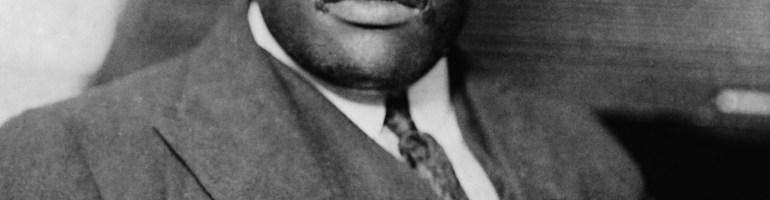
“…I have been keeping in touch with your good work in America, and although there is a difference of opinion on the lines on which the Negro should develop himself, yet the fair-minded critic cannot fail in admiring your noble efforts. The two schools of America have gone as far as to give us, who are outside the real possibilities of the industrial and intellectual scope for Negro energy. We are organized here on broad lines and we find it conducive to pave our way industrially and intellectually…”-
“From Marcus Mosiah Garvey to Booker T. Washington (Kingston, Jamaica) September 14, 1914”
“…I hope that when you come to America you will come to Tuskegee and see for yourself what we are striving to do for the colored young man and woman of the South…”-“From Booker T. Washington to Marcus Moriah Garvey,” September 17, 1914
The personal letters between Marcus Garvey and Booker T. Washington leave much to conjecture because the two did not meet personally as did Washington with other such notable contemporary figures. (For Mr. Washington passed in 1915 prior to Marcus Garvey’s first visit to the states.) While it can be determined that Garvey expressed deep admiration and respect for Booker T. Washington as noted in his letter to Washington to enjoin with his efforts to “pave [the] way [for Negroes] industrially and intellectually,” it is not so clear to what extent Washington reciprocated the overtures beyond this September 1914 invitation to Tuskegee’s campus.
Prior to to his first visit to America, Garvey had been subject to deep criticisms from African American leaders of the period including W.E.B. Du Bois who was concerned that Garvey’s growing influence among the National African African American community was expanding. What made Garvey’s platform palpable for many African Americans was Garvey’s call through the (UNIA) the United Negro Improvement Association and the African Communities League for African Americans to embrace his call to return to African lands. And Garvey envisioned his organization as the potential intellectual partner to Washington’s efforts.
And when this vocation was coupled with Garvey’s UNIA’s possible threat to rival the influence of Du Bois’s NAACP, it is not beyond reason to think that Garvey’s admiration for Booker T. Washington might have been a bit too much to bear for Du Bois and other similarly situated leaders. For if Washington would have secured the public voice, symbolism and support of the flamboyant Garvey whose public stature grew until his eventual deportation from America, Washington would have had an advocate far greater than the pens of both T. Thomas Fortune and Emmett J. Scott in the African American press.
Notwithstanding, it is not entirely clear from Mr. Washington’s return replies to Mr. Garvey that he would have completely aligned his “Tuskegee Machine” with Garvey. The usually very cautious and sagacious Washington learned from news and personal reports concerning Mr. Garvey’s activities prior to his coming to America. Mr. Garvey even wrote at length to explain to Mr. Washington that the criticisms he faced were categorically unfair. Beyond this while Mr. Washington managed his affairs quickly, quietly and with quality, Mr. Garvey moved in a near completely opposite direction for his purposes. Mr. Garvey utilized grandiose speeches, bold rhetoric and military attire that called attention to the nobility of the then described Negro race.
All the same, it is very clear in his communications to Garvey—with his last being on October 1915 one month prior to his death—that he remained non-committal. In this final letter, he wrote that he could not “afford the time just now to give careful study to [Garvey’s] plans as outlined.” Yet, still, as noted in his 1914 invitation to Mr. Garvey to come to Tuskegee—which he did as much for supporters and detractors alike—he remained gracious, kind and hospitable to Mr. Garvey leaving us to pause and wonder yet again ‘what might have been’.
Discover more from Brian Johnson, Ph.D.
Subscribe to get the latest posts sent to your email.
