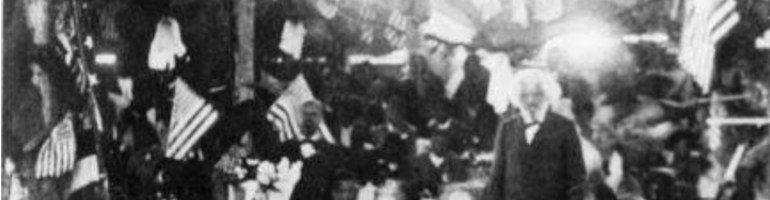
“[Dear Mr. Douglass:] According to promise I have delivered your message to Mr. A.C. Bradford in Montgomery to the effect that you would speak there on the night of the 26th of May, and not on the 25th, leaving here after our Commencement exercises in time to reach Montgomery for the lecture there. This arrangement I find can be made to work, and for this arrangement I have said to Mr. Bradford would be final. For you to speak in Montgomery before coming here, would defeat one of the main objects which I have in view in having you at Tuskegee, and I hope you will not consider for a moment any proposition to appear at any meeting in Alabama before coming to Tuskegee. I shall go ahead with our arrangements with the understanding above stated. We shall look for you here on the 24th. Yours truly, B.T.W.” – Booker T. Washington, “April 29th 1892”
Frederick Douglass was perhaps the single most eminent commencement speaker at the then Tuskegee Institute during Booker T. Washington’s administration. Though Washington would become a luminary in his own right as a formerly enslaved African American chronicled in his _Up From Slavery_ (1901), Frederick Douglass was by far the most eminent formerly enslaved African American owing to his own work, _Narrative of the Life of Frederick Douglass_ (1845) and his lifelong abolitionist and agitation for the rights of African Americans. Mr. Douglass, who would die three years after his address in 1895, the same year of Booker T. Washington’s “Atlanta Exposition Address,” also had other correspondence directed to the young leader of Tuskegee. In a November 20, 1891 letter to Washington, Douglass expressed his deep chagrin at not being able to attend a lecture by Washington owing to his health but expressed “his best wishes for [his] lecture and [his] vocation.”
Washington’s admiration for Douglass was deep and clearly he recognized this commencement address and period—as Douglass’s earthly light was in its twilight—would help cement a kind of ‘passing of the baton’ transferring the mantle of national African American leadership to himself though there was one other contender for this leadership: This would be none other than William Edward Burghardt Du Bois. He expressed as much in his (1911) _My Larger Education_: This would have not escaped the acute perception of both of these stalwarts in American and African American history. For in addition to Washington’s 1895 address, this would be the same year W.E.B. Du Bois would become the first African American to obtain a Ph.D. from Harvard University. Washington writes:
“One of the most surprising results of my Atlanta speech was the number of letters, telegrams, and newspaper editorials that came pouring in upon me from all parts of the country, demanding that I take the place of “leader of the Negro people,” left vacant by Frederick Douglass’s death, or assuming that I had already taken his place.”
It should not be discounted that Frederick Douglass whose record of abolitionist and protest agreed to openly identify with Mr. Washington’s program, which at the time, was slowly gaining severe criticism and that was reaching its crescendo but finally culminated in outright hostility after Washington’s 1895 speech. In the speech delivered to the graduating class on May 26, 1892, Douglass would echo Washington’s themes and hopes for graduates: “You know how our hearts, heads and hands have been wrapped up in you by day and by night…The happiest day in the history of any institution is when it hears of the the success of one of its graduates.”
All the same, the current communication involves Mr. Washington seeking to ensure that Tuskegee’s thunder was not usurped by a competitor in Montgomery, Alabama, who was attempting to secure Douglass’ services prior to his speech in Tuskegee. Mr. Washington responded quietly and quickly to rebuff this attempt. For Mr. Douglass was not merely being brought to Tuskegee for appearances’ sake, but to genuinely help advance Washington and the institution with both his presence and-no doubt-his ties in Washington, D.C. and Maryland, where he would ultimately spend the remainder of his life.
Apparently, some organization in Montgomery sought to secure Mr. Douglass’s presence when it learned of his pending engagement at the institution. Tuskegee was preeminent amongst similarly situated institutions at the time of Douglass’ appearance on campus. As a steward of the Tuskegee Institute (University) brand and reputation, Mr. Washington was particularly careful that Douglass’ presence would go to the renown of his institution and not be had by another.
Discover more from Brian Johnson, Ph.D.
Subscribe to get the latest posts sent to your email.
